
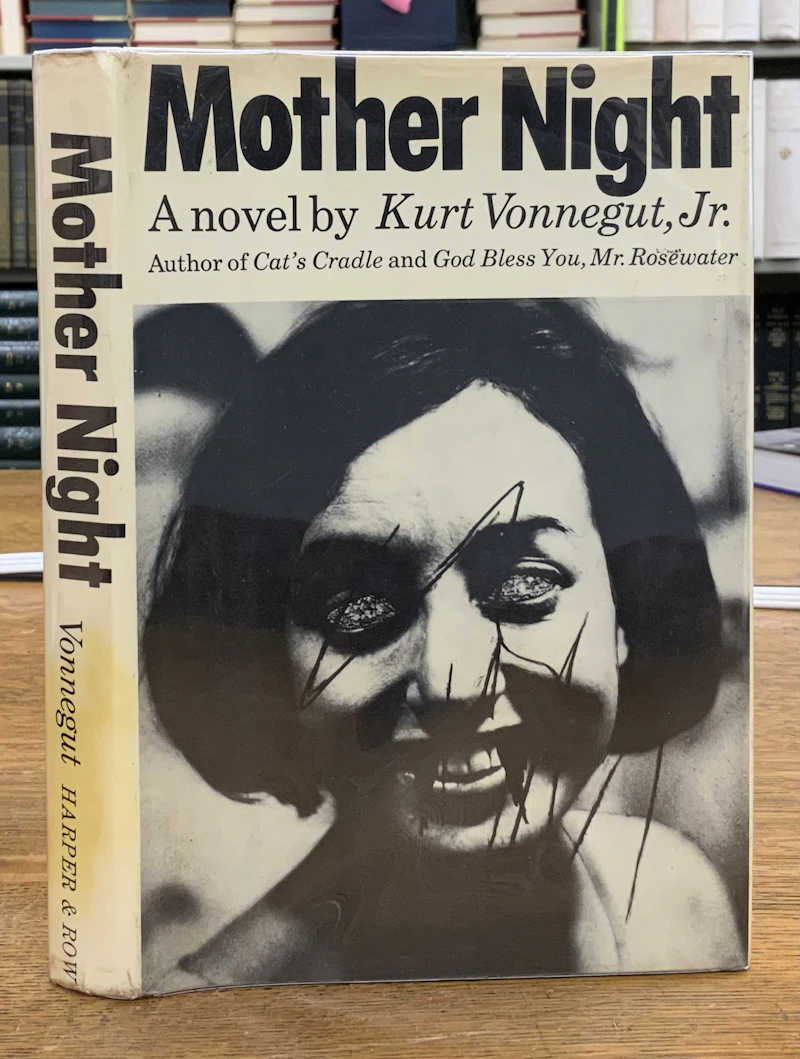
Kurt Vonnegut’s third novel, Mother Night, showed a maturity in a writer who hadn’t yet turned 40. Published in 1961, there’s a more profound approach to character in Mother Night than his previous books, a different way of presenting the complexities of time and the world. And a narrative structure Vonnegut would return to later in his career.
The book opens with an Introduction by Vonnegut outside the fiction, talking about the novel as a novel, followed by an “Editor’s Note” inside the fiction in which Vonnegut presents the text as a diary he edited into shape. Easing the reader into the story, Vonnegut’s also setting up some of the book’s major ideas. His introduction claims the moral of the story is “We are what we pretend to be, so we must be careful about what we pretend to be.”
It’s a strong theme. The two openings also tell you this is a book that wants you to think about fiction and the way fiction works. What’s real, and what’s a story? Does it matter, if we become the story we tell?
The main character’s Howard W. Campbell, Junior. A German-American writer and radio broadcaster who worked for the Nazis during World War Two, as the book opens he’s in an Israeli prison, sentenced to death and writing his autobiography. He tells us he was never a convinced Nazi, but always secretly a double agent for the United States. Unfortunately, proof’s gone missing, his handler’s vanished, and there’s no way to verify his claim.
Vonnegut’s satire isn’t interested in the details of espionage during the war, and most of the novel follows Campbell in the 1950s as he tries to live in New York and be forgotten. Fate doesn’t let that happen, and a series of unlikely events triggers personal and political crises that inevitably lead to the Israeli jail.
In his previous novel, Sirens of Titan, Vonnegut experimented with ideas of non-linear time. He’d do it again in later books, but here he uses memory to move easily across a man’s life in the space of a sentence or two. Campbell remembers his marriage as idyllic until his wife vanished, presumed dead, in the closing years of the war; then she apparently reappears in New York; Campbell, in prison later on, recalls the times of his life in non-linear conjunction.
Writing his autobiography, he knows how things turn out, and his book’s inflected by his knowledge. The future determines the past. Mother Night reads as a satiric but realistic approach to the questions that preoccupy Vonnegut’s fiction. Are our actions predetermined? Is there a point to being kind? Does it matter if we’re a good or bad person?
Campbell’s background is similar to Vonnegut’s, both born in the United States to German-descended parents and conscious of their German heritage. But Campbell’s parents moved back to Germany when he was a child. Vonnegut reflects in his Introduction, after recalling his wartime experience as a prisoner of war, that “If I’d been born in Germany, I suppose I would have been a Nazi, bopping Jews and gypsies and Poles around, leaving boots sticking out of snowbanks, warming myself with my secretly virtuous insides. So it goes.”
But if Mother Night nods to that possible other life, as a satirist Vonnegut’s opposed to the grandiose pretenses of Nazi ideology. The fascists in Mother Night, especially those in America, are pathetic. Campbell, a writer who began his career as a romantic, loses conviction as his life goes on. Events catch him up, and he must go along with them, ending in prison.
As satire, the book’s by its nature an anti-romance. Characters who believe they have heroic missions turn out to be deluded or evil. Campbell fails to live out the story he dreams of. He says that he and his wife lived as a “nation of two,” but in the context of Nazi Germany, their nation’s an illusion that can’t last in the face of history.
Campbell’s name recalls American science fiction editor John W. Campbell Jr., and though Vonnegut later denied a direct connection, the ironic undercutting of adventure fiction fits. The book’s a spy story, not science fiction, but the effect’s the same. If Le Carré rewrote the rules of the espionage novel with the disillusionment of The Spy Who Came In From the Cold, Vonnegut got there first.
Vonnegut once said the seed of the book came from hearing a former member of Naval Intelligence talk about the literal schizophrenia of double agents, and among other things Mother Night’s a look at the human reality of a spy, depicting the kind of a character who leads a double life. Was Campbell ever an American agent, or did he create that fantasy to justify his life to himself?
Is this man telling the truth? Does it matter? He did what he did, whatever he thought he was doing. If he’s pretending otherwise, is that pretense what’s needed to survive the world and the process of history? Is he becoming what he pretends to be?
The book’s as dark as the title implies. Extravagant satire and effective character study, it engages with political issues while embracing bigger themes. Every Vonnegut novel after 1973’s Breakfast of Champions would be a similar mock-autobiography, a man near the end of his life reflecting on his career, often during or after some imprisonment. Perhaps for Vonnegut the condition of being captive and telling a story was a core human experience; in the end, we’re all writing our own stories to ourselves, and if only in our own mind become what we can’t help but pretend to be.