

On this May 20, I celebrate the 17th anniversary of my heart surgery in which I received a new bovine heart valve. I’ve now probably had it longer than the cow did. The ball started rolling when I visited my GP for a face blemish I thought might be troubling, when he said “Oh, that’s nothing, but you have a heart condition in which the blood is backing into your heart from your aorta.” Nothing life threatening… immediately. But perhaps—if nothing was done. Thus the surgery that still allows me to walk all over town, shooting photos.
Today I’ll present a grab bag of Flushing, Queens scenes. The Ganesh Temple of the Hindu Temple Society of North America on Bowne St. just north of Holly Avenue was opened on July 4, 1977. As the first Hindu temple in North America composed of largely imported materials, and constructed by artisans from India, Sri Maha Vallabha Ganapati Devasthãnam (or the Ganesh Temple) is one of the most impressive and historically important Hindu temples in the West. Flushing, Queens was chosen as the location for the Ganesh Temple based on three criteria: it was the gateway of the U.S.—all Indian immigrants came here and there was a large concentration of Hindus in the tri-state area of New York, New Jersey, and Connecticut; it was within walking distance for many, or one bus or subway fare; and the possibility to purchase a suitable site. Its strength and influence outside of New York is proven by the fact that the temple has served as a model for many other Hindu communities.
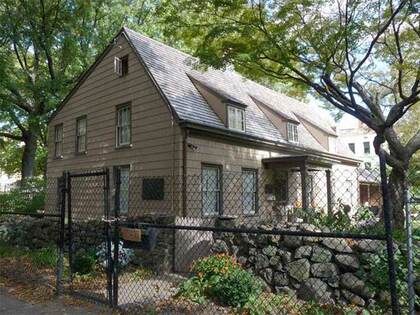
Bowne St. is named for a leader in religious freedom. Bowne House, on Bowne St. north of 38th Ave. in Flushing, was built in 1661 by English settler John Bowne. Peter Stuyvesant, continuing his reign of terror against religious dissenters, had Bowne, a Quaker, arrested in 1662. Before the construction of the Friends Meetinghouse on Northern Boulevard (already a colonial-era route in the late-1600s) Bowne’s house was the primary site for Quaker services. Sentenced to pay a fine, Bowne refused and was jailed; he was subsequently exiled to Holland. While he was there, Stuyvesant’s bosses at the Dutch West India Company reversed Stuyvesant’s non-tolerant policy, claiming that the colony needed immigrants to ensure economic expansion, no matter what faith they were. Bowne returned home to Flushing in 1664; the British sailed into New Netherland five months later, and Stuyvesant surrendered without a shot being fired.
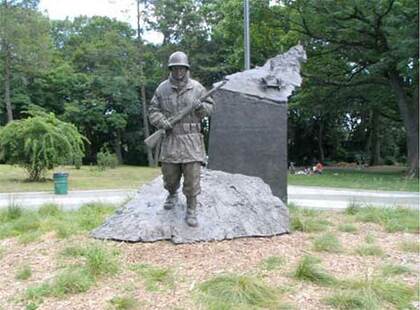
The Korean War, in which US forces defended South Korea against invasion from North Korean Communist forces from 1950 to 1953, is known in some quarters as “the Forgotten War,” perhaps because Americans were understandably war-weary in the early-1950s, just a few years after World war II ended and were loath to celebrate a conflict that ended in stalemate. Still, the Korean War never produced the fevered opposition to the USA’s involvement that the Vietnam and the later Gulf Wars have. It has also produced relatively few memorials.
The borough of Queens has tried to rectify this with the 2007 installation of a Korean War memorial statue in Kissena Park. The bronze memorial was sculpted by William Crozier and depicts a solitary soldier carrying a rifle, heavily coated in the cold Korean winter. The apex of the memorial pedestal shows five soldiers carrying a stretcher, scaling mountainous terrain. On the rear of the pedestal are inscribed the names of all 172 Queens soldiers who died during the conflict, and the names of persons and groups supporting the project. The Korean War Veterans Memorial Association and then-City Councilman John Liu assisted in assembling the funds necessary for the plaza, while the South Korean government, New York State and private donations raised funds for the sculpture in 2007. The memorial’s accessible by entering Kissena Park at Rose Ave. and Parsons Blvd. and walking about 100 yards straight ahead. It’s a solemn location in what’s largely a quiet oasis in eastern Flushing.
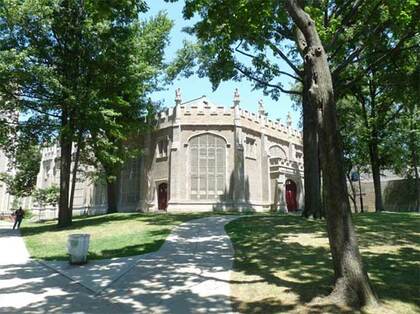
Possibly Flushing’s most beautiful building, the Collegiate Gothic Flushing High School (C.B. J. Snyder, arch.), on the northeast corner of Northern Blvd. and Union St., was completed here in 1915 on what had been the southern edge of the Parsons plant nursery. Flushing High was established in 1875, when Flushing was a separate town in the county of Queens, which was then more than twice its current size (it included most of what has been Nassau county since 1898). It first graduating class in 1878 had six students; today, there are over 2000 graduates per year.
“The school’s monumental square entrance towers, picturesque silhouette, asymmetrical massing, and assorted Gothic-inspired details—crenellation, grotesque corbels, and heraldic statues of unicorns and griffins—echo the fanciful conjoining of styles typical of English universities.”—The Landmarks of New York III, Barbaralee Diamonstein, Harry N. Abrams 1998.
The 1915 building was declared a New York City Landmark in 1991. Amazingly the school was going to be closed and reopened under a new name, with a new staff, after the 2012 school year because of a declining graduation rate, but after a United Federation of Teachers union lawsuit, the school reopened.
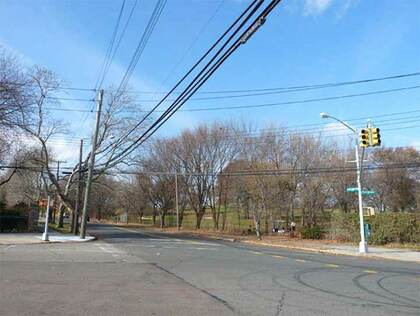
Booth Memorial Ave. and Fresh Meadow La. is an old Queens intersection; you can see it on an 1852 map. Both are old farm to market roads. Booth Memorial Ave. has had a number of names including Ireland Mill Rd. (it led to Ireland Mill Creek, which became Mill Creek, the feeder stream for Kissena Lake).
Ireland Mill Rd. later became North Hempstead Turnpike, a gloriously incongruous name since it did not extend out to the town of North Hempstead in Nassau County. In the tradition of NYC roads like Flushing Ave. and White Plains Rd., it was likely named because it led to roads which would take you to North Hempstead. When the road was named in the 1800s, the town of North Hempstead was in Queens, but when Queens joined NYC in 1898, three of Queens’ easternmost towns opted out to become Nassau.
It was renamed in 1964 for Booth Memorial Hospital at Main St. However, the “new” name is now also outdated, since Booth Memorial became New York Hospital in the 1980s. Let’s go back to the old name! Both avenue and hospital are named for William Booth, founder of the Salvation Army.
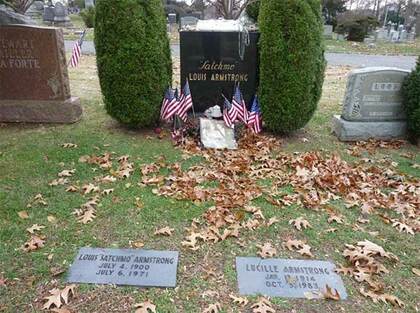
Louis Armstrong was and remains a Queens presence. Satchmo lived for three decades in nearby Corona and is buried in Flushing Cemetery. I’d never set foot in Flushing Cemetery until the summer of 2006, when I went to find Armstrong’s grave. Before starting my website, Forgotten New York, I hadn’t been inside a cemetery since my mother died in 1974. I was comforted that Satchmo was only a couple of blocks away from me—when I lived in Flushing, I was at 43rd Ave. and 159th St.
His marker puts his date of birth on July 4th, 1900. That’s the date he preferred to give; records from New Orleans put the date at July 9, 1901. Though he rose from poverty to become one of the most celebrated jazz trumpeters, latter-day audiences recognized him more from his unique singing on hits like “Hello, Dolly” and “It’s a Wonderful World.”
•••Musicians Dizzy Gillespie (who’s buried in his mother’s plot and isn’t marked by a monument), Hazel Dorothy Scott and Johnny Hodges; Academy Award winner Jo Van Fleet (Arletta in Cool Hand Luke); U.S. Congressmen Thomas B. Jackson, John Lawrence, Lemuel Quigg, Frederic Storm, Elmer Ebenezer Studley and William W. Valk; author and pastor Adam Clayton Powell Sr.; financier Bernard Baruch; restaurateur Vincent Sardi; Civil War hero and winner of the Congressional Medal of Honor, College Pointer Pvt. Carl Ludwig, are all interred in Flushing Cemetery, as well as Eugene Bullard (1894-1961), the first African-American fighter pilot, who fought for the French Foreign Legion.
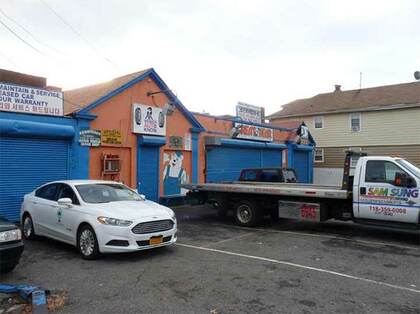
At first glance, there’s nothing unusual about the Great Bear auto repair shop at 165th and Sanford Ave., but it’s owned and operated by Audra Fordin, the first woman to run a Great Bear repair shop and possibly the only woman to do so anywhere in NYC. She inherited the shop from her father.
“ ‘I think different than men,” said the suburban mom. “When I talk about cars, I talk about things that you can relate to. You need air to breathe. Well, the air induction is the respiratory system of the car. The circulatory system is your cooling system. If your car has a fever, the gauge goes up and it leaks.’
Fewer than 1% of auto mechanics certified by the National Institute for Automotive Service Excellence are women, but for Fordin, fixing cars was a natural path.
Growing up, she spent weekends and vacations following her father Bill to work at the shop, which today still stands at its original location at the corner of 165th St. and Northern Blvd. on Sanford Ave.” [NY Daily News]
Kevin Walsh is the webmaster of the award-winning website Forgotten NY, and the author of the books Forgotten New York (HarperCollins, 2006) and also, with the Greater Astoria Historical Society, Forgotten Queens (Arcadia, 2013)