
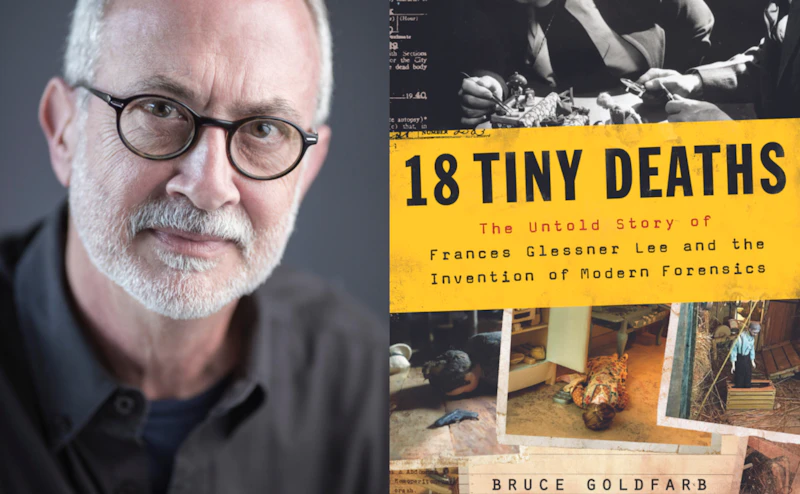
Last week I introduced the story of Frances Glessner Lee for those who aren’t already enthralled by the captivating tale of the 19th-century mother of forensic science and first woman police captain in the United States who built miniature crime scenes to teach investigation skills at Harvard—all without a college degree. This week I’m speaking with Bruce Goldfarb from Baltimore, whose captivating biography 18 Tiny Deaths details how Lee revolutionized crime scene investigation in creating her intricate "Nutshell Studies of Unexplained Death" dioramas to train detectives in founding modern forensic science.
Mary McCarthy: If you’re introducing France Glessner Lee to readers who don’t know her, why does she matter so much to modern forensic science?
Bruce Goldfarb: She matters because the principles she taught are still relevant today. At the time, many technological developments in forensic science—fingerprints, trace evidence—were emerging, but women didn’t have the opportunity to contribute in those areas. She’s really the only woman of that era who made a major contribution to forensic science as a discipline. And the methods she taught haven’t changed—they’re still used today.
The nutshell studies are still used for training because they provide something nothing else can. Even now, people try 3D scans and modern tools, and they’re good—but they’re not a substitute for physically examining a three-dimensional scene. Her teaching methodology is actually experiencing a renaissance. More people are returning to dioramas as training tools. She’s underappreciated as an educator.
MM: What exactly were the miniature crime scene dioramas, and how were they used to train investigators?
BG: They were highly detailed miniature crime scenes. The key challenge in forensic training is teaching observation. You can show someone a photo of evidence, but that’s not the same as walking into a room and figuring out what matters. At a real crime scene, everything is cluttered—there are distractions, red herrings. The brilliance of the dioramas is that they replicate that complexity. Nothing tells you what’s important. You have to look, interpret, and decide. It’s the closest thing to a real crime scene without being at one.
MM: Level of detail is what separates a great miniaturist from an average one—an almost obsessive attention to details. It sounds like that’s how she worked. What does that craftsmanship tell about her philosophy of forensic investigation?
BG: Absolutely. She had incredibly high standards—not just for herself, but for others. She didn’t suffer fools gladly. That precision matters. Small details can change everything in an investigation, and she believed in getting everything right.
MM: You describe how she helped push the shift from a coroner system—often political and untrained—to a scientific medical examiner system. Why was that transformation so important?
BG: The coroner system wasn’t scientific—it was often political. Coroners could be elected officials with no medical training. That might’ve worked in small, earlier communities, but in modern cities, with mobility and anonymity, it failed. Lee helped push toward a scientific system—trained medical examiners, standardized investigation methods. In many ways, everything we associate with modern forensic investigation traces back to her influence.
MM: And yet parts of the United States still use the coroner system?
BG: Yes—about half the country by geography. It persists because it’s cheaper and politically entrenched. As one medical examiner put it: “Dead people don’t vote, and living people don’t want to spend money.”
MM: What was the most surprising or little-known thing you uncovered about her?
BG: The exact moment she decided to pursue this work. There’s a conversation with McGrath that seems to spark it—it’s like a turning point. I couldn’t have invented a better origin story. (Note: Lee told her mentor, Dr. George Burgess Magrath: “The organs of the human body are so beautiful that they should be considered a work of art.")
MM: It seems like her work completely consumed her.
BG: It did. She had an obsessive focus—possibly OCD tendencies, maybe even something like mania. Once she had an idea, she worked nonstop.
MM: There were more than 18 dioramas, right?
BG: Yes—there were about 20 completed at one point. One was damaged and lost; another was found later in poor condition. She originally envisioned making around 50. She never stopped working on them, even in old age.
MM: And they’re still used today?
BG: Yes—for training. But public access is very limited. They’re preserved and used for their original purpose.
MM: You recently released a new book The Worst Day: A Plane Crash, A Train Wreck, and Remarkable Acts of Heroism in Washington, DC—how does it connect?
BG: It’s about a single catastrophic day in Washington, D.C.—a plane crash, a subway derailment, and a massive snowstorm all happening at once. It’s written minute-by-minute, reconstructing the day through interviews with survivors, first responders, and witnesses. Reconstructing details of tragedy is what they have in common.