
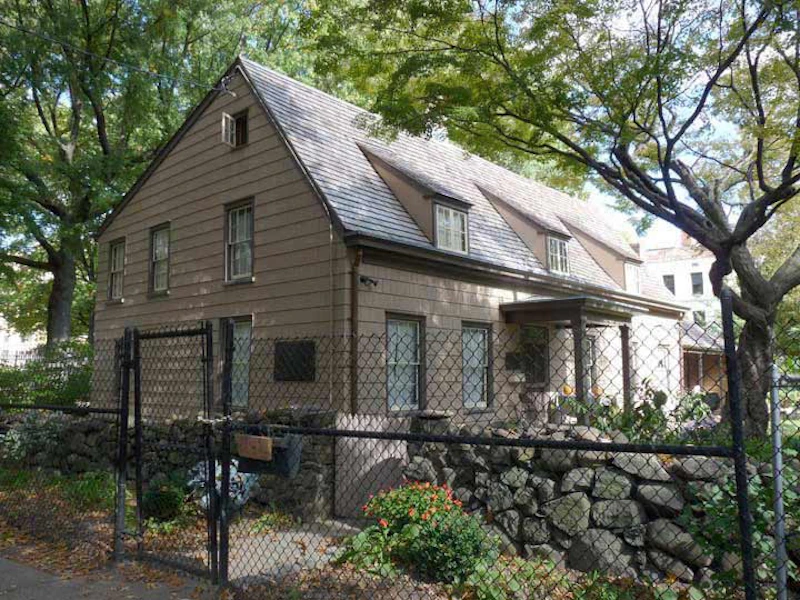
Bowne House, on Bowne St. north of 38th Ave. in Flushing, Queens, was built in 1661 by English settler John Bowne and, unlike many other colonial houses from the 17th and 18th centuries, it still looks like it did when it was built.
16th-century New Amsterdam colonial leader Peter Stuyvesant, continuing a reign of terror against religious dissenters, had Bowne, a Quaker, arrested in 1662. Before the construction of the Friends Meetinghouse, Bowne’s house was the primary site for Quaker services. Sentenced to pay a fine, Bowne refused and was jailed; he was subsequently exiled to Holland. While he was there, Stuyvesant’s bosses at the Dutch West India Company reversed Stuyvesant’s non-tolerant policy, claiming that the colony needed many immigrants to ensure economic expansion, no matter what faith they were. Bowne returned home to Flushing in 1664; the British sailed into New Netherland five months later, and Stuyvesant surrendered without a shot fired.
Bowne’s descendants included Robert Bowne, who founded the still-extant Bowne & Co. financial printers; Walter Bowne, NYC mayor from 1829-1833; shipping magnate Robert Bowne Minturn; and abolitionist Mary Bowne Parsons, wife of horticulturalist Samuel Parsons, who may have used the Bowne House as an underground railroad way station.
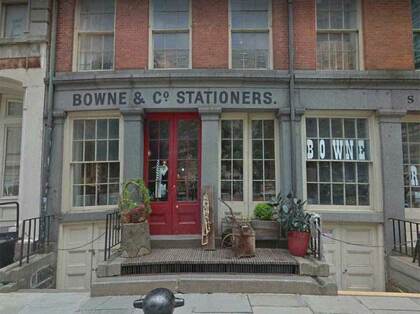
Bowne & Co. Stationers at 211 Water St., at the South Street Seaport, is a working job print shop as well as a department of the South Street Seaport Museum. It was one of the first preservation projects undertaken by the Museum in 1975.
Two hundred years before, a dry goods store called Bowne & Company opened, and it later focused on printing, especially financial documents like prospectuses and merger proxies. One of its customers was Lehman Brothers, the investment bank that collapsed in 2008. Today, Bowne Printers still works in handset type, as was done 200 years ago. The Bowne family has far-flung holdings in the NHYC area; the John Bowne House (see above), built in 1661, still stands in Flushing, Queens. Other Bownes settled in City Island, an island in Eastchester Bay part of New York City since 1895, and there, Bowne Street recollects their presence.
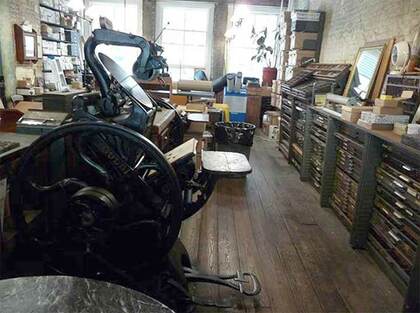
The museum says the original shop’s inventory was itemized in a city directory in 1829 as gilt-edge letter paper, straw paper, tissue paper, copying paper, drawing paper, blank books, bill books, cargo books, bankbooks and seamen’s journals.
Print shops of this type originated common phrases like “uppercase” and “lowercase” as the letters were once kept in two separate cases. “Mind your p’s and q’s” came about because the two lowercase letters are mirror images of the other.
Meanwhile there’s a Bowne St. in Brooklyn, in Red Hook. According to Benardo & Weiss’ Brooklyn By Name, that Bowne Street is named for brothers Rodman and Samuel, who ran a ferry from Red Hook to Catherine St. in Manhattan beginning in 1811.
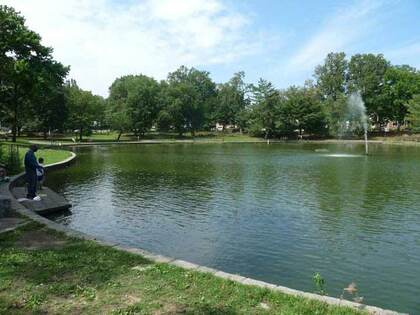
Bowne Park is a somewhat large park in Murray Hill, Queens, northeast of Flushing. Shaded paths wind around a central lake and there’s a playground on the eastern end of the park, which is between 29th and 32nd Aves. and 155th and 159th Sts. The Bowne this park is named for is Walter (1770-1846), who served as NYC mayor from 1828-1832. Walter Bowne’s summer residence stood on the site until it burned down in 1925 and the City acquired the property for parkland.
Bowne was in office during a cholera epidemic and in 1832 established a strict quarantine restricting travel in and out of the city which at that point consisted of just Manhattan island, in a situation that reminds us of the 2020s with Covid. Bowne, and others at the time, were unaware that cholera isn’t contagious and only much later, in 1883, was it discovered that cholera’s spread through contaminated water or food. Despite his efforts cholera killed hundreds of New Yorkers.
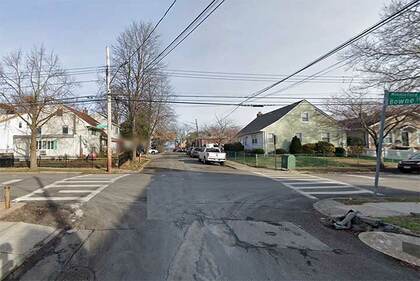
City Island, a Bronx spit in Eastchester Bay, is connected to the mainland via the City Island Bridge. The island’s laid out like a fish skeleton, with a central spine (City Island Avenue) bisected by multiple east-west “bones” or streets. One of these is Bowne St.: the Bowne family is considered one of the founding families of the island settlement and owned considerable properties there in the 18th and 19th centuries.
Kevin Walsh is the webmaster of the award-winning website Forgotten NY, and the author of the books Forgotten New York (HarperCollins, 2006) and also, with the Greater Astoria Historical Society, Forgotten Queens (Arcadia, 2013)