
Earlier this week I wrote an article that was pegged to octogenarian Roger Rosenblatt’s tongue-in-cheek column championing the art of “small talk.” Then again, I could’ve been wrong about the veteran journalist/author’s intent: when reading a Times dispatch—for the dim: there’s no difference between the “news” pages” and editorial section—my first assumption is that it’s parody, but the question is whether the elderly Rosenblatt was given carte blanche to join in on the charade.
I have a lot of newspaper/magazine print-outs on my desk and last Friday I came upon another Rosenblatt Times “Guest Essay,” headlined “Before You Toss That Book…,” which was either a send-up about noisy book fetishists (“I don’t know how’d I’d live without my books!” is a common declaration, one that I don’t remember seeing so frequently a generation ago) or a sincere rumination of how books speak to Rosenblatt, and are “valued friends.” I think it’s on the level, despite the ridiculous concept.
The prolific author writes: “Yet every book you have is a story of who you are and who you were when you acquired it. And who you became when you read it. It’s part of you, your present and your history. We may think we finish with books, but they don’t finish with us… Bright new books gleam like actors in tryouts, destined to grow gray with faded titles and bends and bruises on the covers.”
It’s beyond my ability to translate that mush.
As Bob Dylan wrote in the original scrawled liner notes for his underrated Planet Waves, “And where do I begin?” Like many, I’ve acquired thousands of books in my lifetime—some purchased, some grabbed in the surfeit of reviewers copies in the mailroom of my weekly newspapers—and have jettisoned a good percentage of them. I’ve kept Joan Didion’s Slouching Towards Bethlehem and Play It As It Lays, but haven’t returned to them since reading the former in 1970 and the novel in 1972. And I’m a Didion fan (at least the pre-1985 author). There’s still a copy, in one bookcase, of Hunter S. Thompson’s Fear and Loathing on the Campaign Trail ‘72, his collection of 1972 Rolling Stone articles on the presidential race, but I’ll admit that’s nostalgia. (A college journalist in 1975, I met Thompson and he was a riot—we drank Wild Turkey and Budweiser tall boys, while he related coherent and eye-popping political anecdotes—but his writing descent was already apparent.)
As a high-school teenager I bought most of Richard Brautigan’s books, read them in single sittings, and though I was disposed to like him from his counterculture persona, I didn’t. They were lousy, if not out-and-out garbage like so many novels today. Taking the above Rosenblatt quote at face value: I know who I was when I read Brautigan’s Trout Fishing in America and In Watermelon Sugar, and those slight titles were definitely “finished with me.” On the other hand, I was happy when my son Nicky returned Enid Starkie’s 1961 biography of Arthur Rimbaud, the same copy—its definitive New Directions cover barely intact—I read in 1971, and two more times when I was in college and writing a term paper on Rimbaud’s influence on Dylan. I do remember in 1977, upon finishing the paper for a French “independent study,” and one of my roommates, recently besotted by Rimbaud, looked forward to reading my 25-page essay. He said it sucked. Maybe so, but I received an A, a rarity in my college career.
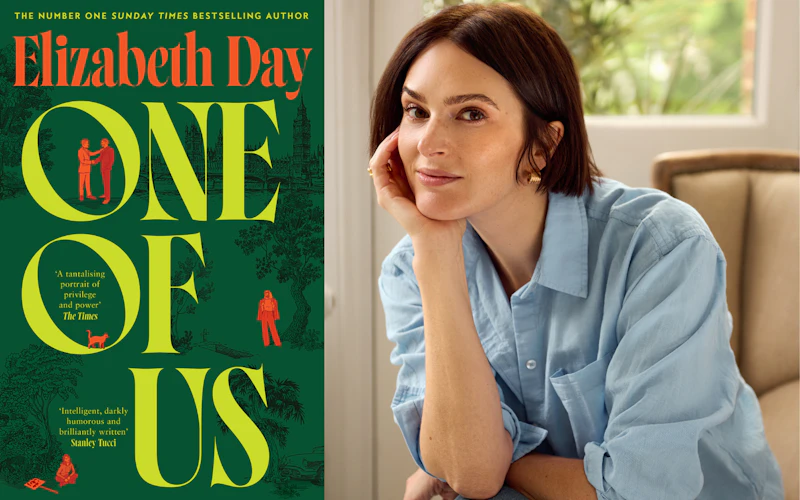
A novel I just finished, Elizabeth Day’s One Of Us, will end up somewhere in the house, or, if I get around to it, put in a carton for the local library or Goodwill. A mystery that’s also a vituperative defenestration on Britian’s increasingly powerless upper class, it more than held my interest, despite Day’s lapse into now-lapsed internet-cliches and trite “public school” asides from the entitled. I was waiting for just one “Pip, pip, cheerio, and all that rot,” but it never came, although I could’ve missed it.. One Of Us was released in America last month, and received high marks from critics (the caustic descriptions of the “class wars” was in synch with like-minded reviewers) and is a follow-up to Day’s 2017 The Party. As noted, the prose is little more than pedestrian, but it’s an excellent yarn, filled with dislikable characters—a main focus is the weak-willed Martin Gilmour, still seeking the approval of the aristocratic Tory politician Ben Fitzmaurice (who adapts to “woke” statements despite his abhorrence for them), even after the latter’s done him dirty—rape, murder, 15 shots away, and a conclusion that telegraphs a third part of the series.
In The New York Times, Sarah Lyall wrote: “The author is too kindhearted to allow all her characters’ lives to end in ruins. But her depiction of the casual entitlement of Britain’s ruling class, and of the micro-snobberies that animate the stratified social structure, is deliciously spot-on.”
Lyall lost me with the all-too-common use of “delicious” in describing a book (as well as movies, paintings and music), as if someone would eat it. Is a book vegan-friendly?
—Follow Russ Smith on Twitter: @MUGGER2023