
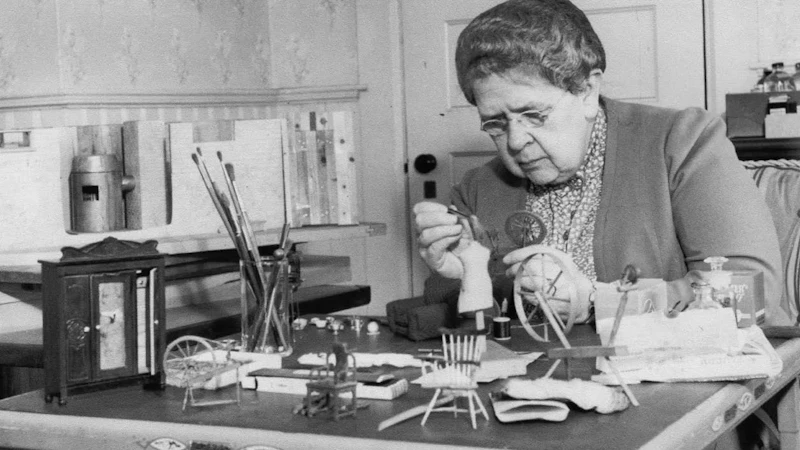
As a miniaturist, Marylander, and true crime fan I became enamored by the story of Frances Glessner Lee; the unusual tale of the woman who developed modern forensic science in the United States.
How did a 19th-century mother who never went to college become known as the “mother of forensic science?” This is the first in a two-part series exploring barely the surface of the fabric of her life’s tapestry. Next week I’ll have an interview with her biographer, Bruce Goldfarb, author of 18 Tiny Deaths, so if you’d like to join the “murder in miniature book club,” grab a copy. Goldfarb’s book brings her story to life, showing how she broke into a male-dominated field without formal scientific training and helped shift death investigation toward a more scientific, evidence-based system. It’s part biography, part true-crime history, and compelling in how it reveals the lasting impact of one woman’s meticulous, unconventional work.
The intricate miniature crime scenes known as the “Nutshell Studies of Unexplained Death” look at first glance like the dollhouses perhaps other contemporary early-20th-century women created. But look closer, and they’re something else entirely. Lee created detailed miniature crime scene dioramas, first used when she helped establish the Department of Legal Medicine at Harvard University, and still used today by the Maryland Office of the Chief Medical Examiner to train investigators in observation and critical thinking.
Born in 1878 to a wealthy Chicago family, Lee grew up in a world of privilege but with strict expectations. Formal higher education wasn’t considered necessary for women of her class, but she developed a lifelong intellectual curiosity about medicine and criminal investigation through her friendship with her brother’s classmate George Magrath, who later introduced her to the inconsistencies and limitations of early-20th-century death investigations, where poorly-trained coroners and lack of standardized procedures often led to missed or mishandled evidence.
Lee didn’t begin her forensic work until her later years, following the death of her parents and the end of her marriage. With financial independence and a renewed sense of purpose, she turned her attention to improving death investigation practices, becoming the first female police captain in the United States (she’d married at 20, had three kids and divorced before beginning her miniaturist/Forensic Science Founding/Police Captain/Harvard lecturer days in her 50s). In the 1930s,, she began creating the Nutshell Studies, designed to challenge investigators to observe carefully, think critically, and avoid jumping to conclusions. Lee named her project the Nutshell Studies of Unexplained Death, after an old police saying to "convict the guilty, clear the innocent, and find the truth in a nutshell."
She funded the establishment of the first academic program in legal medicine at Harvard University, creating a foundation for modern forensic training. Her insistence on careful observation and evidence-based conclusions helped shape the investigative standards that are now taken for granted.
Lee’s legacy has also extended into film and television. Her work and life have inspired documentaries and have been referenced in crime series, reinforcing her influence on modern forensic storytelling. One notable example is the John Waters-narrated documentary Of Dolls and Murder, which explores both her artistry and scientific rigor, capturing the eerie beauty and educational power of her creations.
Her work was exhibited publicly, after restoration of the dioramas, at the Smithsonian Institution in 2017-2018, which brought renewed attention to Lee’s work, although public access to the dioramas was restricted since then by the Maryland Office of the Chief Medical Examiner which allows no one to view them.
Much of what we know about Lee’s life and work today comes from Bruce Goldfarb, whose book 18 Tiny Deaths offers an engaging account of her contributions. Goldfarb brings Lee into focus not just as an innovator, but as a complex individual navigating societal constraints, personal loss, and an unconventional calling. His work has played a major role in reintroducing Lee to a broader audience and cementing her place in forensic history.