
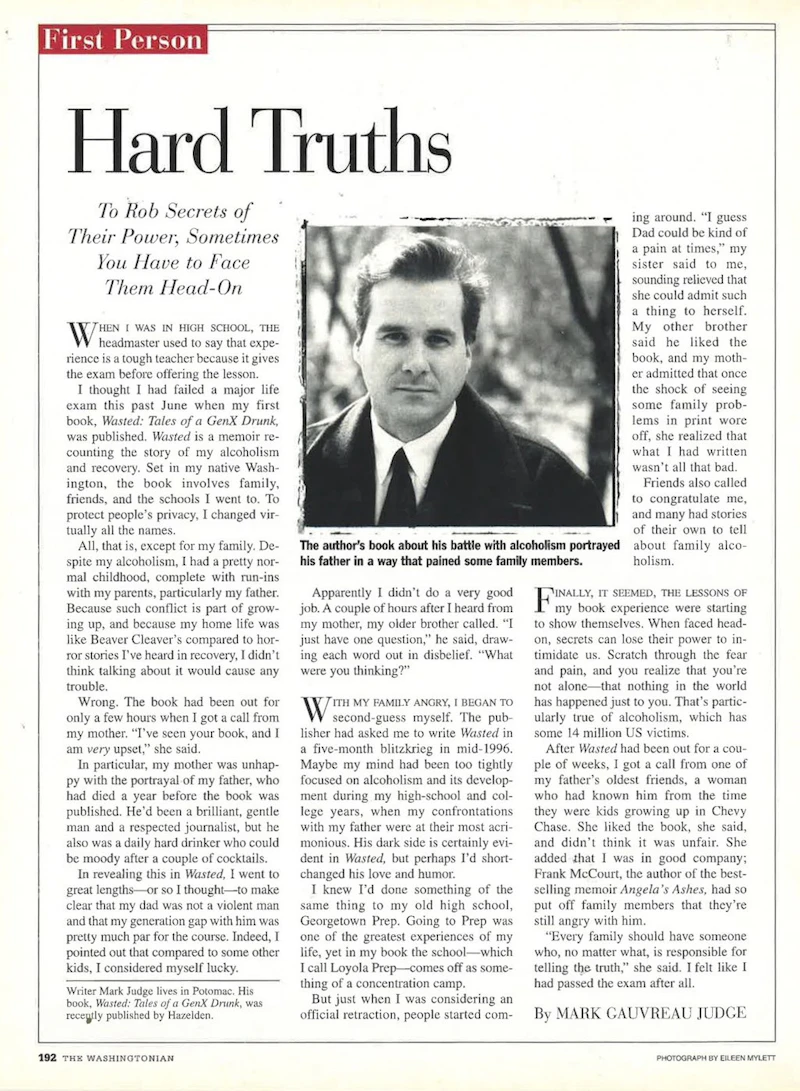
Last year, Washingtonian magazine commissioned a profile of me. The author would be Cathy Alter, a successful journalist who’s appeared everywhere from The Washington Post to Oprah magazine. The editor who gave Alter the green light is Patrick Hruby.
A year later, the profile was spiked. Alter finished the piece and sent it to the editor in the winter of 2025. Hruby, she told me, was solid on the idea that I was a compelling subject. As I noted in a recent blog post, I knew part of the topic would be about my involvement in the 2018 Brett Kavanaugh nomination circus. Yet Alter wanted more. We met at Georgetown University, and she asked me non-political questions—what frightened me, what my family was like growing up, what girls I dated in high school at Georgetown Prep, where I met Kavanaugh. I was also asked about Christine Blasey Ford, the woman who in 2018 accused Kavanaugh of sexual assault—and said I was in the room when it happened. Still, Alter won me over. We met two more times and I drove here around the places in Maryland where I spent my youth. More than once she said that she’s known for decades that while I’m a flawed person, I’m also a kind one.
On March 31 of this year, I got a text from Alter:
Hey there. I wanted to tell you as soon as I heard (in a phone call today with the editor), Washingtonian is killing the story. I’m tied up now with a list of crap to finish but I wanted to let you know. How about I take some of my kill fee and treat you to a fancy meal? I’m really sorry. And really disappointed.
Alter made the mistake of making me look human. In the pages of the Washingtonian, a D.C. glossy, the friend of Brett Kavanaugh who exposed the media in his book The Devil’s Triangle can’t be made to look human. Let me put it this way—a person featured in the April issue of the magazine is Debra Katz—the lawyer for Christine Blasey Ford.
I’m currently reading a fascinating new book: Rolling Stone and the Rise of Hip Capitalism: How a Magazine Born in the 1960s Changed America. Written by Charles L. Ponce de Leon, a professor of history and American Studies at California State University Long Beach, it’s a seminar on what makes great journalism. For the first 20 years of its existence, from 1967 to 1987, Rolling Stone produced some of the greatest journalism in American history.
The cowardice of Washingtonian makes what Rolling Stone founder Jann Wenner achieved that much more impressive. Wenner’s long been known as an egomaniac and a jerk, but he was also ambitious and brave. He hired the best people and let them flourish, even if they disagreed with him. This produced a magazine that was always engaging. Despite growing up in California and being close to the counterculture, Ponce de Leon writes, “Wenner quickly recognized that this wasn’t his scene. Despite his love of marijuana, LSD, and rock music, he wasn’t entirely comfortable with the blossoming counterculture… Like many other young Americans, Wenner was, at best, a fellow traveler, never a full participant.”
Rolling Stone was launched in 1967, and Wenner hired editors who knew that they were doing: “By the middle of 1969, Rolling Stone had become more consistent and professional—and more successful than ever, demonstrating the virtue of Wenner’s plan to occupy the middle ground between the mainstream and the countercultural fringes. Wenner appreciated the help and supported [new editor John] Burks’s innovations. He knew they were making Rolling Stone a better publication.”
One of the strengths were the record reviews: “Given the diversity of taste among the magazine’s reviewers and the wide range of music they wrote about, there wasn’t a single standard for determining the quality of a record or the virtues of an artist. And no artist was uniformly praised. Even the magazine’s favorites released records that elicited mixed reviews and occasionally worse, and the features of their music that sparked praise varied. This was one of Rolling Stone’s strengths. Within its pages, readers could find a variety of perspectives, and the magazine’s eclecticism generated a liveliness that made it stimulating to read.”
Wenner “made a point of publishing writers with divergent tastes who disagreed not just about individual albums but also about styles of music.” Reviews editor Greil Marcus put it this way: “I felt debate and conflict within the section was good—that it was a version of how people actually argued about albums.” He made it clear to them that they could be critical. “I said to people over and over again, ‘Be as mean, as tough, as angry as you want to be. If something insults your intelligence or is a betrayal of somebody’s talent, say so. Don’t hold back.’ ”
This kind of freedom and integrity isn’t possible in today’s Rolling Stone—or at Washingtonian.
Several Rolling Stone writers were present at Altamont, the 1969 free concert the Rolling Stones put on outside of Tracy, CA. It was a riot and one man died. “When they reported back to the office,” Once de Leon writes, “it became clear that the magazine had arrived at an important crossroads. As journalists, they had to report on the tragedy and assign blame.” Magazine co-founder Ralph Gleason was “adamant” that they cover the story as if it were “World War III.” Still, “the staff knew about Wenner’s friendship with Jagger and were fearful that Wenner would pull punches. He listened to their pleas and wracked his own conscience.” Wenner wrote in his memoir: “I had a choice, and I didn’t have a choice… Mick meant a lot to me, the pleasure of his company, the bragging rights of knowing him. He would expect me to be protective. But perhaps, with time, it would be less painful, and he would understand what I had to do.”
In that spirit, someone should publish Cathy Alter’s profile.
