
I stalk neighborhoods with the camera, attempting to see the old and decrepit amid the new and shiny. I began my website Forgotten New York when I was 40 and now that I’m 68, I find myself old and decrepit too, though not so bad as to completely stop me. I look for traces of what was and things that have been forgotten or that the city and its real estate developers would prefer you missed. I’ll continue this work as long as my health and funds persist. There seems to be a never-ending fount of research and resources I can tap into. My only regret is that I was unable to record my findings sooner. Why didn’t I carry a camera everywhere until 1998? That’s my fault.
Today the area I concentrated on was Bushwick into Ridgewood. Well-worn ground, but there are plenty of streets I’ve never been on or covered in any detail and that’s in line with the statement that you can never fully know New York until you have walked every block in it. There are a number of people who have done so. I haven’t, and I’ve been exploring NYC since my first bus rides in grade school with my parents and then bicycle forays in Brooklyn, Queens and Staten Island.
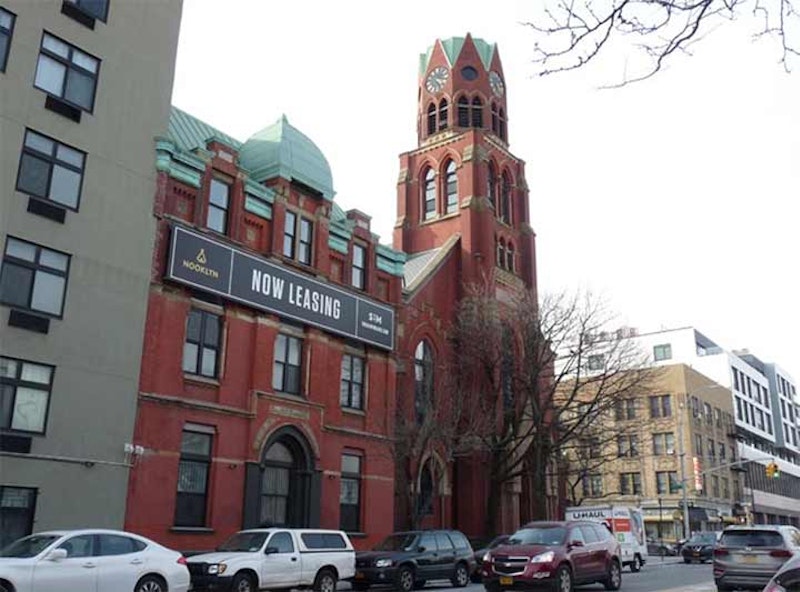
Unlike, say, Park Slope, Clinton Hill or Brooklyn Heights, Bushwick in the 19th century was economically mixed, with middle-class rowhouses, upper-class mansions and working-class tenements existing side by side. Many, although not all, of the mansions belonged to brewers. These brewers also endowed some of the neighborhood’s most majestic churches. Since Germany is part Protestant and part Catholic, the neighborhood has St. Mark’s Evangelical Lutheran Church, shown above, and the breathtaking, Spanish-baroque style St. Barbara’s Roman Catholic Church. Unfortunately St. Mark’s lost its tall steeple during its conversion to residences, billed as “affordable” though the definition of the word changes from neighborhood to neighborhood.
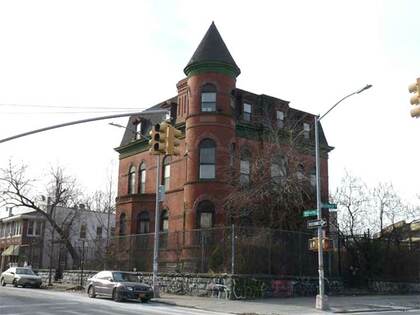
The William Ulmer Mansion at Bushwick and Willoughby, which later belonged to explorer Frederick Cook, who claimed to be the first person to reach the North Pole, has been rehabilitated and is now occupied after years of moribundity. The mansion was previously occupied by brewer Ulmer, whose nearby brewery complex on Beaver and Belvidere Sts. has recently been landmarked by the city Landmaks Preservation Commission. Ulmer also built a long-vanished amusement park in Bath Beach, which today is remembered by the Ulmer Park bus repair facility and storage yard at 25th and Harway Aves. And the Ulmer Park Library.
Born in Wurttemberg in 1833, William Ulmer immigrated to New York in the 1850s to work with his two uncles, Henry Clausen Sr. and John F. Betz, in the brewing industry, eventually becoming the brewmaster for Clausen’s very successful New York firm. In 1871, Ulmer partnered with Anton Vigelius to form the Vigelius & Ulmer Continental Lagerbier Brewery on Belvidere and Beaver Sts. in Bushwick. Born in Bavaria, Anton Vigelius immigrated to Brooklyn in 1840 at 18 and was involved in the produce business prior to opening the brewery. He purchased land at the corner of Beaver and Belvidere Sts. from Abraham and Anna Debevoise in 1869. In 1877 Vigelius sold his share of the brewery to Ulmer.
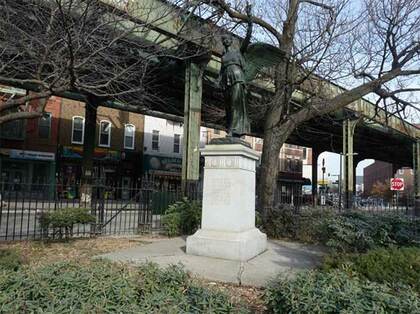
The triangle across from the Ulmer/Cook mansion, Freedom Triangle, contains the first of two war memorials along Myrtle Ave. alongside the el structure. Both are works of sculptor Pietro Montana. The “Angel of Victory With Peace” was installed here in 1921 and honors Bushwick’s 93 casualties in World War I.
“She appears to us to be wearing the crown of Victory, sword hilt forward and face transfigured. Her arm uplifted in a torch-like gesture to the vision of peace—the supposed end for which the Great War was fought, by America at least. The ninety-three dead who were sacrificed to it are carved on the handsome pedestal. Both statue and setting have been recently restored, thanks to the Department of Parks Division of Art and Antiques, and Greenstreets.”—Cal Snyder in Out of Fire and Valor
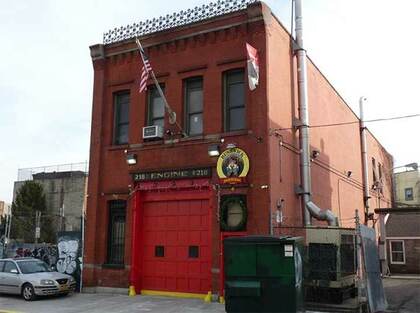
FDNY Engine 218, 650 Hart Street at Central Avenue was built in 1887. So many firehouses around town are museums of differing architectural stylings. In a neighborhood in which many streets were named for Declaration of Independence signatories, Hart St. honors John Hart of New Jersey. During the Revolutionary War Hessian mercenaries destroyed his farm and traumatized his wife, hastening her death. Hart spent much of the war hiding from the British in caves and forests, according to Leonard Benardo and Jennifer Weiss in Brooklyn by Name.
Hart St. originates in Bedford-Stuyvesant, at Nostrand Ave., and turns northeast at Broadway. Only a few streets in Bedford-Stuyvesant: Hart, Willoughby, DeKalb, Greene, Gates, Madison, Putnam, Jefferson, Hancock, Halsey, Decatur, and Chauncey, extend as far as Bushwick with a few going into Ridgewood into Queens. They were probably selected arbitrarily when the streets were named and laid out in the early- to mid-1800s.
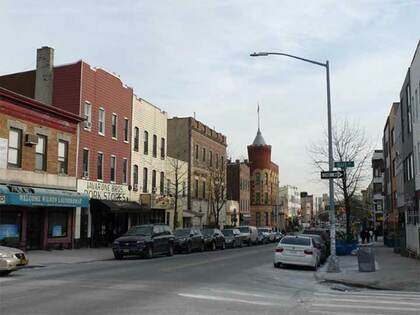
Wilson Ave. was originally named Hamburg Ave. in honor of its wealth of German immigrants, but was changed in 1918 to honor the sitting president, Woodrow Wilson. Most of America’s presidents have a street in NYC that bear their names, but not all of those names honor the namesake presidents.
I keep finding landmarked buildings, or at least buildings that ought to be, in unfamiliar neighborhoods. The flag-poled gem at Wilson and DeKalb Aves., seen here in the center right, was the 20th and later, 83rd Precinct of the NYPD, constructed in 1894-95 and designed by William Tubby (who also built a number of buildings in Pratt Institute). No longer a precinct, it’s now home of offices of the Department of Housing Preservation and Development. It’s not endangered; it was named a NYC Landmark in 1977. The building now houses the Brooklyn North Task Force and the Patrol Borough Brooklyn North Headquarters.
When the 83rd Precinct moved to 480 Knickerbocker Ave., the Wilson Avenue building was basically abandoned. In 1996, it was renovated and rededicated for its current use. The original holding cells are still inside, though unused. The 83rd was used for exterior shots to represent the 13th Precinct in Manhattan for the 1970s’ Kojak. The Dutch phrase Eendraght Maakt Magt, or Might Makes Right, is inscribed on the frieze above the entrance portico.
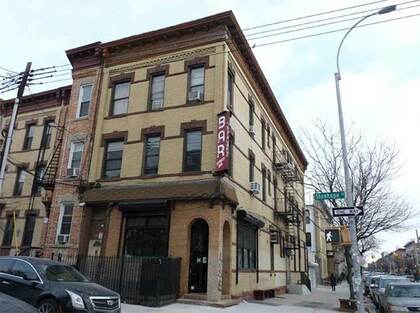
My friend Heather Quinlan (the filmmaker behind If These Knishes Could Talk, an entertaining examination of the NYC accent, as well as an upcoming documentary on the lost Cherry Lane Cemetery in Staten Island, an 1800s African-American congregation) accompanied me on a Bushwick-Ridgewood walk in 2017. We went into the Cypress Inn Cafe, on Cypress Ave. and Stanhope St., a cozy joint where we got panini sandwiches, and I admired the vintage cash register. The undefended Brooklyn-Queens line runs through the center of Cypress Ave., while the Inn is on the Queens side. At the Inn, if you want pickles on the panini, specify “on the side.” Otherwise, they get pressed into the sandwich.
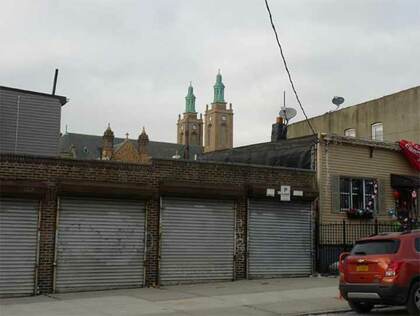
The “twin peaks” of St. Aloysius Church stick up above Himrod St. garages. The church, at 135 feet tall, is second only to St. Barbara’s Church in the battle for height supremacy in the Bushwick-Ridgewood area. Stockholm St., and the surrounding neighborhood in Ridgewood, is dominated by the twin-towered church at Onderdonk Avenue. It was built between 1907 and 1917 (Francis Berlenbach, arch.). The parish celebrated its 125th anniversary in 2017; however, it had been seeking funds to restore its bell towers. The church is the largest building in the city constructed with Kreischer brick.
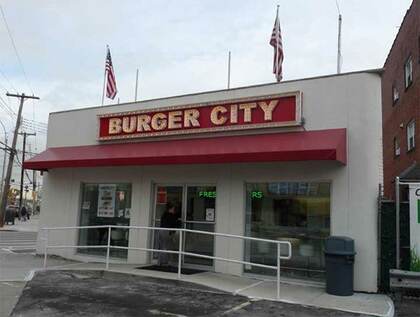
The reason I wanted to get on Himrod is because at its northeastern end at Metropolitan Ave. there was lunch at Burger City. I wasn’t disappointed as the freshly made burgers and French fries rival Shake Shack quality at a much lower price; they also make shakes. In the summer, I get ice cream at the Carvel next door. It’s one of the last old-school Carvel buildings, and formerly had revolving mechanical ice cream cones before Hurricane Sandy made quick work of them in October 2012. A second Burger City is located on Hempstead Turnpike in East Meadow near the Nassau Coliseum.
—Kevin Walsh is the webmaster of the award-winning website Forgotten NY, and the author of the books Forgotten New York (HarperCollins, 2006) and also, with the Greater Astoria Historical Society, Forgotten Queens (Arcadia, 2013)