
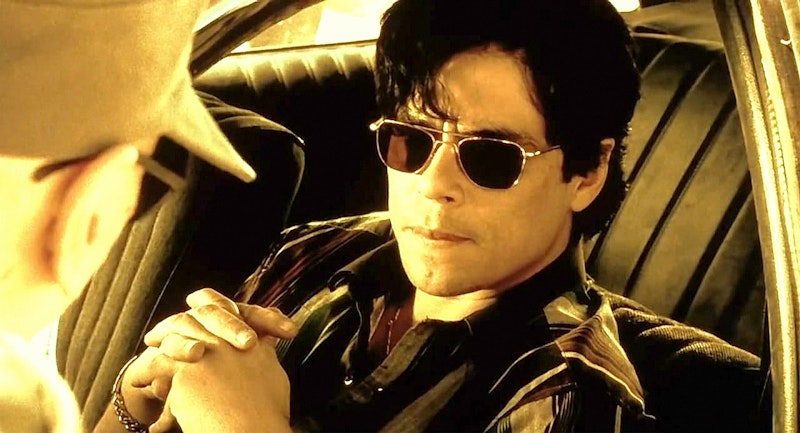
For a film that won five Oscars, Steven Soderbergh’s Traffic is overlooked today. His other 2000 film, Erin Brockovich, has endured because of Julia Roberts’ performance (one of her best), and I saw it pop up on many “best of the century so far” lists people were making after Quentin Tarantino talked about his favorites on The Bret Easton Ellis Podcast, a regular source for headlines on slow news days. 2000 was the turning point for Soderbergh, when he shot his last film with a cinematographer (Ed Lachmann) and his first as his own DP. Through trial and error—he told Charlie Rose that he had to throw out multiple days of shooting—he created a highly stylized film that presaged the “Golden Age of Television” that would emerge 10 years later in the 2010s.
Traffic is the blueprint for nearly every notable series of that era: the yellow filter that would travel to Afghanistan and eventually New Mexico in Breaking Bad, the all-encompassing systemic corruption of The Wire, the misbehaving rich kids of Succession, the almighty dollar that rules the world in Mad Men, the wisecracking buddy cops in over their heads of True Detective, and, by the time Catherine Zeta-Jones decides to take over her husband’s (Steven Bauer) drug smuggling empire, the corruption and dissolution of the American family and the American dream explored throughout The Sopranos, which premiered just a year before Traffic’s release.
Watching the film now, it’s impossible not to see how it’s been reiterated over and over in the last 26 years, and especially on television. There was a stretch in the 2000s where every scene in the Middle East, or Mexico, or Africa, or anywhere without many white people, was put through a piss-yellow filter, signaling the audience that they’d entered some third-world hell; but by the time Marvel reared its ugly head, war movies became less interested in responding to, supporting, or allegorizing the Iraq or Afghanistan War. Early-2010s war movies like White House Down and Olympus Has Fallen were ridiculous and had as much to do with the world as Spider-Man, and in 2012, Hollywood closed the book on the War on Terror with Zero Dark Thirty, followed closely by the television series Homeland.
Traffic is propaganda of a different, decidedly more innocent time. In three separate stories that never connect, the War on Drugs is dramatized through a prominent politician (Michael Douglas) and his junkie daughter (Erika Christensen); a socialite (Zeta-Jones) who turns kingpin when her husband’s arrested for business she really knew nothing about; and Benicio Del Toro as a Mexican federale playing both sides against each other. It’s often didactic and sentimental, and inevitably lacking the depth and nuance of most of the lengthy miniseries it would inspire; but because it’s been so long since any War on Drugs “messaging” has been pushed by the mainstream media, the only scene that really feels unrealistic and beyond mawkish is towards the end when Douglas refuses the job of White House Drug Czar, leaving the lectern mid-acceptance speech: “I can’t do this. We say we’re ‘fighting a war’—how do you fight your own family?” And of course, just a few scenes before, he was holding his strung-out daughter in his arms, briefly a whore on skid row, now Natalie Wood in The Searchers, with Douglas’ own version of Ethan Edwards ready to take her home.
Soderbergh improbably won the Oscar for Best Director in 2001, despite being nominated twice in the same category. Smashed beyond belief, he managed not to embarrass himself; although his 1989 debut sex, lies, and videotape is widely cited as the beginning of the Gen X New Wave in American film, it’s not a movie that people seek out or watch a million times in their teens, like, for example, Reservoir Dogs, Slacker, Clerks, or El Mariachi. Soderbergh spent most of the 1990s lost in the woods, releasing duds like King of the Hill, The Underneath, and Kafka. He made one of his best, and least accessible films, in 1996 with Schizopolis, a kind of cinematic cleansing, and then got a second chance with the assignment Out of Sight. Before that 1998 hit, Soderbergh was way down on the list of “in demand” Hollywood directors; by early-2002, buoyed by the commercial and critical success of Erin Brockovich and Traffic, and the blockbuster phenomenon of Ocean’s Eleven, he had the power to do whatever he wanted.
And he did: toss-offs, sketches, and experiments like Full Frontal, Unsane, The Good German, The Girlfriend Experience, and Haywire sit alongside pure entertainments like Contagion, Logan Lucky, Black Bag, and the Magic Mike series. He put out two movies two months apart last year, and he has a new one, The Christophers, opening next month. Because he makes so many movies, the sketches and experiments are almost always better, and as he himself admitted last year after the disappointing box office performance of Black Bag, the mid-budget studio movie that he made a career out of this century might be on its way out, or, at the very least, changing beyond recognition. Soderbergh’s nimble enough to navigate it all and stay up, even if he’ll probably never make a masterpiece. But looking at his movies, you can usually see the future half a decade or more ahead of time.
—Follow Nicky Otis Smith on Twitter: @NickyOtisSmith