
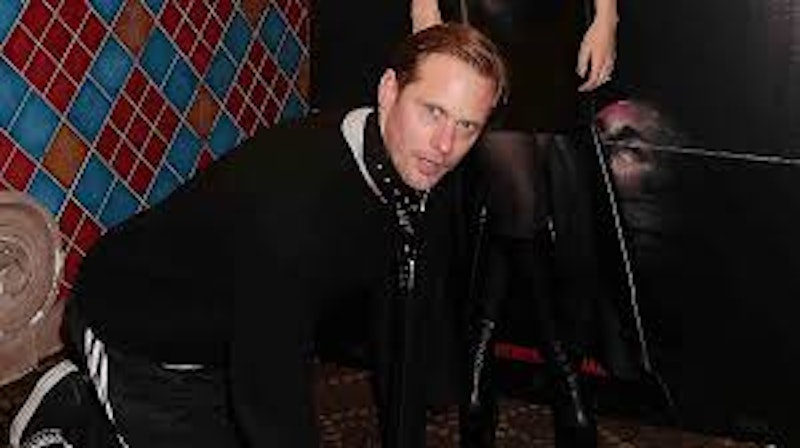
If you want a snapshot of the strange moment Hollywood now finds itself in, look no further than Pillion—Alexander Skarsgård, hulking, blond, Nordic thunder-god, playing a leather-clad, BDSM-obsessed gay biker who ushers an innocent young man into a world of collars, commands, and back-alley encounters best left unremembered. The film won awards at Cannes, earned a standing ovation, and reminded every straight male actor that if he isn’t taking a gay role in 2025, he may as well hand his Oscar ticket to someone who will.
Skarsgård won’t be the last. Hollywood’s most bankable leading men—the square-jawed, straight-laced, classically “masculine” ones—are sprinting toward gay roles with enthusiasm. Jake Gyllenhaal did it first with Brokeback Mountain, and he did it so convincingly the public briefly forgot he was supposed to date women. Paul Mescal, Ireland’s softly-spoken charm export, is now playing gay men at a pace that suggests he’ll be eligible for an honorary membership in Soho House’s more adventurous upstairs bar. Daniel Craig emerged from 15 years of tuxedos and shaken martinis only to start playing sexually fluid characters with the confidence of a man following a well-established Bond retirement plan. (There is no such plan.)
It’s not just film. Television—especially the kind churned out by Netflix, HBO, and whichever streaming platform is currently hemorrhaging cash—is now so littered with gay, bi, pan-curious, queer-coded storylines that you’d swear executives are operating under a contractual requirement to include at least one same-sex longing glance per episode.
If a series isn’t at least mildly homoerotic, executives start pacing the corridors like anxious parents waiting for exam results. They hover outside writers’ rooms asking questions no straight-faced adult should ever have to ask: “Can the two male leads look at each other for one extra beat? Maybe a little shoulder graze? What about a flashback where they shared a tent?”
To say this isn’t homophobic; it’s simply describing what everyone with functioning eyesight can see. Hollywood no longer deals in variety. It just keeps repainting the same narrative template, always with a fresh coat of homoerotic subtext. Gay content used to be a genre. Now, it’s the default seasoning. Not every story warrants it, but they sprinkle it on anyway because some Silicon Valley algorithm told them viewers “engage more deeply” when a perfectly normal male friendship starts to look like the early stages of a Grindr chat.
I say this as a straight man who just wants to watch a show without feeling like I need to reach for the remote. I’d like characters who don’t look like they’re one episode away from confessing repressed desire in a stairwell lit like a Calvin Klein fragrance ad. I’d like two male leads who can share a drink without the camera hovering as if it’s waiting for them to kiss and file for divorce.
In modern Hollywood, nothing happens by accident. The industry is allergic to risk and addicted to fleeting trends. Once one film about a tortured gay romance wins awards, executives assume the public is starving for more tortured gay romances. Straight men used to earn prestige by playing soldiers, kings, cowboys, gangsters, priests, alcoholics, or troubled fathers. Something admirable, tragic, or historically weighty. But in a culture where masculinity is under permanent cross-examination, the straight male actor must now prove he’s more than a chiseled exterior with emotional constipation. Playing gay—especially gay in a tortured, lyrical way—is shorthand for depth.
The actors often justify the decision with a kind of over-rehearsed earnestness. They talk about “challenging assumptions,” or “exploring desire,” or “pushing boundaries,” when the real motivation is awards season and the knowledge that Variety will print an essay calling them “brave.” Play a gay character, and suddenly you’re Serious. A Thinking Actor. You may be allowed to wear a beard on the BAFTA red carpet. For years, Hollywood cast gay actors in straight roles without a second thought. Now the pendulum has swung so hard we’re hitting a different absurdity.
And then there’s the political underside. Hollywood has spent the past decade terrified of being labeled outdated, bigoted, or insufficiently progressive. Studios now greenlight scripts with one eye on sensitivity readers and one hand on their publicist’s shoulder. Including gay themes—or at least a faint, tasteful trace of homoeroticism—is a reliable way to signal virtue without actually fixing anything meaningful. It’s the cinematic version of a Fortune 500 company posting a rainbow logo while quietly shipping production overseas to avoid labor laws.
But the real insanity lies in the gap between these actors’ public and private lives. Skarsgård, for instance, is so aggressively straight in every other role that watching him bark commands in leather chaps is like watching a Viking chief try to order a latte. Daniel Craig, post-Bond, seems determined to prove he’s more than the man who punched terrorists in tuxedos, even if that means making out with a bartender in a movie most fans will never watch. Gyllenhaal still can’t mention Brokeback in an interview without journalists leaning forward, hoping he’ll say something confessional.
Hollywood spent years insisting masculinity must be dismantled and reimagined. It succeeded. Now, its leading men are dutifully reimagining themselves. Not by becoming wiser or braver, but by signing contracts for films where the lighting is soft, the longing is palpable, and the intimacy coordinator is the most powerful person on set. This is a culture war. But it's also a casting war. And right now, the gay roles are winning.
