
During the Vietnam War, I was an elementary, junior high, and high school student in DC. To protest it, and also to protest the conditions of what I regarded as arbitrary incarceration in the dysfunctional DC public school system, I helped lead several student walk-outs at Alice Deal Junior High in 1972 and '73. I was suspended repeatedly, and on one occasion the whole lot of us (hundreds) were gathered up in the morning for an assembly and then locked in the auditorium so we couldn't escape. It had a “powder-keg” feeling, and we finally escaped again somehow, picketing with signs and chants and "all we are saying, is give peace a chance."
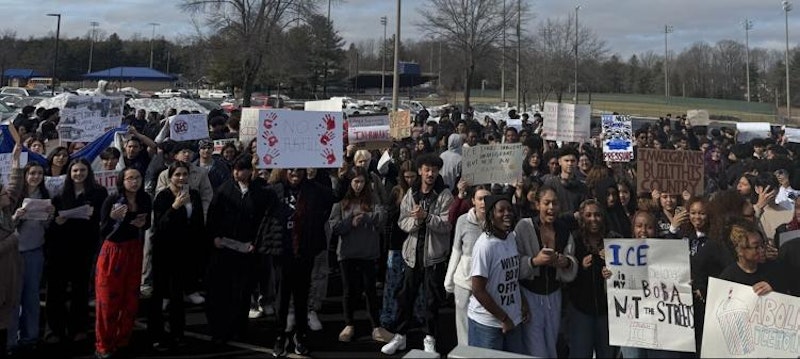
That's one reason I was very encouraged by the student strikes over the last week here in Northern Virginia, for example at Woodbridge High School and Gainesville Middle School. The reasons for the walk-outs, involving hundreds of students, were more urgent than our reasons and a lot closer to home (though of course the Vietnam War was actually planned in DC): ICE immigration enforcement.
Kids walked out on behalf of their friends and their friends' parents, who in the current conditions are subject to arbitrary internment based on racial profiling and many of whose lives have already been ripped to shreds. Maybe I thought we were interned under compulsory-attendance laws. ICE is buying giant warehouses to make a prison camp for your family. I can see thinking that some things are more urgent than algebra.
Hundreds of students walked out of Woodbridge High School on Friday. Woodbridge's principal Heather Abney, in an email to parents, said that the school “is committed to the principles of free speech and expression and other forms of constitutionally protected expression." But the school suspended 323 students who left the campus in protest. It's true that the US Constitution doesn’t specifically enshrine freedom of movement as a basic right, though it’s often considered a "basic unenumerated right." But how would you define “internment”? And for that matter, let's explore the concepts of “child abuse,” “kidnapping,” etc.
I appreciate Abney's nod toward the Constitution, though we could draw some wider conclusions. Does the administration control what can possibly be expressed on the walls of the school? Does it impose some sort of dress code? These are violations of the constitutional rights of students, if they have any. That they can’t be permitted to leave school grounds (for their own safety) during school hours isn’t what the Supreme Court would recognize as being within the government's authority with regard to adults who hadn’t been convicted of a crime. With regard to student safety improved by remaining on campus (which seems unlikely), it's fair to say that by this argument, class should never be dismissed and that custody of your children should simply be assigned to school administrators.
The rights of children are a fraught legal matter. But whether they strictly had a legal right to walk out and then off school grounds or not, they did the right thing. And I hope that student strikes and protests continue and spread. It’s happening already all over the country: in Quakertown, PA, and Pittsburgh; in Virginia Beach; in San Antonio and Killeen TX; Tampa Bay; Chicago; Silver Spring. MD. These kids are our conscience, and they’re learning something extremely important in multiple ways: that government authority is very often abusive of children.
ICE is a child abuser. Jeffrey Epstein probably got to at most a hundred girls, ICE on any given day is abusing hundreds. That is the kind of thing that, even if we’re incapable of outrage, we should let our kids express themselves about. I hope they can’t be stopped.
—Follow Crispin Sartwell on X: @CrispinSartwell
