
The conspiracy theorists were right all along: there really was an international pedophile ring connecting politicians, billionaires and business leaders. David Icke was writing about it in the 1990s. Except that, if you read Icke, you also have to absorb blood-sucking, shape-shifting reptilian aliens from another dimension, the planet Saturn as an artificial broadcasting system, and a hollow Moon, along with a whole host of other weird science fiction conceits.
Even if you dismiss the most extreme aspects of Icke theory, you’re still left with a narrative in which the operation was supposed to have been run through a pizzeria in Washington DC. The owner and his staff received multiple death threats. One guy, from North Carolina, traveled to the restaurant to investigate and fired a rifle to break the lock on a door during his search. He thought the door led to a secret dungeon where the sex slaves were being kept. It turned out to be a storage room full of mops and cleaning equipment.
The release of the Epstein files shows that, while there was always a kernel of truth to these lurid tales, there’s also much misinformation along the way: a muddying of the waters, a slew of deliberate misdirection.
Here in the UK, the files have already brought down one de-frocked Prince (Andrew Mountbatten Windsor) and one Ambassador to the United States (Peter Mandelson). It may also destroy the Prime Minister. In the US, however, most of the names of the perpetrators have been redacted and no one, except Ghislaine Maxwell, and Epstein himself, has suffered any consequences.
Meanwhile, one name that has been systematically shamed is that of left-wing icon, Noam Chomsky.
I admit this has been hard to swallow. Chomsky is something of a father figure to me. I’ve written about my relationship with my own father before, about the blazing row we had when I was in my teens, when I questioned his ideas about Israel/Palestine. I went to school the following day with a split lip and a black eye. My father had Jewish roots, which he never told me about. The issue was personal to him.
I first discovered Chomsky in the 1990s. I knew who he was, of course, but I’d never heard him speak. I bought a copy of a magazine called Index on Censorship, which came with a free tape of a Chomsky lecture. I was struck by his voice: quietly confident, clear without being assertive. I forget now what the subject was. I just remember one section. He’d been talking about the Sikorsky plant in Stratford, Connecticut. He said it wasn’t far from the site of the Pequot massacre in 1637, in which several hundred men, women and children were burned alive by rampaging colonists, while the warriors were away. Then he reminded us of the names of some of the Sikorsky helicopters: Black Hawk, Choctaw, Comanche. They were the names of Native American tribes.
“It would be like a German manufacturer labelling their equipment ‘Jew’ or ‘Gypsy’,” he said.
Something shifted in me when I heard that. It was like he was ripping the veil from my eyes, allowing the light of truth to enter my brain for the first time. Of course! Only a heavily propagandized population could see the names of massacred tribes on military equipment and not consider it strange and inappropriate. It was the beginning of my political awakening.
After that Chomsky became my go-to informant on any news item. When a story broke in the press, I’d look up Chomsky and find out what his views were. I bought his book on humanitarian intervention, which focused on the war in Yugoslavia. It became clear that there was a disjunct between the official narrative and what the real story was. Reading Chomsky was like gaining perspective on the world. It was offering an alternative viewpoint, a new way at looking at things.
He also wrote about Israel/Palestine from the Palestinian perspective. It helped that he was Jewish. I was absolved of guilt for my early confrontation with my father. I’d been right all along. I never abandoned my dad. In fact we became close towards the end of his life, when he was vulnerable and alone. I felt very tender towards him. But Chomsky remained my intellectual father-figure, my spiritual guide, my touchstone on political reality.
He was open to all inquiries. He answered everyone’s emails, even mine. I interviewed him, in the build-up to the Iraq war, in a piece that appeared in two parts in the Big Issue, February 10-16 2003. It involved a transatlantic phone call, a tape machine and days of transcription. You can read the resulting articles here and here.
Later he slipped from my attention. As he grew older his voice started to crack and become more hesitant. It was difficult to listen to him. Also I found other sources. The internet is full of them. We don’t only have Chomsky to rely on these days. There’s a host of alternative voices out there, freely available. Most of them have been, like me, trained by Chomsky.
So the revelations about his relationship with the convicted pedophile, Jeffrey Epstein, have been confusing and hard to take.
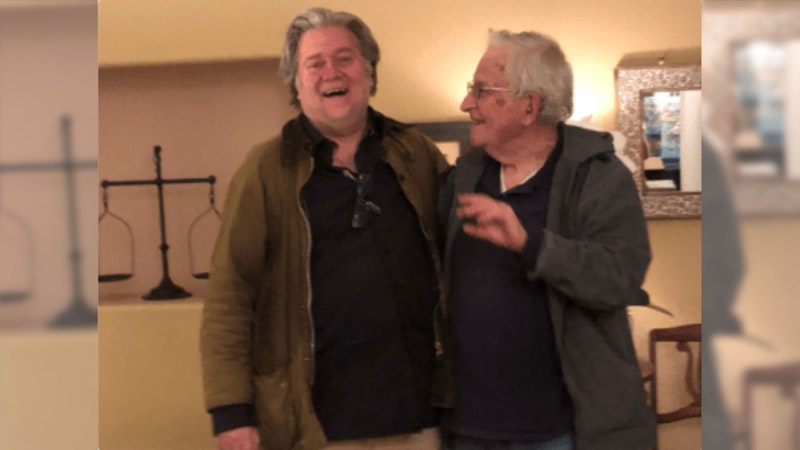
It’s difficult to know what was going on. It’s clear that they were close. There’s a mass of correspondence, some of it exceedingly warm. Much of it is financial, revealing an ongoing business relationship. Some of it’s social. They shared meals. Epstein paid for Chomsky’s hotel rooms. They flew together on Epstein’s private jet, the so-called Lolita Express, as evidenced by one often shown photograph, plus there’s an incriminating email which appears to absolve Epstein of his crimes, while blaming the victims.
The email is dated February 23 2019. It gives advice on how Epstein should respond to the growing outcry about his crimes. Chomsky tells Epstein to ignore it.
"What the vultures dearly want is public response, which then provides a public opening for an onslaught of venomous attacks, many from just publicity seekers or cranks of all sorts. That's particularly true now with the hysteria that has developed about abuse of women, which has reached the point that even questioning a charge is a crime worse than murder."
This is pretty damning. What’s he saying here? Is he diminishing the abuse of the women as mere “hysteria”? That’s a misogynistic word in itself, used historically to dismiss women’s concerns, but it’s clear from reading the email as a whole that he’s applying the term broadly. He’s projecting from his own life. He refers to “groups devoted to vilifying me,” and says that he pays no attention. “Venomous attacks”, from “vultures… publicity seekers or cranks...” is obviously a part of Chomsky’s everyday experience.
What this shows, at the very least, is a degree of unacknowledged misogyny. It’s embarrassing for those who, like me, have always held Chomsky in high regard, but it’s not a crime. There’s no suggestion that he ever participated in any of Epstein’s more repulsive activities. The bigger question here is, what was Chomsky doing hanging round with Epstein in the first place? How come the renowned Professor, reputedly one of the most intelligent people on the planet, was unable to tell that he was being groomed by a pedophile?
One of my observations is that the debate on this issue misses one key aspect of the relationship: the fact that Epstein was a psychopath. I wonder how many people have ever met one? In fact, they’re common. They tend to gravitate towards positions of power. Many of our politicians and billionaires show psychopathic tendencies. Not every psychopath is like Hannibal Lecter. They’re not all serial killers. Mostly they can appear perfectly normal.
As it says in Wikipedia: Psychopathy... is a personality construct characterized by impaired empathy and remorse, persistent antisocial behaviour, along with bold, disinhibited, and egocentric traits. These traits are often masked by superficial charm and immunity to stress, which create an outward appearance of normality.
The key word here is “charm.” Psychopaths are adept at manipulation. They know how to make you feel good. They know how to lie. They can put on a variety of masks. A psychopath is a predator: someone who’s able to hide in plain sight, still and self-contained, while waiting for the right moment to strike.
Chomsky was getting old by now. He was certainly vulnerable, as his recent stroke shows. He’d grown increasingly decrepit. There’s much that we don’t know. Things must have changed after the death of his first wife, Carol, in 2008. Meanwhile Epstein was running a Kompromat operation and Chomsky, as the leading public intellectual of the left, was an obvious target. There are some suggestive lines in the emails, jokes about sex, that imply that Epstein was already working on him, and an invitation to the notorious Island that would definitely have caused even more embarrassment. Epstein took photographs of everything. They were the currency of his trade.
None of this absolves Chomsky. It’s clear that he has undergone some sort of a shift in the years since 9/11. For instance, in 2021, during the Covid scare, he called for the unvaccinated to be coerced into isolation. "People who refuse to accept vaccines, I think the right response for them is not to force them to but rather to insist that they be isolated." There’s a contradiction here. How can you insist on someone doing something without forcing them? You can’t.
The tone is very un-Chomsky-like. It’s not the Chomsky I remember, the champion of free speech, who wrote an introduction to a holocaust deniers book, because he thought you shouldn’t suppress any idea, no matter how problematic. As he said: “If you don’t believe in freedom of speech for people you disagree with, you don’t believe in freedom of speech.”
But there’s another possibility: that Chomsky was a double agent all along, that he’s what the conspiracy theorists call “controlled opposition.” He refers to this idea himself. In his book, The Common Good (1998), he says: “The smart way to keep people passive and obedient is to strictly limit the spectrum of acceptable opinion, but allow very lively debate within that spectrum—even encourage the more critical and dissident views. That gives people the sense that there's free thinking going on, while all the time the presuppositions of the system are being reinforced by the limits put on the range of the debate.” Is he speaking from experience?
The death of Michael Parenti, in January this year, suggests that there could be some truth in this. Parenti was Chomsky’s main rival in the role of American dissident but, while Chomsky remained secure in his position at MIT for most of his life, hobnobbing with the establishment intelligentsia, Parenti was consistently blacklisted from university posts and struggled to make a living.
Both were critical of American foreign policy. The difference? Chomsky promoted a form of political organization called Libertarian Socialism, which currently doesn’t exist, whereas Parenti pointed to real and existing socialism, as it is practiced in countries around the globe.
So maybe that was Chomsky’s role all along: “to keep people passive and obedient,” to offer “more critical and dissident views,” “to strictly limit the spectrum of acceptable opinion.” In other words: to absorb people’s anger while diverting attention away from actual, real-world solutions.
I’m starting to think I might’ve been duped.


