
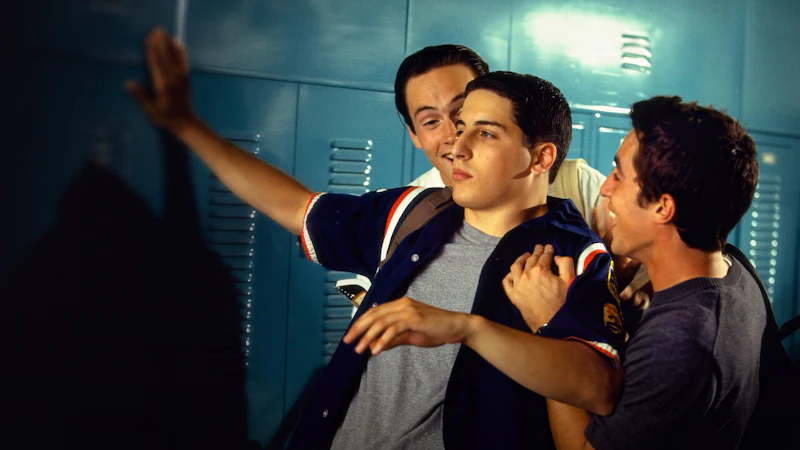
Unlike nostalgia cash-cows American Graffiti, Grease, and Happy Days, which were thoroughly Middle American, the teen sex comedy craze of the 1980s came straight from Italy. Porky’s and all of the films that followed were inspired comedia sexy all’italiana, a genre as tonally distinct from Hollywood cinema as Bollywood. Although some of these films were theatrically distributed in the 1970s (often starring Laura Antonelli or Edwige Fenech), they didn’t translate, despite being dubbed or subtitled. It’s not totally alien like anime, which was imported and successful as-is in America because it bears zero resemblance to anything in our entertainment or lives. The Italian sex comedies are distinct but still close enough to retain an uncanny valley quality, or enough of a hindrance that capped their commercial potential and cultural influence. Mocked by critics and without an audience, one country’s inescapable popular cinema becomes impossible to find elsewhere. Provocative and “arty” foreign films will occasionally make their way into North American theaters, right in time for awards season, intact but lacking the context of the country they were made in.
Rather than break even with flesh-filled Italian comedies, Hollywood embraced its own kind of raunch throughout the 1980s. People think of these films as juvenile, sexist, and stupid, which they are, but they also mistakenly attribute some malicious conspiracy meant to demoralize everyone who wasn’t an attractive and able-bodied straight white man. Porky’s and Losin’ It are essentially English language remakes of any number of comedia sexy all’italiana; it’s the John Hughes films that would prove more pernicious, as his highly personal movies were turned into teenage blueprints, his off-putting blend of conservatism and kooky perversion refashioned as something “universal.” Say you what you will about Porky’s and Losin’ It, but they’re more real than any of the Hughes films.
By the end of the 1980s, the teen sex comedy was dead along with horror; in 1996, Scream revived both genres and inspired Adam Herz to write Untitled Teenage Sex Comedy That Can Be Made For Under $10 Million That Most Readers Will Probably Hate But I Think You Will Love, which was shot under the title East Great Falls High in the summer of 1998, and released the following year as American Pie. It was an unexpected smash in a year of unexpected smashes; besides spawning nearly a dozen sequels, American Pie single-handedly revived the teen sex comedy in America. The genre wouldn’t recede again until Judd Apatow reared his ugly head with The 40-Year-Old-Virgin in 2005. The media once again confused personal, idiosyncratic work for “universal statements,” and Apatow’s own oafish misogyny was laundered not only through his own films but those he produced and championed through the second half of the 2000s.
The best teen sex comedies from the 2000s aren’t as grounded as American Pie or the Apatow films: Josie and the Pussycats, Scary Movie, She’s All That, Dude, Where’s My Car? all operate in a cartoon register without concern for the welfare of the youth of America. They are free, and much more fun than the circumscribed and circumcised Pie films.
American Pie tries to split the difference between sex-ed and sex jokes, and it doesn’t succeed. American Pie is one of those movies, like Saturday Night Fever, which isn’t remembered for its story, its characters, or even its dialogue, but images and one-line quotes. These are familiar to anyone who was alive in 1999:
“What does third base feel like?”
“Like warm apple pie.”
“McDonald’s or homemade?”
“This one time, at band camp…”
“She’s a M.I.L.F. — Mom I’d Like to Fuck!”
“We’ll just tell your mother that we ate it all.”
Add in Jason Biggs balls deep in an apple pie, the close-up of the ruined pie, Stifler (Seann William Scott), accidentally drinking cum, and Shannon Elizabeth stripping nude in Biggs’ bedroom while being webcast to the entire town. These moments endure in pop cultural memory, but the movie itself is not a well-regarded, oft-watched classic like Fast Times at Ridgemont High or Clueless. More than 25 years later, what’s striking about American Pie is how endearing the entire cast is in their first moments. This is what made the movie an enormous success: the character introductions are remarkably well-written, performed, and presented, and they immediately ingratiate the audience.
he opening scene, where Biggs masturbates to pirated Skinemax before interrupted by his parents, is second only to the pie-fucking scene. Chris Klein plays the same dumb but lovable jock that he played in Election, giving this quartet of friends some plausible deniability against the charge of NERDS! Thomas Ian Nicholas plays the most obviously relatable character in the movie, the good boyfriend still learning to take his time and mind his manners with girlfriend Tara Reid. He’s introduced playfully teasing Reid about her college admissions, and in his first close-up, he smiles wide and tells her, “You got in.” Nicholas, like the rest of the cast, didn’t go on to movie stardom, but he wins the audience over in that single shot. Ditto Eddie Kay Thomas, the “sophisticated” friend, introduced drinking “mochaccino” and reading the newspaper while wearing a corduroy blazer.
However, American Pie doesn’t fulfill its promises. The precision of those opening scenes is quickly replaced with a violent see-saw between after school special sex-ed and scatological humor. American Pie inspired many better films, but its lasting influence is in casting twentysomethings to play horny teens. None of the four male leads in American Pie are believable as teenagers. It’s merely funny now, but I found it really confusing by the time I reached high school. There was a basic dissonance in how we looked—why do we still look like kids? Because the movies got grown-ups to fuck in our place.
—Follow Nicky Otis Smith on Twitter: @NickyOtisSmith
