
Gore Verbinski’s Good Luck, Have Fun, Don’t Die is a twisty, audacious paranoid anti-AI thriller that takes its disparate source material—The Terminator, Black Mirror, Groundhog Day, Night of the Living Dead, Philip K. Dick—in unexpected and delightful directions. It’s also a simple-minded exercise in hectoring moralism which embraces moral panic because it’s too cowardly to engage with the forces steering us towards a bleak future. The combination of anarchic energy and glib sententiousness isn’t unheard of in Hollywood. But the whiplash from this effort is unusually abrupt and sustained.
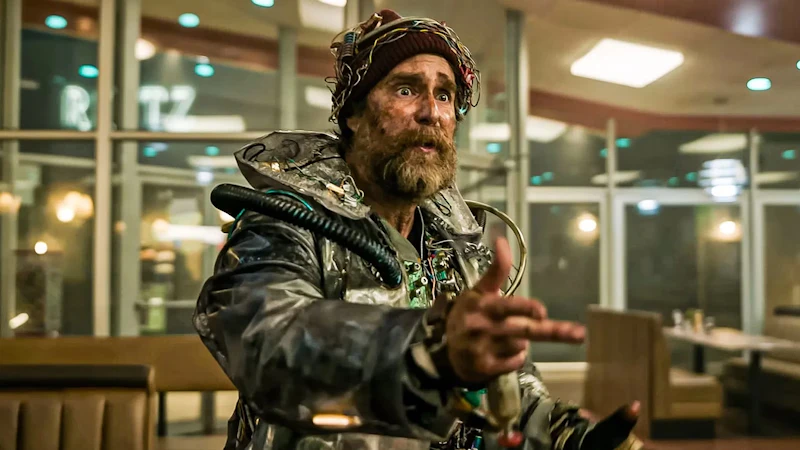
Part of the movie’s fun is that it has a series of interlocking and increasingly preposterous high concepts. It starts with a man in wild attire (Sam Rockwell) bursting into Norm’s Diner with a bomb and a plastic coat. He claims he’s from the future, and that he needs to pick a team from the patrons to prevent a nine-year-old genius from creating the singularity AI. If it wins, AI will attain sentience and destroy the world (shades of Skynet). He’s returned to this diner again and again, trying to find the right combination to save the world—but maybe this time he’ll get it right.
As the crew heads across the city, dodging cops, knife-wielding homeless guys, and pig-masked assailants, we’re witness to a series of absurdist flashbacks, involving zombie high school students in thrall to their phones, addictive virtual reality scenarios, and more.
Verbinski is charmingly willing to abandon narrative probability or even coherence in the name of absurdist satire, and when the movie hits it’s a cross between the Naked Gun films and Terry Gilliam. Perhaps the best sequence in the film starts with Susan (Juno Temple) discovering her son has been killed in a school shooting. The other mothers are weirdly blasé, and direct her to a secret cloning institute, which resurrects her son—or a boy who looks like her son. The awkward, painful crescendo of the riff occurs when a couple tells her their daughter has been murdered in shootings four times, and now they just have fun with the clone—programming it to be very tall, to tell jokes, to be Muslim. Susan watches their chuckling monologue them with mounting, frozen horror.
Susan’s flashback is effective because it captures American indifference to extreme violence—the way the same nightmare occurs over and over as our government shrugs and occasionally frowns ruefully. But the critique’s also toothless, inasmuch as it blames no one. This is a world in which school shootings are entirely disconnected from right-wing gun culture and the political paralysis it’s created around gun control. There are no villains here, except for a generalized refusal of reality, which is linked, not to a particular partisan death cult, but to a contentless embrace of technology.
That’s the approach of the film as a whole. The central metaphor is one of the ragtag crew of heroes, Ingrid (Haley Lu Richardson), who has a mysterious allergy to tech and Wi-Fi; her nose starts to bleed if anyone’s on the phone. Tech isn’t dangerous for anything in particular it does—spreading radicalizing content, allowing for innovative harassment, circulating disinformation. It’s just bad because it’s tech.
The importance of phones in recording police brutality, the way the internet can be a place for queer kids to find community, the huge amount of information that’s now at everyone’s fingertips—none of that’s acknowledged in any way. The man from the future’s initial (stock, tedious) rant about the dangers of tech includes a riff on how there are no bookstores and no record stores anymore, as if that means there are no books or music. But the fact is that people have access to more books and music than ever before in history.
I’m not arguing for some sort of techno-utopian vision. We’re in a high-tech era that’s not a utopia. But it’s a lot easier to blame teens for looking at their phones, or to blame moms for not disconnecting their kids, than it is to talk about billionaires allowing their platforms to be used for organizing genocide (as Zuckerberg did) or using their sites to spread horrifically abusive sexual material (see Elon Musk). Who has the power over our lives, digital and otherwise—a nine-year-old, or the oligarchs and their authoritarian fascist pals?
You could argue that the film is self-aware of its own limitations here. As it spirals towards its end, the movie explicitly discusses the ways in which AI, social media, and film all offer the same kinds of dopamine rush—high stakes, exciting adventure, moral clarity, happy endings. The distraction you’re watching is the distraction that’s critiqued; the movie warns about failing to engage with reality, and that warning applies to the movie itself, which (in the Hollywood tradition) refuses to engage with reality lest it say something that might make it a partisan target, or alienate potential viewers.
But self-critique doesn’t mean the critique isn’t justified. Maybe Verbinski will return again, like his man from the future, to these themes and find the courage to focus his substantial movie-making talents and considerable ire on the forces that’re dragging us towards servitude and apocalypse. Good Luck, Don’t Die, Have Fun is an entertaining exercise whose flash and glitter can’t cover up its lack of brain, flesh and heart.