
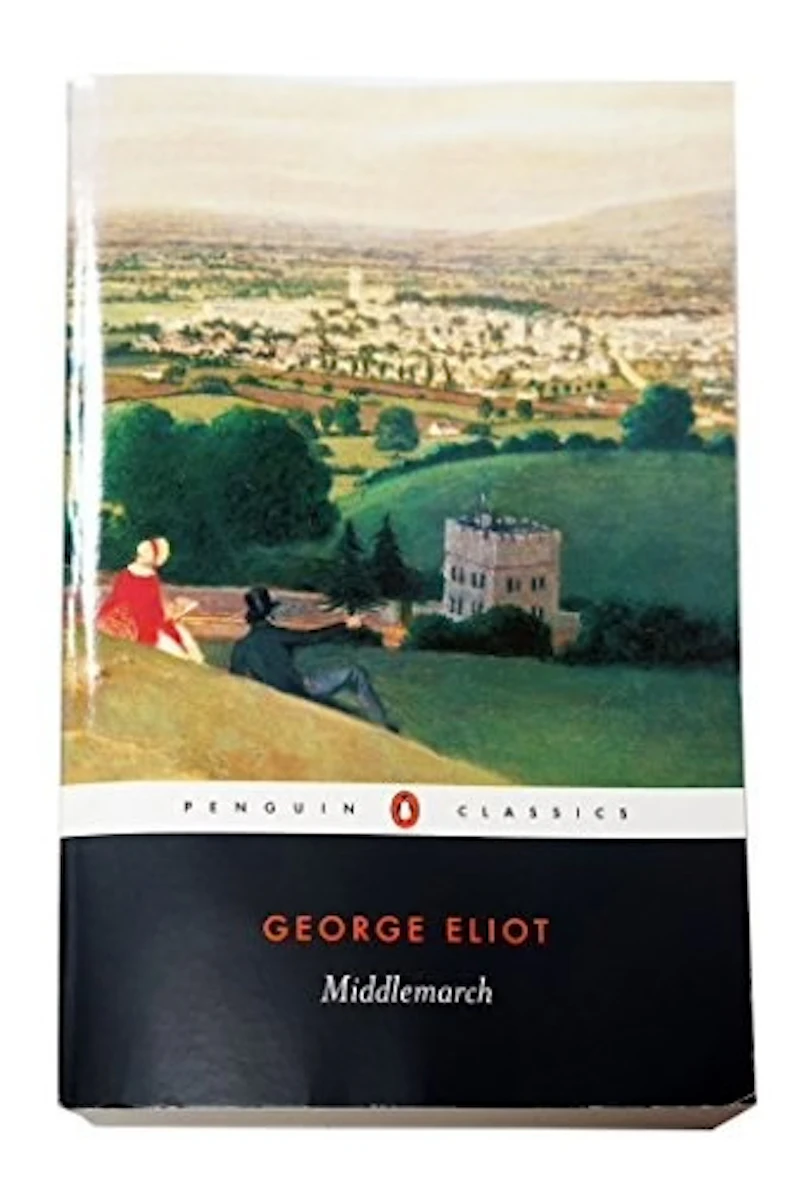
I’ve just finished reading Middlemarch. It’s a remarkable book: elegantly written, psychologically insightful, realistically imagined. It’s the second time I’ve read it. The first time was when I was a teenager, sometime in the late-1960s. It made as much an impression on me then as it does now.
In case you’re not familiar: it’s full title is Middlemarch, A Study of Provincial Life. It first appeared as eight instalments, from December 1871 to December 1872. It was written by George Eliot, the pen name of Mary Ann Evans. The story is that she chose a man’s name in order to be taken seriously. However, there were a number of highly regarded women writers in the 19th century, including Jane Austen, Mary Shelley, the Brontë sisters and Elizabeth Gaskell, to name but a few. It’s much more likely, then, that the reason she hid her identity was because she was involved in a scandalous affair with a married man.
She was a free-thinker, intelligent, independent and wayward in her manners. It’s said that, of all her contemporaries, only Dickens recognized that she was a woman. Reading Middlemarch, however, it’s obvious that she had to be female. No one but a woman could’ve written these characters with such clarity and depth.
Take Rosamond Vincy for instance. She’s beautiful but vain. She entrances the idealistic medical professional, Tertius Lydgate, whom she marries. She picks him, first because he is an outsider, but then because he has aristocratic connections. She’s obsessed by her position in the social hierarchy and imagines that Lydgate’s rank will raise her prospects. She’s spoiled and profligate in her spending. However, Lydgate is relatively poor and unrealistic about his financial situation. He gets into debt and tries to set a budget but, rather than going along with his attempts to rein in their spending, she undermines him at every turn.
In the battle of the sexes we see Rosamond as the stronger partner. He rages. She refuses. He tries to control her, but her will’s greater than his. She never raises her voice, but is quietly, gracefully stubborn. She reverses all of his moves behind his back and in the end he’s broken. He speaks of mastery but is a slave to her indomitable will. A strong man is brought low by the machinations of a frail woman.
And this is just one of the lesser plots.
All of the characters are beautifully drawn. The book’s laced with irony. The central character, Dorothea Brooke, a cypher for Eliot, while she’s intelligent, is also often mistaken in her judgment. I won’t give the story away. Let’s just say that reading the book I was often moved to shout at the page in frustration. As readers we can see what’s going to happen. We’re allowed an elevated position in the unfolding of the various scenarios, but unable to change the outcomes. There’s a relentless inevitability about the proceedings.
The book centers around income, status and property. Maybe it’s called Middlemarch because these are the middle classes we’re dealing with: their blindness and absurdity, as well as their humanity. There are a few yokels and the occasional maid or servant too, but these are secondary figures. You can’t help identifying with the characters. The book’s woven with tragedy and comedy, with the occasional bout of melodrama thrown in for effect. It’s a Victorian novel, after all. Mostly, though, it’s realistic, with insight into the psychology of small town life.
It’s also humane. Even the villains are drawn with a certain sympathy. No one is treated unfairly. Everyone is shown to be a human being, with their frailties and well as their strengths.
The book’s set earlier in the 19th century, in the 1830s, at the time of the Swing Riots, just as the railways are being built. As such it shows a world in transition, moving from a rural landscape into an urban one. We’re not told where Middlemarch might be, but, knowing the writer, we can guess that it’s Coventry, as this is where Eliot lived for much of her life.
It’s in the Midlands, in the middle of the country, not far from the geographic and industrial heart of the UK. This is where I come from. I was brought up in Birmingham, on the Coventry Road, about half an hour’s drive from where Middlemarch is set. My Uncle Robert still lives in Coventry. My cousin lives in Rugby. My Grandpa on my Dad’s side had a shop in Worcester. He was a tailor. My Nan and Grandad on my Mum’s side lived in Marston Green.
At one time, this whole area was covered in woods. It was known as the Forest of Arden. Shakespeare was brought up here, before he went to London to seek his fortune. He was a Midlander like me.
As a boy, living on the outskirts of Birmingham, I’d often cycle to Chelmsley Woods with my friends. I had an impression that this was literary country. The idea of a secret woodland haunt underlying the vast industrial city that occupied the land around me, stirred my youthful imagination. I saw myself in those terms: as a writer, from a place. I thought that the place was the Forest of Arden, the locus of my imagination, even though it barely existed in reality. Later the woods were concreted over to make way for a huge, sprawling council estate: the British equivalent of the ‘Jects. That was where many of my friends lived. It’s also where my youthful fantasies are buried.
I think this may be why Middlemarch has had such an effect on me: knowing that it was conceived and written near the places where I grew up. Even though the landscape would have been radically different in the 1830s compared to the 1960s, when I lived there, the inner life of its inhabitants are still recognizably the same. There’s a skein of humanity running from that time to this.
You can find Middlemarch on LibriVox read by Margaret Espaillat for free. It’s an extraordinary achievement. She hardly stumbles throughout the 35 hour-marathon. She has an American accent, but that doesn't hurt the story. I imagine that small town America isn’t so different from small town England. There’s also a 1994 TV series, available on the BBC.