
After Melaka, we took a car service to Malaysia’s capital, Kuala Lumpur, driven by Joe, a dark-skinned raconteur of mixed ancestry (his mother was cagey when asked who his father really was), who elaborated on Malaysia’s economy as he drove through the countryside, past rubber trees, palm trees and coconut trees. In KL, as the city’s called, we visited the Petronas Towers, the lighting of which was originally done by the late Howard Brandston, my wife’s mentor in the architectural-lighting field. It once was the tallest skyscraper in the world. Even higher is Merdeka 118, now the world’s second-tallest.
We flew into Phuket, Thailand, from Kuala Lumpur, on Air Asia, after reorganizing our luggage to accommodate the weight restrictions. We stayed in Khao Lak. This is a resort area that was inundated by the 2004 tsunami. My son competed in the International Geography Championships, and my wife and I were part-time moderators of quiz competitions or chaperones for group day trips.
Flying to Thailand, rather than going by car as we’d done from Singapore to Malaysia, may’ve been for the best. The Southern Thailand Insurgency is occurring in the historically Malay Patani region, on the eastern coast, off the Gulf of Thailand. If one’s going to cross the border by car, better to stick close to the western coast, off the Andaman Sea.
Khao Lak feels safe, and the people are very friendly, once one gets past the dour functionaries at the airport immigration section. In Thailand, it’s imperative never to say anything derisive about the royal family. The country has severe lèse-majesté laws, such that foreign offenders aren’t simply deported but rather placed in prison for several years.
The Thai greeting—sawasdee ka, if spoken by a woman; sawasdee khrap, if by a man—sounded like “swastika” to me and turned out to have a related linguistic origin in Sanskrit. The swastika’s long had benevolent associations in Hinduism and Buddhism, representing auspiciousness and good wishes, though the Nazis’ use of the symbol might’ve been a point of pride for the Thai nationalists of the 1930s, who developed the standard greeting (replacing an earlier one, “Have you eaten yet?”) and for a time made it compulsory.
It was also then that Siam became Thailand, a name evocative of nationalism, in that “Thai” translates as “free,” suggesting a country unified by language and religion (Buddhism), whereas “Siam” had origins in a Sanskrit word for “dark” or “brown” and was a name associated with its use by foreigners, though the country was never colonized.
Our hotel, the JW Marriott Khao Lak Resort and Spa, was excellent, with the “longest pool in Southeast Asia," where one can swim along connected paths for 2.4 kilometers. It has a beachfront on the Andaman Sea, where flags are red if waves are dangerous, yellow for caution, and green otherwise; a purple flag indicates “marine pests,” such as jellyfish. The water was wonderful, as were the meals and massages at the small businesses just off-site. The “night market” at Ban Niang is a cab ride away, offering excellent values in food and clothing; for my son, I bought a T-shirt emblazoned “Lord of the Dictators,” with Tolkienesque imagery of Vladimir Putin, Kim Jong Un, Xi Jinping, and Donald Trump.
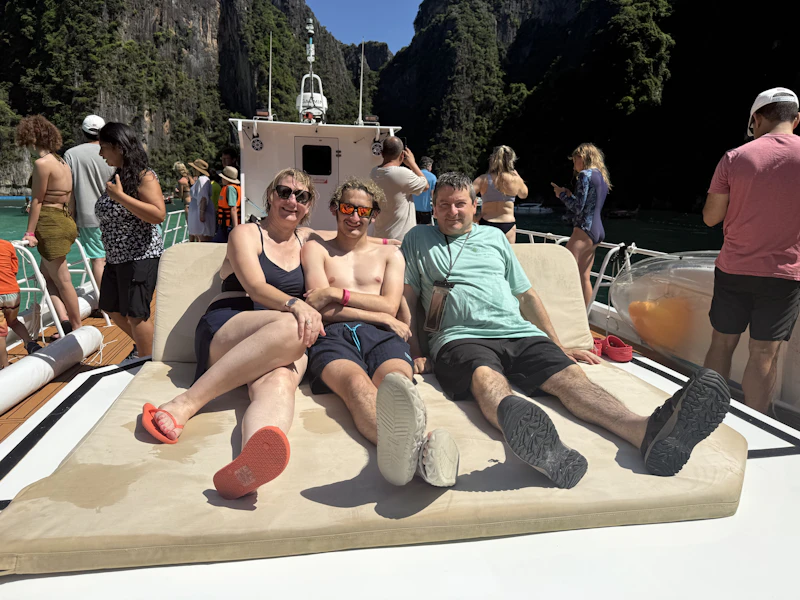
Day trips included boating to the scenic Phi Phi Islands, and, on the mainland, a morning of bamboo rafting and visiting a turtle sanctuary, which is located on a naval base.
The Phi Phi Islands (pronounced “pee pee”) are striking, notwithstanding that one sees their sights while surrounded by other tourists. On one island one looks for long-tailed macaques, preferably from a boat as they’re aggressive; a bite from them, carrying viruses and bacteria, necessitates a trip to the hospital (I never saw them). On another, one wades to the ankles at Maya Bay, while baby blacktip reef sharks swim nearby (I never saw them); this is where the Leonardo DiCaprio movie The Beach was filmed (I never saw it). I became violently ill, beginning on the drive back after disembarking, probably from something I’d eaten. Restrooms in the area, such as at gas stations, may or may not have toilet paper, offering instead bidets that shoot powerful jets of water. By the next day, I was feeling well.
Nature is close at hand in Khao Lak. On a bamboo-raft trip, the guide, rowing with two large bamboo shoots, will point out the venomous snakes curled above you in the trees. They’re not a threat, as they hunt at night. At the naval base, one visits the turtle conservancy and looks over pools in which the amphibians swim. A female turtle will have about 100 offspring, many of whom won’t survive, but this center keeps some safe to improve the odds. Older or injured turtles are cared for permanently, while younger ones will be returned to sea. Nearby are displays of two naval vessels, destroyed by the tsunami.