
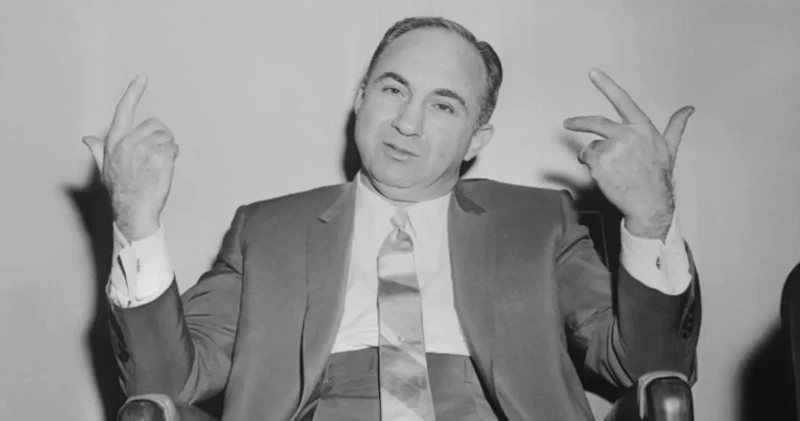
On the evening of February 5, 1950, Mickey Cohen and his wife Lavonne went to bed early in their Moreno Drive home in the Brentwood neighborhood of Los Angeles. Around four a.m., a henchman of gangster Jack Dragna placed 30 sticks of dynamite beneath Cohen’s front bedroom where Cohen typically slept. At 4:15, the makeshift bomb exploded. The entire neighborhood was woken by the blast as if an earthquake had struck. Cohen was lucky. He’d been sleeping on the opposite side of the house in Lavonne’s bedroom. The bomb was positioned beneath a concrete floor safe dispersing the blast. Cohen and Lavonne were unhurt though the explosion left a crater 20 feet wide and six feet deep.
The bombing of Cohen’s home wasn’t the first attempt on his life. He was beaten, shot and stabbed. He survived more than a dozen attempts throughout his career. What was his career? Mickey Cohen was a flamboyant and vicious mobster.
Though only 5' 5" tall, Cohen controlled the Los Angeles underworld for nearly four decades. Tabloids dubbed him “Public Nuisance Number One.” He embraced the media and loved seeing his photo in newspaper and magazine headlines.
Cohen was born in Brooklyn in 1913 the youngest of six children. His parents were Jewish immigrants from Russia who spoke little English. They moved the family to Los Angeles when Cohen was nine. Cohen turned to petty theft as a youngster including trying to rob a Boyle Heights theater with a baseball bat. He was sent to reform school where he learned boxing skills. At 15, he moved to Cleveland to become a professional boxer. He won his first fight and then lost his next five though they may have been fixed.
In Cleveland, Cohen met bootlegger Moe Dalitz. This was the time of prohibition and Cohen did small jobs for Dalitz until he was arrested for armed robbery. Cohen escaped to Chicago to work for the Chicago Outfit, a crime gang run by Al Capone. Capone sent Cohen to Los Angeles in 1937 to organize the Southern California rackets.
In Los Angeles, Cohen worked beneath gangster Bugsy Siegel, a boss of the National Crime Syndicate. Cohen established illegal gambling operations and ran mob-sanctioned card games. Cohen helped Siegel set up illegal sports books for the new Flamingo Hotel in Las Vegas. The two Jewish mobsters became close friends.
Cohen met and fell in love with prostitute Lavonne Weaver. The couple married with small-time gangster William “Stumpy” Zevon (father of rock star Warren Zevon) serving as Cohen’s best man.
As building costs soared for the Flamingo Hotel, Siegel incurred the wrath of the Mafia’s national crime syndicate. Siegel was shot dead while sitting on a couch in his girlfriend’s Beverly Hills home. The assassination was ordered by Meyer Lansky and Lucky Luciano and coordinated by Los Angeles mobster Jack Dragna.
Cohen was furious. Thinking the assassins were hiding in the Roosevelt Hotel, Cohen stormed the property and fired a .45 caliber gun into the ceiling. He screamed for the killers to meet him outside then fled the scene before the police arrived. The murder of Siegel made Cohen the de facto mob leader of Los Angeles.
Cohen’s methods were brutal. He relied on public acts of violence like drive-by shootings and bombings to intimidate foes. He ordered hits on his own gang members if they failed him or on rivals who infringed on his territory. He demanded “protection” money from local business owners. If someone refused, he used his boxing skills to beat them to a pulp.
Cohen’s biggest rival was Jack Dragna. This led to a long-running gang war between the two mobsters. Dragna orchestrated numerous attempts on Cohen’s life.
On August 18, 1948, Cohen and three bodyguards gathered inside Cohen’s haberdashery on Sunset Boulevard. Three gunmen, including Jimmy “The Weasel” Fratianno, stormed the store and began shooting. Cohen’s bodyguard Hooky Rothman was killed while the other two were wounded. The shooters tried to find Cohen, but he was nowhere to be seen.
Cohen’s pathological fear of bacteria saved his life. When the shooters arrived he was in the bathroom soaping his hands obsessively. He hid in a stall until the shooting stopped and emerged unharmed. Cohen was a germaphobe who washed his hands as much as 50 times a day. He disposed of his clothes after wearing them only once.
Cohen made efforts to appear legitimate. He owned restaurants, jewelry stores, flower shops, clothing outlets and a fleet of ice cream trucks. He befriended politicians and gave large donations to political campaigns. In 1946, he befriended Richard Nixon and helped the future president win his first Congressional campaign. He became friends with evangelical Billy Graham and newspaper publisher William Randolph Hearst.
Cohen hobnobbed with celebrities like Errol Flynn, Lana Turner and Frank Sinatra. When black performer Sammy Davis Jr. dated white actress Kim Novak, Columbia Pictures president Harry Cohn hired mobsters to threaten and intimidate Davis. Gangster Johnny Roselli wanted to break Sammy’s legs. Cohen intervened. He protected Davis from a brutal beating and then convinced the performer to marry black singer Loray White in a sham wedding. This quelled the controversy.
In 1947, Cohen helped screenwriter Ben Hecht raise money for Zionist causes to support Israel’s efforts to become a nation. At a fundraising benefit at Slapsy Maxie’s Café, Cohen ordered armed mobsters to stand around the audience as speakers asked for financial support. The meeting raised $200,000. The Hebrew Committee for National Liberation gave Cohen a silver cigarette box with the engraving “In Gratitude, to a Fellow Fighter for Hebrew Freedom.”
In 1951, Cohen appeared before the Senate’s Kefauver Committee investigating mob influence in America. Cohen arrived in a bulletproof Cadillac wearing flashy clothes. He portrayed himself as a down-on-his-luck tailor struggling to make a living. The committee wasn’t convinced and indicted Cohen for tax evasion. He spent four years in prison.
Freed from incarceration, Cohen agreed to a television interview with journalist Mike Wallace. Cohen told Wallace, “I have killed no man that in the first place didn’t deserve killing.” Cohen said he was trying to go straight but Los Angeles Police Chief William H. Parker made it impossible for him to make a living as a florist. Cohen called Parker a “sadistic degenerate.”
Police and federal authorities put pressure on Cohen and his money-laundering businesses. He was again indicted for tax evasion in 1961 and sent briefly to Alcatraz before serving time at the Atlanta Federal Penitentiary. In August 1963, Cohen was attacked in prison by an inmate with a lead pipe. His injuries included a crushed skull and brain hemorrhaging. He was in a coma for two weeks while doctors performed surgery to insert a steel plate in his head.
The beating left Cohen partially paralyzed and permanently disabled. Upon his release from prison in 1972, he sued the U.S. government for $10 million for failing to protect him in prison. He won a verdict of $100,000 but the money was seized by the IRS as payment for back taxes.
During his prison time, Cohen was diagnosed with a stomach ulcer. Doctors later determined the ailment was actually stomach cancer. He endured several stomach surgeries but his health diminished. He died in his sleep in 1976 at 62. He was buried at the Jewish Hillside Cemetery in Culver City.