
A strange synchronicity happened on Sunday. This year I’ve been making my way through The Simpsons from the start, and was watching the last two episodes of Season 15 so as to return the discs to Beyond Video and get the next set. Those final two episodes of Season 15, “The Bart-Mangled Banner” and “Fraudcast News” involve, respectively, Bart accidentally mooning the American flag (causing the denunciation of Springfield as un-patriotic) and Mr. Burns buying up every news outlet in town to launder his image. The spread-eagle psychosis of the town is eventually broken in the former, and the latter episode ends with Burns pondering, “I guess it’s impossible to control all the media. Unless, of course, you’re Rupert Murdoch. He is one beautiful man.” Smithers agrees, as the pair look directly into the metaphorical camera.
It’s a good joke, in part because Murdoch doesn’t really own all of the media. As of 2026, Fox is only a partial owner of the IndyCar series.
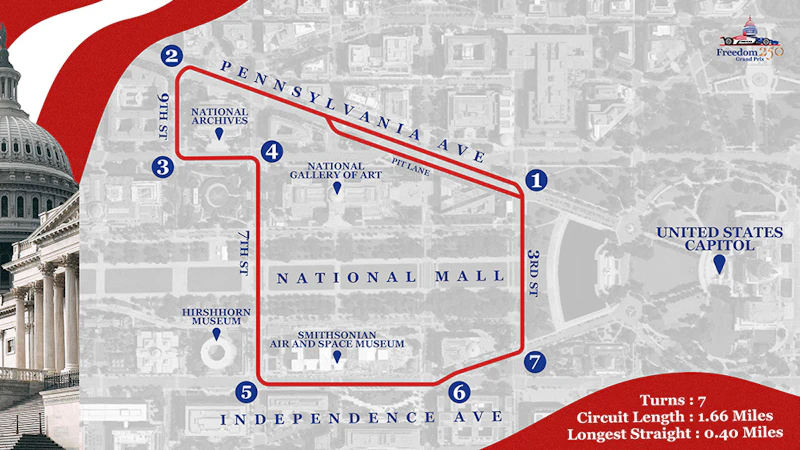
The idea of a “Freedom 250” where race cars would zip down the National Mall is the kind of gauche, childish idea that’s become a staple of the second Trump administration. But in a year where a UFC fight was held on the White House lawn, it’s not so strange that another one of America’s premiere sporting leagues should also take to the streets of Washington. What’s bizarre is the selection of IndyCar, specifically; although, it’s unlikely this race would’ve been considered for any other series, even its more popular younger cousin, NASCAR.
It’s no secret that Trump is at least a passing fan of IndyCar, from his many references to the series’ flagship 500-mile race to even his featuring of Mario Andretti on The Apprentice. Like his affection for Broadway or how often he plays Sunset Boulevard on Air Force One, it’s another bit of out-of-touch interest that shows the President’s age—very few people younger than Boomers would remember that IndyCar was once America’s most popular motorsport, and fewer still would fight for its return to the forefront.
But here, in 2026, IndyCar did something that no other racing series has done before, and took the streets of DC. And it went well. The weekend prior at the new street track in Markham, Ontario began with practice sessions cancelled because the track wasn’t completed, and most were expecting a similar situation if not worse. Locals complained about traffic delays in downtown, and many—rightly—pointed to the endeavor as a vanity project for Trump. On the face it is, and it likely would’ve only happened through the virtually unchecked power of his pen (Trump claimed that Roger Penske has tried to get a race to DC 211 times, which may be a completely farcical number, although there’s truth to Penske’s efforts over the years).
Via Trump’s executive order, and the fact that most of the track is controlled federally and with few businesses to consider on the edges of the layouts, setting up a race here was arguably easier than in other cities. If anything, the race organized so quickly and without any noticeable hitches (besides the unfixable crosswalk bumps which became a staple of the race) is a testament to the professionalism of IndyCar and Penske Entertainment compared to, say, the hucksters that organize UFC events. Maybe it shouldn’t be such a surprise given that series owner Roger Penske made his fortune in logistics.
Penske and Trump represent a notable divide in modern conservatism. There’s Penske, the old-school businessman, the type who makes his fortune by getting things done. And Trump, whose entire worth is valued off the perception of his brand’s prestige. If anything’s indicative of Trump’s second term, it’s the systems failure of replacing experts with pundits, bureaucrats with self-styled and sycophantic idea men. These are loud talkers, but not particularly effective because they don’t really know what they’re doing, they just know how to sell it. Penske, then, is the perfect partner for Trump (and vice-versa), because Penske’s an arch-conservative and ardent nationalist who successfully runs a logistically complex business that’s in desperate want of advertising. While they won’t splurge for much more than AI art, they do get immeasurable marketing by tying themselves to the most famous, infamous man in the world.
It's a devil’s bargain (and one that people thought would make the monkey’s paw curl sooner), but so is the entire history of motorsports. It was still this century that a former member of the SS and the son of the founder of the British Union of Fascists were duking it out over control of the FIA. Take one look, too, at prominent people spinning around the Indianapolis Motor Speedway in the interwar years, and you’ll find that the Brickyard used to be a hotbed of support for the America First Committee. No matter how hard motorsports tries to decouple itself from its past, the legacy of 20th-century fascism will always be tied to it because they’re not just kindred in their thematics and aesthetics (see: Paul Baxa’s Motorsports and Fascism for a detailed study), but are practical to each other. The fusion of the state with capitalist industry makes it easy to put on a motor race: it streamlines permits, and keeps manufacturers sharp. It builds a good national myth, where a German car or an Italian team or an American driver can bring glory back to their country.
Yet that nationalism proved at one point to be IndyCar’s downfall: in 1994, then-IMS owner Tony George announced that he’d form the Indy Racing League, which would exclusively race on ovals and combat how he thought CART was becoming too international of a series when he believed Indy driving should be America first. Even though the two reunified in 2008, the damage had already been done, and IndyCar’s popularity has never recovered from having two dwindling series be overtaken by the NASCAR boom.
At the Freedom 250, everyone from IndyCar to DC to Trump got what they wanted. The race went off without a hitch (well, there were plenty of Yellow flags, but that’s part of going racing) and, as P2 finisher Christian Lundgaard noted, “It’s fitting that an American won.” The bootstrap-pulling street circuit specialist Kyle Kirkwood managed the victory. It was good to see the fight come down to him and Lundgaard given that they’ve been the two most exhilarating drivers to watch all season, and it's better to see them go for the top step of the podium rather than scrap way behind Alex Palou who, despite qualifying on the pole, had an uncharacteristically mistake-ridden race that would lead him to finish last, holding onto a couple of points rather than wrapping up the championship fight that day.
Kirkwood may have been a perfectly inspiring winner, and the commentators made sure to note that the Andretti driver had to win to get every race seat he had because otherwise he wouldn’t have had the funding to keep going. And he did win, toppled the junior formulas and continues to take victories at the highest level of American open-wheel racing. But in that is also the darker truth, that the system is built up by benefactors, that no wheels are hitting the track without sponsorship, that all of the achievement was for someone else, whether that’s a matter of nationalist pride or money, or, more likely, some combination of both.