

A look at a map, or an aerial photograph, makes Gravesend stick out: the original town was first settled in 1643, making it not only the oldest settlement in Brooklyn, but the oldest in Long Island, and the original town’s square shape hasn’t been compromised as Brooklyn grew up around it. It’s either named for a town in Britain or derives from a Dutch name, s'Gravenzande or s'Gravensande, so named by Dutch provincial governor of New Netherland William Kieft, who donated a small tract of land in what became Gravesend to a British immigrant, Lady Deborah Moody, and her son, Sir Henry, in 1643. s'Gravenzande means "The Count's Beach" and may have been named for Henry; perhaps it was named for Kieft's birthplace on the Maas River in Holland.
The original map of Gravesend, as laid out in the mid-1600s, is a square with a cross in the middle. This original street layout is still in place, not obliterated by Brooklyn’s overlaying street grid. The square is Village Road North, South and East and Van Sicklen St., and the cross is formed by McDonald Ave. and Neck Rd., which originally extended to today’s Marine Park area, which was then a wide peninsula or “neck.” McDonald Ave. was extended north and south over time; by 1873 it had reached north to Parkville and Kensington. In 1933 it was retitled McDonald Ave. in honor of a Kings County court clerk.
Lady Deborah Moody, a widow in her mid-50s, arrived in Gravesend in 1643. She was granted a town patent by Kieft that permitted adherence to any church, a novelty in an age of religious fervor. Lady Moody, an Anabaptist (a sect that rejected infant baptism in favor of adult baptism) found the climate in England oppressive and sailed for the Massachusetts Bay Colony in 1639; finding the Puritans there hardly accommodating, she founded Gravesend in 1643. The Native-Americans destroyed the new settlement before it got a permanent foothold in 1645.
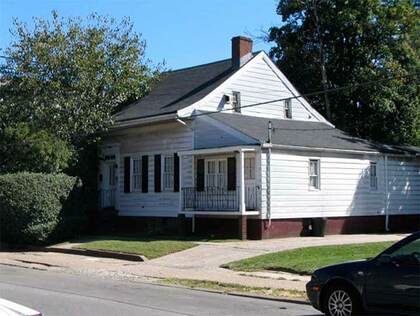
The purported Lady Moody House, #27 Gravesend Neck Rd. west of McDonald Ave., dates to either 1665 or 1770, depending on which account you believe. Brooklyn historical records have Sir Henry Moody, Deborah Moody’s son, selling the property on which the house stands in 1659 to Jan Jansen ver Ryn. It passed through various hands before winding up with the Van Sicklen brothers, John and Abraham, who may also have built the house in the early- to mid-1700s.
In 1904 the house, now a private residence, was acquired by realtor William Platt who renovated it in the Arts and Crafts style and spread the word that the house had been owned by Deborah Moody. It’s an old house that occupies the plot where she lived, but it was likely built decades after her death. During one of the very successful Forgotten New York tours, over 40 Forgotten Fans gathered at the house in June 2019.
The Landmarks Preservation Commission has done a poor job in protecting the area’s oldest dwellings. During my time chronicling the neighborhood over the last 27 years, it has lost at least five historical properties. One was the Ryder-Van Cleef House, constructed in 1840 by Lawrence Ryder, which stood at 26 Village Rd. north before it was moved to #38 in 1930. A Ryder daughter married a Van Cleef, giving it a hyphen. Village Road North has unofficially been called Ryder Pl. in the past, and many Ryders have lived in the area. Ryder St. in Marine Park, Ryder Ave. in Midwood, and a now-vanished road also in Marine Park named Ryder Ave. attest to the influence of the Ryders in Kings County in a bygone era. After the Landmarks Preservation Commission declined landmark designation because the 1920s relocation and later alterations compromised its historic integrity, the property was sold to developers and demolished in early-2023.
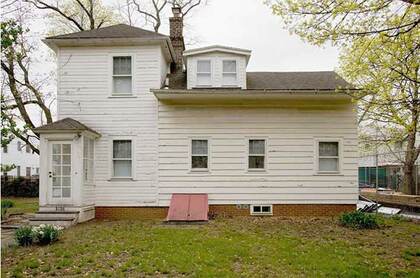
One success in preservation is the Samuel Hubbard House, which may now justifiably be called the John Antonides House, at #2138 McDonald Ave. north of Avenue T. The right side of the house was built in the early-1800s (some researchers say late-1700s) and was originally occupied by Nelly Hubbard and her son Samuel.
The house was purchased by Vincenzo Lucchelli in 1904—he added the ell on the left side of the house in 1924. Lucchelli’s daughter Theresa occupied the house until her death in 1997, by which time the house was in bad repair. Antonides purchased it, renovated it, and was rewarded when the Landmarks Preservation Commission landmarked it in early-2009, assuring the old place an even longer life.
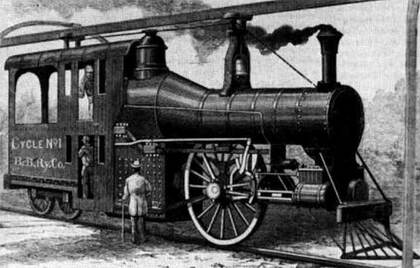
Photo via Ephemeral New York
Hidden histories abound in New York City’s street names. In Gravesend, a one-block street, Boynton Pl., connects W. 7th St. and Ave. X between 86th St. and the MTA’s Coney Island Subway Yards. Its location at the trainyards isn’t serendipitous. Eben Moody Boynton was an entrepreneur and inventor in the first decade of the 20th century. Though railroads had already been in common use for nearly three quarters of a century at that time, experiments with their efficiency were ongoing. It was Boynton’s idea to reduce the loads carried by traditional tracks laid on the ground by placing one track on the ground and another track overhead, resembling a monorail but with two tracks instead of one. Boynton claimed such an arrangement would enable trains to run at the unheard-of (at the time) speed of 60 miles per hour. An experimental locomotive and trainset, as well as tracks, were constructed in the Coney Island grasslands. Critics dubbed Boynton’s creation the “Flying Billboard” since the loco and passenger cars were only four feet wide, as well as the “Bicycle Railroad” for its one row of wheels. His train did exceed 60 MPH, but he was never able to obtain enough backing to expand. Rails from the experimental railroad later replaced those on the nearby Sea Beach line (today’s N train). The Flying Billboard is remembered by Boynton Pl., which reportedly is in its old right-of-way.
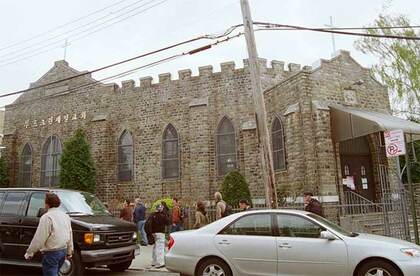
The handsome brick church, the first address on Gravesend Neck Rd. at the SE corner of Van Sicklen St., was once home to the Reformed Dutch Church of Gravesend, with the original church built a block away at Gravesend Ave. in 1833. A new church was dedicated here at 14 Gravesend Neck Rd. in 1900, but changing demographics, with more Roman Catholics from southern Europe moving into Gravesend, crimped the Reformed Church’s patronage, and services were discontinued in 1914.
A new church was founded on the site using the same building in the 1920s by Italian Pentecostals. In 1937, the church hired architect R.T. Schaeffer to construct a new building, the one seen here today. According to local legend, Belgian blocks from surrounding streets were used for the church walls. After the Coney Island Pentecostal Church moved out in 1979 to a larger building on Neck Rd. and E. 1st Street, the First Korean Church of Brooklyn moved in, and maintains the building today.
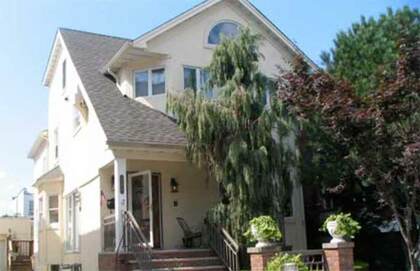
2340 E. 2nd St. south of Ave. W was constructed in 1903-1904 as part of the Wood, Harmon and Company development known as South Marlboro. The development was a mixed success and was only partially developed as late as the 1920s. 2265 Ave. W, just west of E. 2nd, was also a part of the development. The Marlboro name survives in the Marlboro Houses on 86th St. between W. 8th and W. 11th Sts.
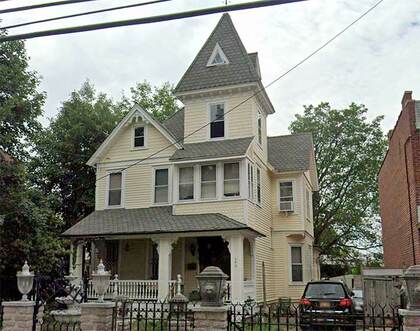
This distinctive peaked building on Van Sicklen St. north of Gravesend Neck Rd. underwent a restoration, with 1890s-era style fish-scale treatments replacing the plainer aluminum siding that had been there for many years. The house belonged to the final mayor of Brooklyn, Frederick W. Wurster (Brooklyn narrowly voted to join the Bronx, Staten Island and Queens in forming Greater New York in 1898).
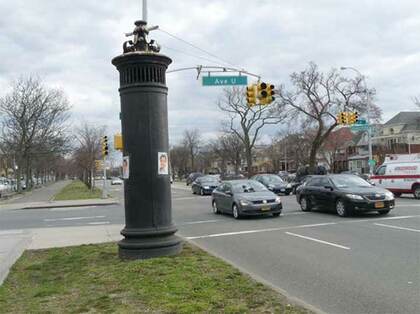
No doubt a lot of motorists traveling north of Ocean Parkway wonder what this object is on the NE corner of Ave. U. I’d long suspected it was a massive vent of some kind. Oscar Israelowitz, in his Flatbush Guide, finally provided the answer: it’s the air vent for a sewage pumping station beneath that intersection.
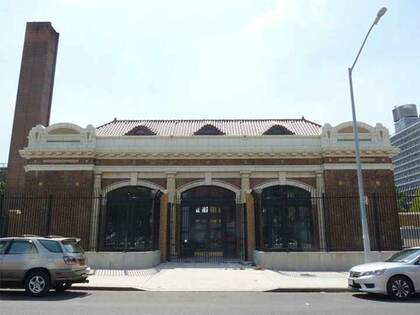
That’s not the only sanitation-associated architectural highlight in Gravesend. Standing on Ave. V just west of 86th St. in Gravesend is one of NYC’s few decorative structures associated with its sewers. It resembles one of the Beaux-Arts subway entrance buildings designed by Heins and LaFarge back when the subway originally opened in the first decade of the 20th century. The Ave. V Pumping Station was constructed between 1911 and 1916, at the tail end of the Beaux Arts era, designed by architect Albert A. Martin and was eligible for NYC Landmarks designation in 1998. It was given a $210 million restoration in 2015 that repointed the brickwork and touched up its terra cotta trim and Spanish tiled roof.
The renovation wasn’t limited to the exterior. More importantly the upgrade added to the capacity of the station capacity to pump 80 million gallons of sanitary and stormwater flow to the Owl’s Head Wastewater Treatment Plant in Bay Ridge each day, more than 150 percent more than it could before the upgrade. The station’s upgrade also adds to the hope that the brackish, polluted Coney Island Creek will someday be cleaned up, as is the hope with Gowanus Canal and Newtown Creek.
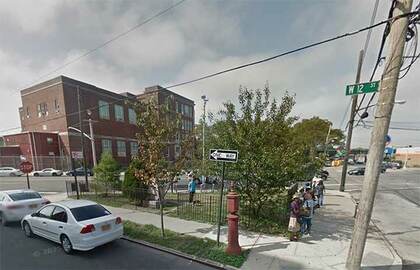
The triangle formed by 86th St., Ave. U and W. 12th St. is dedicated to Antonio Meucci (1808-1889), who invented the telephone. Alexander Graham Bell, you say? He perfected the telephone for voice transmission, but it was Meucci, as long ago as the 1850s, who invented the first device that transmitted sound over copper wire from one location to another.
Meucci was one of those tragic figures of history who had the right idea at the wrong time or place. He obtained a patent in 1871, and renewed twice more after that, but failed to renew in 1874 when he couldn’t produce the $250 filing fee. He died in poverty in 1889. His Staten Island home is now a museum. In the 1850s he hosted his good friend there, the Italian unifier Giuseppe Garibaldi.
—Kevin Walsh is the webmaster of the award-winning website Forgotten NY, and the author of the books Forgotten New York (HarperCollins, 2006) and also, with the Greater Astoria Historical Society, Forgotten Queens (Arcadia, 2013)