
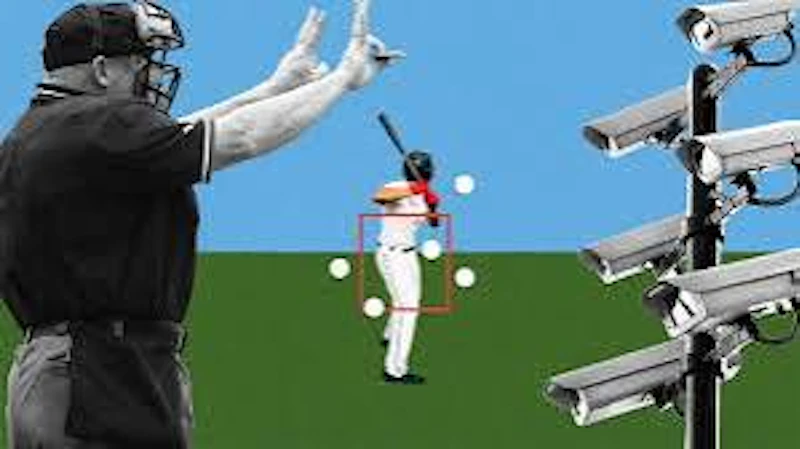
Kyle Schwarber stepped into the batter’s box the other night looking like every Phillies fan has felt lately: frustrated, searching, hoping one good swing might bring the team back into the groove again. The pitch came in. He didn’t swing. Instead, he tapped his helmet. For a few seconds, baseball paused while Major League Baseball’s new Automated Ball-Strike system decided whether the home plate umpire had gotten it right.
An automated set of balls is exactly what was happening in that moment since everyone watching knew the pitch was a strike, since we all have eyes. But what gets me is how instinctive that ironic double-tap gesture has already become. Faced with an unfavorable judgment, the first response is no longer acceptance, a whiny little-leaguer tantrum-face towards the umpire or simply the game moving on to the next pitch.
It’s an appeal to a machine.
That little tap on the helmet has become one of the defining images of baseball’s newest era, and I wonder if we’ve lost something more valuable than a missed strike call.
A terrific recent New York Times essay by J.R. Moehringer, “Can We Keep One Small Corner of America Technology Free" captured this “strike three and you’re out, human race” unease. He wrote that “robot umps will soon decide every pitch of every ballgame, and human umps will be reduced to costumed extras, shambling around the periphery like Cicil War re-enacts, only creepier and less relevant,” and simply that baseball “was never meant to be perfect.” His essay is nostalgic, funny and delightfully grandiose, but beneath the wit is a serious question: Does everything need to be optimized?
Supporters of the ABS make compelling arguments. MLB has repeatedly described the challenge system (which they constantly note is sponsored by T-Mobile because God knows selling the sponsorship like selling out diamond real estate is what matters) as a compromise, preserving the human umpire while allowing obvious mistakes to be corrected. The league says the goal is to improve accuracy while adding “a fun new layer of strategy.”
Baseball writer Tom Verducci argued the challenge format strikes a balance between tradition and technology, noting “If you get a kick out of Yankees manager Aaron Boone blowing a gasket, I guess you’ll miss his rants directed at the home plate umpires.” Reuters reported during the All-Star break that players including Dylan Cease embraced ABS not simply because of greater accuracy but because they enjoyed the strategic element of deciding when to challenge. "I think it's entertaining," Cease said at the MLB All-Star Game press conference. "I like it when it goes my way, and I don't like it when it doesn't. I think it's entertaining, and it's just one of those where I've kind of just accepted it is what it is, and I thought it's been kind of nice."
ESPN’s Jeff Passan is even more enthusiastic, arguing “just like with the pitch clock, the advent of robot umpires did not break Major League Baseball,” and further that, “not only does ABS work, it makes the game better.”
These aren’t strange opinions, and fans are probably right about one thing. ABS almost certainly produces a more accurate strike zone.
Baseball has followed me around for most of my life. I earned a varsity letter as my high school’s baseball manager after managing my younger brother’s teams. Years later, my husband coached our son Bobby while I managed his teams. I did time sweating inside the costume of the Orioles’ farm team mascot uniform. And today, my son is a professional umpire. I love this sport. Which is why I keep asking the question: what problem are we actually trying to solve?
MLB’s own numbers show home plate umpires correctly call balls and strikes roughly 94 percent of the time. Think about that. They stand behind home plate judging a baseball traveling close to 100 miles an hour through an invisible strike zone that changes with every batter’s stance. When did 94 percent become failure?
We’ve become a culture that mistakes optimization for progress. If an app can save us three minutes, we’ll download it. If an algorithm can shave off one percent of human error, we’ll celebrate it. Somewhere along the way we began believing every disagreement has a correct answer waiting to be revealed by a screen. Baseball never worked that way.
The strike zone has always been part science and part judgment. Researchers at Cornell described it as a “social construct,” a point Moehringer wisely highlighted. That’s why fans argue and managers explode out of the dugout. It’s why catchers frame pitches and pitchers try to paint the corners. The strike zone is called a zone for a reason: it’s always existed in that fascinating gray area where reasonable people disagree. It’s not a defect to be fixed: it’s baseball.
Watching my son develop from a great player in high school to an umpire gives me an appreciation for a job most fans (and hysterical travel league parents) never think about until they’re angry. Umpires spend years learning the rulebook, traveling endless miles, and making split-second decisions while masses of people enthusiastically inform them they’re blind. Most fans remember the one pitch an umpire missed. They forget the other 200 he nailed. Sometimes he misses one. So does the shortstop, the cleanup hitter, and the manager who leaves his starter in one batter too long.
Baseball’s always acknowledged human imperfection. It’s the only major sport that keeps score of its mistakes. Every box score includes an error column. The game doesn’t hide flaws. It records them permanently, shrugs because no one’s perfect, and tells everybody to come back tomorrow to play ball. The advocates of ABS are right: the technology makes the strike zone more accurate. But accuracy isn’t the only value worth protecting. Tradition matters. So does accepting that human beings get things wrong. You don’t tap your helmet because your boss misunderstood you. You don’t ask a computer to review an argument with your spouse or overturn a decision that didn’t go your way.
Baseball has quietly prepared us for reality for more than a century. And it’s always evolved. Night games, free agency, instant replay and the pitch clock changed the sport in different ways. Not every innovation is an assault on tradition. But I agree with Moehringer: not every innovation belongs between the white lines, either. At least not in any expanded way, which is what my concern would be about the technology. It’s one thing to have it, it’s another to let it replace the beauty of imperfection in human error.
Give me the occasional blown strike-three call, hot-headed manager kicking dirt on home plate, cacophony of fans booing in unison, and arguments we’ll still be talking about over breakfast the next morning.