
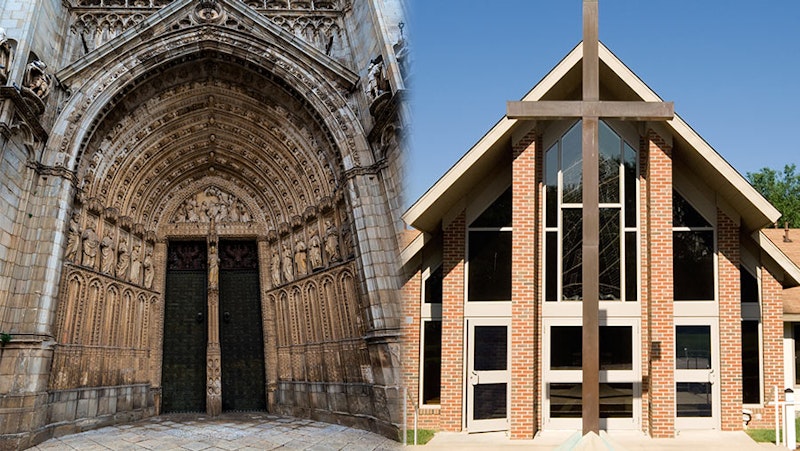
"Catholicism is the most aesthetic religion" and "the most beautiful religion" are among the sentences that appear most frequently on X, usually above an image of a cathedral interior or a bishop, cardinal, or pope in clerical vestments. One can directly see what they mean. Catholicism's emphasis on beauty is proverbial and conscious in a way the aesthetics of some other denominations isn’t. And there’s a particular aesthetic involved, variously interpreted through the centuries and across the globe: rich, elaborate, teeming with images, emphasizing red and gold. (At the outside, we might point to the "hyper-baroque" or the Churrigueresque, the most maximal aesthetic ever deployed spiritually.)
Many people whom I've talked to say they’re Catholics at least partially because of the experiences of beauty they associate with it, and (for example) the great aesthetician George Santayana described himself as an atheist and also as "an aesthetic Catholic." He went to church on Sunday despite his apparent lack of belief. But on occasion, I imagine, the beauty of Catholic cathedrals and ceremonies has led people toward conversion experiences.
It’s a relatively familiar point that one of the driving factors in the Protestant reformation of the 16th and 17th centuries, which ripped Europe apart, was partly driven by a rejection of Catholic aesthetics, or even a rejection of aesthetics as a whole. All over northern Europe, Protestants engaged in iconoclasm, destroying statues and paintings, stripping churches and cathedrals of their decorations.
Protestant spearhead Martin Luther didn’t recommend this, but he called the Catholic Church "the whore of Babylon" and accused it of seducing people into sin with its "cosmetic arts." He decried the expense that the Vatican was incurring during the Renaissance, of building and decorating St. Peter's Basilica, for example. The poor were starving, Protestant leaders pointed out, as Popes commissioned another fresco by Michelangelo or Raphael. People like John Calvin and Andreas Carlstadt directly advocated destroying the Catholic conception of beauty.
Protestantism, even now, seems to many people (in particular, Catholics) an anti-aesthetic spirituality, opposed not only to luxury and vanity, but to beauty and the profound experiences to which it can lead. Protestantism tried to delete the aesthetic aspect of spirituality, a kind of aesthetic asceticism or mortification of the flesh, an association of all forms of human pleasure with sin: a grim and joyless religious development focused on self-denial and punishment.
There were some extreme Puritans who believed all of that, and designed their churches, outfits, and accessories with anti-aesthetic values in various ways. But whether they did it consciously or not, Protestantism developed its own standards of beauty. Partly because of its conscious rejection of Catholic aesthetics, Protestantism deployed its own standards of beauty. I’d think of the stripped-down meeting houses of radical Protestant denominations such as the Quakers and the Mennonites as deploying an equal and opposite standard of beauty and its relation to spirit. The minimal aesthetic of Shaker furniture, for example, isn’t opposed to beauty: it’s a form of beauty, one which has made its way into the Metropolitan Museum. If Michelangelo's Sistine Chapel is a directly aesthetic evocation of spirituality, so is the worship room at the Arch Street Friends Meeting House in Philadelphia, which is entirely unadorned, and in which the worshippers sit on plain benches facing one another, rather than rows facing a central image, altar or priest.
The stripped-down aesthetic of Protestantism is reflected in the extremely influential art movement of the 1960s known as minimalism. Artists such as Donald Judd and Agnes Martin made objects emphasizing pure abstract forms and minimal ostentation or vanity, trying to find a humble aesthetic even in the context of the great museums of America and Europe. Wandering around MOMA, one might read modern art as a continuing dialogue between Catholic repleteness and Protestant minimalism or absence. We might think of the abstractions of Pollock as Catholic, and those of Mondrian as Protestant.
Well, that might not be the best way into modern art and is only one of a number of possible structures or dialectics for laying out art's history or understanding why things look like they do. But it might be a profitable approach to much of the material nonetheless, looking on art history as in part a dialogue between an outpouring of emotion and self-containment, between excess and deficit, between fullness and emptiness, intricacy and purity.
All those pairs are spiritual as well as aesthetic (and ethical too, for they bear on how a church or a denomination is going to expend its resources). Perhaps the astonishing aesthetics of the Catholic Cathedral invites God to earth and invites believers to heaven, by showing that something analogous to heaven can be made even here on the sinful earth. And perhaps the emptiness of the Mennonite meeting house indicates the purity of God as spirit or light rather than something that could be manifested or captured physically, or to which any aesthetic expression could be fully adequate.
What I'm trying to say, is that either of these approaches, which I put together for a central aesthetic and spiritual dialectic of the West, might be valid for certain purposes, economic, political, ethical and spiritual. And implicitly, I'm defending Protestantism as creating forms of beauty or denying that Catholicism is directly more beautiful than Protestantism: it depends on what forms of beauty we're talking about, what forms of beauty we need.
I like to imagine that God's tastes are eclectic, and that the Sistine ceiling and the Arch Street meeting house might both be beautiful in His sight.
—Follow Crispin Sartwell on X: @CrispinSartwell
