
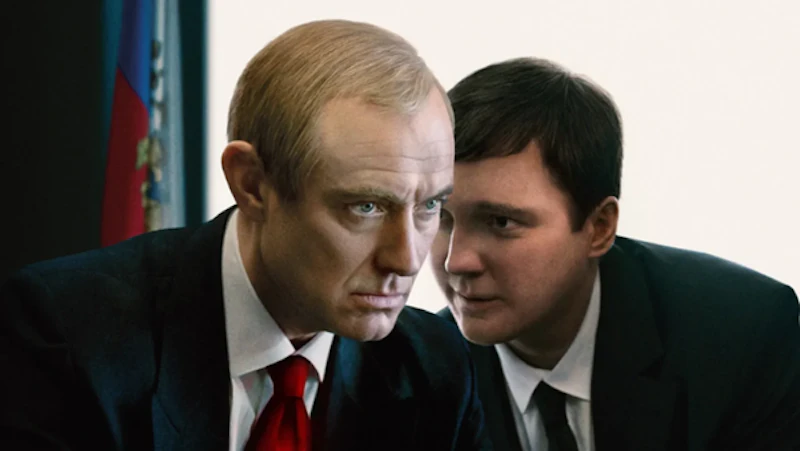
The rise of Vladimir Putin and how he became a despotic leader is a fascinating, if well-trod, subject, one could become the basis for an outstanding biopic. But that’s not what The Wizard of the Kremlin is. Despite coming from a pretty major filmmaker, Olivier Assayas (Irma Vep, Personal Shopper, Clouds of Sils Maria), the film sinks almost right away, thanks to a series of seriously baffling choices.
The country depicted doesn’t really resemble Russia. The main character isn’t very interesting, the actor playing him isn’t very good, and I’m not sure what, if anything, the film is trying to say about Putin, Russia, or anything else.
Based on Giuliano da Empoli's novel, The Wizard of the Kremlin follows Russian history from the early-1990s until around the time of the Russian invasion of Crimea in 2014. The protagonist isn’t Putin but Vadim Baranov, a fictionalized version of Putin’s longtime aide-de-camp, Vladislav Surkov, played by American actor Paul Dano.
Putin doesn’t even appear until about 40 minutes in, and that first act is the film’s best stretch. It shows the wild west of Russia in the Yeltsin era, filled with oligarchs getting wealthy and the kind of nonstop debauchery chronicled in Matt Taibbi’s The eXile. Baranov is shown making his way in the Yeltsin years, first in the theater scene and later as a TV producer, all the while smitten with a certain woman (Alicia Wikander), who’s often just out of his reach. An Italian movie about Silvio Berlusconi, Loro, had a similar structure: an underling worming his way into the despotic leader's inner circle, and some future biopic of Donald Trump should adopt that tack. But The Wizard of the Kremlin doesn’t know what to do with Putin or his right-hand man.
The Wizard of the Kremlin was mostly filmed in Latvia. Not only is the movie mostly in English, but, shades of The Death of Stalin, very few of the actors even attempt a Russian accent. So we get Jude Law as Putin, who, despite vast intensity and a passable physical resemblance to the Russian leader, speaks with his British accent.
The film world’s currently at odds over whether Helen of Troy can be Black, and/or whether it matters that none of the major characters in Christopher Nolan’s upcoming The Odyssey are played by Greek actors. I’m not bothered, because The Odyssey is based on a poem that’s thousands of years old. But Putin’s a present-day figure who’ll still alive. I liked Law better as the Pope.
Dano’s character is also shown telling his story to an American journalist (Jeffrey Wright), and as consistently good as Wright is, the framing device is unnecessary. Also, if you’re looking for validation about Russiagate in either direction, you won’t find that here. The film touches extremely lightly on the Trump/Putin relationship, or anything involving the 2016 American election, as we hear a lot about the creation of the Internet Research Agency, but not much about Trump Tower Moscow or the email hacking.
I didn’t to see that, or a dramatization of the Ukraine invasion, which took place after the movie’s timeline. But Wizard of the Kremlin is left with little to say about its ostensible subject.