
A lesson that the entertainment industry hasn’t learned is that remakes are best when they’re based upon films that had solid ideas, yet failed within execution; for example, Steven Soderbergh’s 2001 reimagining of Ocean’s Eleven is a far slicker, stylish, and star-studded reimagining of the tedious 1960 film, which saw “The Rat Pack” at their laziest. In theory, the idea of an Anaconda remake is smart, given that the 1997 film was inept. However, Anaconda’s legacy was changed by audiences who recognized its potential to be a cult classic; instead of being viewed as a cheap B-movie, ‘97’s Anaconda is thrown in the same category as Plan 9 From Outer Space, Batman & Robin, and The Room as being “so bad that it’s good.”
The issue faced by 2025’s Anaconda is being in-on-the-joke without becoming obnoxiously self-aware; outside of the rare Deadpool-esque success, studio films that try to lampoon the dearth of creativity behind their inception come off as smug and obnoxious. Director Tom Gormican walked this fine line with his previous satire, The Unbearable Weight of Massive Talent, which starred Nicolas Cage as a fictionalized version of himself. It was a film that worked because Cage acknowledged, but did not apologize for his most ridiculous performances and willingness to get over-the-top. With Anaconda, the premise is surprisingly convoluted for a film that’s ultimately more interested in toilet humor than any critique of Hollywood’s obsession with reboots.
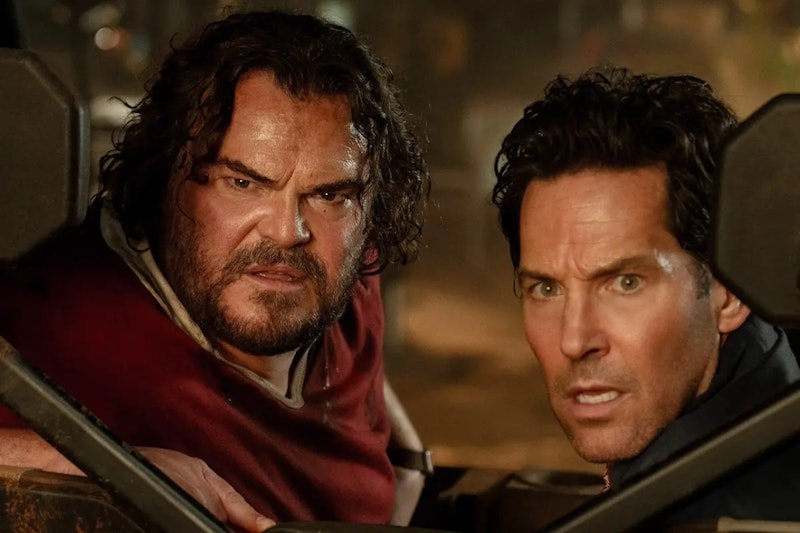
Jack Black, who’s a big movie star for the 12-and-under crowd, plays the straight man, Doug McCallister, a video editor who’s spent his adult years working on professional wedding videos. If Barry Judd, Black’s character from High Fidelity, had worked at a Blockbuster and not a record store, he would’ve ended up a lot like Doug, who’s an obsessive cinephile burdened with adult responsibilities. Doug has stayed in touch with his childhood friends Griff (Paul Rudd), Kenny (Steve Zahn), and Claire (Thandiwe Newton), who all grew up making low-budget movies together. It’s after he’s reminded of how much fun it was to be in control of his own films that Doug’s convinced by his friend to head to the middle of the jungle to commence production on a remake of ‘97’s Anaconda, which Griff has acquired the rights to.
The notion of childhood friends given the chance to reconnect through the joys of moviemaking is a great idea for a standalone film, and it may have been a decent way to reboot Anaconda had Gormican’s script taken an interest in the unusual circumstances surrounding the release of the ‘97 film. However, none of the characters in the new Anaconda seem to care about the old Anaconda; it just happened to be a film that Griff thought could convince Doug to invest his savings into, even if their production still has a fraction of what a standard studio budget would.
The callbacks to the childhood adventures that the four leads shared are playful, and sincere in their celebration of how exciting it can be to complete a film, no matter the eventual quality. By comparison, the references to Anaconda are odd and distracting, even if Griff is keen to reference that it’s a cynical idea to begin with. In a year that featured nuanced Hollywood satires like The Studio and Hacks, Anaconda’s breezy acknowledgment that “studios are out of ideas!” isn’t enough, even if the film does call out Sony Pictures by name.
If The Unbearable Weight of Massive Talent felt like it was written exclusively for Cage, and hinged upon his involvement, Anaconda is divorced from the original film, so much so that any deliberate callbacks stick out. The first half of Anaconda is centered around Doug and Griff’s tumultuous discovery of just how hard filmmaking can be, and is generally pretty funny thanks to the chemistry between Black and Rudd. It’s a film about unaccomplished adults that’s geared towards kids, and doesn’t lean too heavily into the idea that these are depressed losers who peaked when they were in middle school. It’s when Anaconda ‘25 is turned into Anaconda ‘97 that the seams show; a poorly-rendered computer-animated snake isn’t as funny 28 years later, considering that Sony could’ve afforded to give their reboot a bit more polish.
The issue with what Anaconda is transformed into is that the humor’s taken away from the characters and given to the set pieces. Although the idea of schlubby, DIY filmmakers going to the middle of the jungle is amusing, it's not supernatural; all the jokes come from the fact that Griff’s only acting experience is as an extra, Kenny hasn’t matured that much in nearly three decades, Claire’s a mother who has better things to do, and Doug seems to think that he’s Stanley Kubrick, even if he’s working with cheap costumes and a dubious snake trainer. Studio comedies seem are reticent to avoid effects-heavy climaxes that include explosions, celebrity cameos, and other shenanigans that make the characters a lot less aspirational. Doug’s interesting as a straight-laced family man given the opportunity to pursue his dreams, but he’s not very compelling as the hero of an action-comedy.