
Not too many of Kings County’s or any other boroughs’ town halls remain. The history of Kings County’s towns is complicated, but the $2 history is: The county’s original towns were Brooklyn (today’s downtown and stretching east and south as far as Bedford-Stuyvesant and Sunset Park), Bushwick, Flatbush, Flatlands, Gravesend and New Utrecht (New Lots was carved out of the eastern end of the town of Flatbush in 1852), and after a series of secessions and reorganizations, Brooklyn, by then a city, managed to annex all other towns and cities in Kings County in 1896—only to consolidate with Greater NYC in 1898. Brooklyn became synonymous with Kings County.
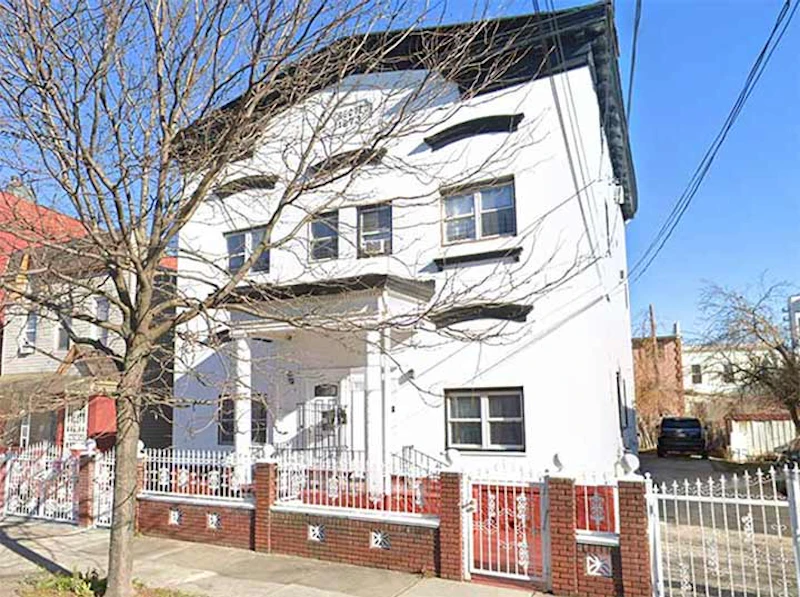
New Lots’ town hall can be found at #109-111 Bradford St. between Fulton St. and Atlantic Ave. in East New York. When opened in December 1873, the building included office space, rooms for public assembly and a fire department, and a police headquarters and jail cells were later added.
Its tenure as a town hall was short-lived as the city of Brooklyn annexed New Lots in 1886. It served as a police precinct for a decade and then became the Bradford Hospital, serving in that capacity until 1934. After that it was divided into residences. Other than the addition of a front wall and fence and a white paint job, it doesn’t look much different than it did in 1940 and I’m glad this relic of Brooklyn’s towns has been retained. Unfortunately the Landmarks Preservation Commission hasn’t designated it.
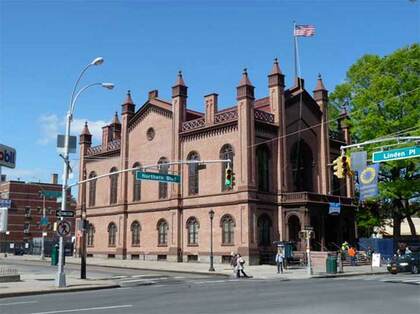
Flushing Town Hall, constructed in 1862 by a local carpenter at Northern Blvd. (then called Broadway) and Linden Pl., is an example of Romanesque Revival. It’s a reminder of the days before Flushing became a part of Queens and then a part of New York City. Frederick Douglass and P.T. Barnum, and at least two presidents, appeared here during the building’s heyday. After NYC consolidation in 1898 Flushing Town Hall became a municipal courthouse, but it suffered from a gradual deterioration over the decades; there were fitful attempts to turn it into an anthropological museum in the 1970s. When I first moved to Flushing in 1993 it was a rundown heap protected by chicken wire from ever-present vandals.
The story does have a happy ending. Town Hall was magnificently restored in 1995 by the architects Platt Byard Dovell and it’s currently the seat of the Flushing Council on Culture and the Arts. The building is now a locale for local arts programs and jazz concerts. The Flushing Council on Culture and the Arts presents a variety of programs including teacher training workshops, rehearsals and meetings of cultural and community organizations.
Central Flatbush, clustered around Flatbush and Church Aves., boasts a number of historic buildings in a relatively small area, similar to other originally Dutch Colonial NYC towns like Flushing and Jamaica. You’ll find the Dutch Reformed Church and Erasmus Hall, both from the 18th century, and other old homes scattered around. The Loew’s Kings Theatre was recently restored and reopened. But here’s one of which you may not have read about.
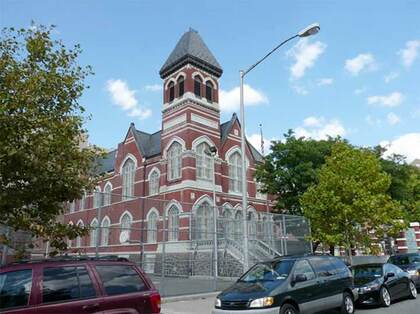
The enthusiastically rococo, towered building at Bedford and Snyder Aves. is a relic of Flatbush’s status as a town on its own before it was absorbed into the city of Brooklyn in 1894 and then the City of New York in 1898. Flatbush Town Hall was built by John Y. Culyer in 1875 in a style known as Ruskinian Gothic, after John Ruskin, a Victorian critic and writer who championed the Gothic style after visiting Europe in the mid-18th century. Culyer also designed PS 90, which now stood, shockingly neglected, a block away at Church and Bedford until a couple of years ago. After its stint as Town Hall, the building served as the 67th Police Precinct until 1972.
Directly across the street is the former Diplomat Bowl, where I bowled badly in league play from 1976-78. Around the corner is an original Ebinger’s bakery building. There’s plenty to see in Flatbush if you scout around.
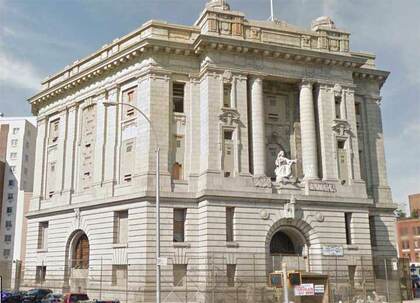
The old Bronx Borough Courthouse building has been officially closed since 1977 and is a ruin protected by the Landmarks Preservation Commission. It was built when the Bronx was a borough, but not yet a county. The Bronx attained county status in 1914 and until then, it was a part of New York County, which since 1914 has been made up of the Borough of Manhattan exclusively. This building saw the newly-minted Bronx County’s first murder trial and conviction. The Borough Courthouse features two statues representing Justice, one of which looked into the Third Ave. Elevated cars as they rattled past.
The Borough Courthouse is located at an unusual Bronx crossroads—here, 3rd Avenue takes a sharp jog to the northeast, following the old Coles’ Boston Rd. path, while Brook Ave. angles northwest, along the path of the now underground brook the avenue follows. The Borough Courthouse replaced a country inn, Hammer’s Hotel.
The Bronx Borough Courthouse shouldn’t be confused with the Bronx County Courthouse, or the Mario Merola Building, the present home of the Bronx Supreme Court, County Clerk, Sheriff, Public Administrator, District Attorney, and Bronx Borough President. That building is located on the Grand Concourse between E. 158th and E. 161st Sts. and was built in 1933 by architects Max Hausel and Joseph Freedlander. Hausel was an associate of Michael Garvin, who built the Borough Courthouse in 1905. Between 1933 and 1977, the Borough Courthouse served as the Bronx branch of the New York City Criminal Court.
A building this impressive deserves frequent viewings. Although the building’s fate is unknown, in 2015 its received a cleaning; that year, I patronized an art exhibit held within. A wooden sign dating to the Ed Koch administration (1978-1989) survived on the facade under the statue of Justice at least until 2014.
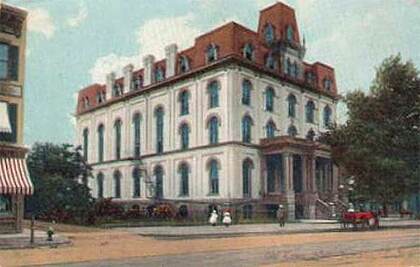
Jamaica Town Hall was erected in 1869 as the civic center for all villages within the Town of Jamaica. Any Queens neighborhood today that begins with a 114- zip code was once part of this town. After its 1898 consolidation into Greater New York City, the structure served as a traffic court and small claims court. The high cost of maintaining the massive Victorian structure doomed it and it was demolished in 1941. A plaque from Jamaica Town Hall was donated to the Queens Borough Public Library’s archives.
Every country has a county seat, a town that is its capital. For Queens, it used to be Jamaica. After the American Revolution, the national capital and many state capitals were relocated to geographic centers of their respective units. Mineola took up the title and held it until 1874, when Long Island City took the county courthouse and legislature. In 1898, eastern Queens towns that opposed consolidation seceded from Queens to form Nassau County with Mineola as its capital. At that point, Jamaica attempted to regain its title as the capital of Queens but in 1940, the present-day borough hall was completed in nearby Kew Gardens.
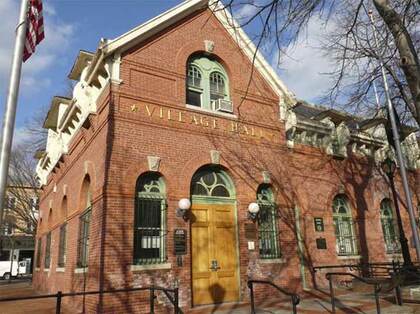
Just as Kings County was once divided into six separate towns, so was Staten Island: the Town of Castleton comprised St. George, New Brighton, and Livingston; Edgewater consisted of Tompkinsville, Stapleton, and Clifton; Middletown, the Todt Hill region; Northfield was the entire northwest of the island including Port Richmond, Mariners Harbor, Graniteville and Travis; and Southfield, most of the south shore including Richmondtown, Greenridge, Annadale, Huguenot, Prince’s Bay, Richmond Valley and Tottenville. These town distinctions were erased when Staten Island joined NYC in 1898.
This red brick Romanesque Revival edifice, designed by Stapleton resident Paul Kuhne in 1889 in Tappen Park, at Wright and Canal Streets, is Staten Island’s only remaining village hall (the New Brighton village hall, after nearly 50 years of abandonment, was razed in 2004). Stapleton was part of Edgewater Village, in turn a part of Middletown, one of Staten Island’s five towns, a political division done away with when Staten Island became a part of New York City in 1898. Unfortunately, the village hall is generally closed to the public and is used for local municipal organizations’ offices.
—Kevin Walsh is the webmaster of the award-winning website Forgotten NY, and the author of the books Forgotten New York (HarperCollins, 2006) and also, with the Greater Astoria Historical Society, Forgotten Queens (Arcadia, 2013)