
Last week I read a jaunty, superlative-laden mash note to the city of Washington, D.C by Emma Camp in The Wall Street Journal, with the trite headline (perhaps Kamp didn’t write it; hard to tell in 2026), “I Left My Heart in Washington, D.C.” Camp, a senior newsletter editor at the Journal’s “Free Expression,” has a book coming out next year, Good Boundaries, is Gen Z and an okay writer. But with so few major newspaper outlets hiring people under 30 (like The New York Times), I think it’s unkind to be overly critical.
She moved to D.C. at 22 with her now-husband after they graduated from the University of Virginia (she first visited at 16 for a slam poetry event and the city was “love at first sight”) and says it’s where she “grew up.” Now in Brooklyn for four months she misses her former home.
Camp writes: “There is a battery of practical reasons why I loved Washington. I find the city’s rows of quaint townhouses to be far superior to New York’s hulking brownstones. All the best museums are free. The city is more approachable than New York, but there are still plenty of smart and interesting people doing smart and interesting things there… It’s a city of nerds, a place filled to the brim with wonks and grown-up debate captains, people who are unselfconscious in their zeal for the outwardly mundane.”
Not much of a recommendation. A “city of nerds”? Fun! Also, as I suspect Camp knows, there are “smart and interesting people” all over the country. Since like Sly Stone I’m Everyday People, hooray that Camp has fond memories of all those “grown-up debate captains” and “wonks.”
When I was around Camp’s age, and running Baltimore’s City Paper with Alan Hirsch, the two of us, young, ambitious, naïve and wanting nothing to do with the mundane, we started another weekly in Washington, D.C. It wasn’t financially prudent, an eyes-bigger-than-the-stomach project, but eventually Washington’s City Paper (after we sold a majority stake to the Chicago Reader owners in a very generous deal) became profitable and, under the editorship of Jack Shafer, influential in that city. But the early days were sketchy, not only for a lack of funding but because I disliked the city, aside from the restaurants, especially in Adams Morgan and Chinatown, and when I took a train back home to Baltimore, in 1981, a relative cool place to live, I exhaled with relief. The early-morning commute was a drag. (Unlike D.C., Baltimore’s population didn’t turn over every year, giving it the stability lacking in the nation’s capital.
As I’ve often said, and still believe, Washington, D.C. is among the most beautiful cities in the country, with the architecture, Smithsonian, cherry blossoms in the spring, and, at least back then the superb Union Station. But the people—specifically in the northwest quadrant, where Camp lived—are on the whole drab and sometimes obnoxious. That makes sense since it’s filled with lobbyists, politicians and their obsequious aides and interns and Beltway journalists. Before Casual Friday, there was an unofficial dress code, depending on the season: the same trenchcoat, blue blazers, “power ties,” and Brooks Brothers suits and button-down shirts. Upper-middle-class, and the young aspiring for the same, conformity.
Jack Shafer, whom I hired in 1985, was a D.C. anomaly. He wore the uniform, but was witty, dogged, unbothered by political correctness and very hard-working. (An example: he told me that he’d taken LSD but never smoked pot. Talk about headscratchers.) He’d come up to Baltimore every Wednesday, where the paper was produced, and was genial but firm with the paste-up staff who always regarded people from D.C. with a wary eye. He was ahead of the curve on cliches: throwing out words like “nothingburger,” “national treasure” and “I’m up to my ass in alligators.” Hirsch and I joked: “Hey Russ, I know you’re up to your A in A, but I could use some help on a sales rep interview.”
Jack, at CP for many years, before departing for the start-up Slate with Michael Kinsley (when it was an excellent site, and well-paying!), was kind about our relationship, with a trademark twist, telling an interviewer: “About Smith's hiring, Shafer said, ‘I will always be grateful, although I reserve the right to be peculiar about how I express that gratitude.’”
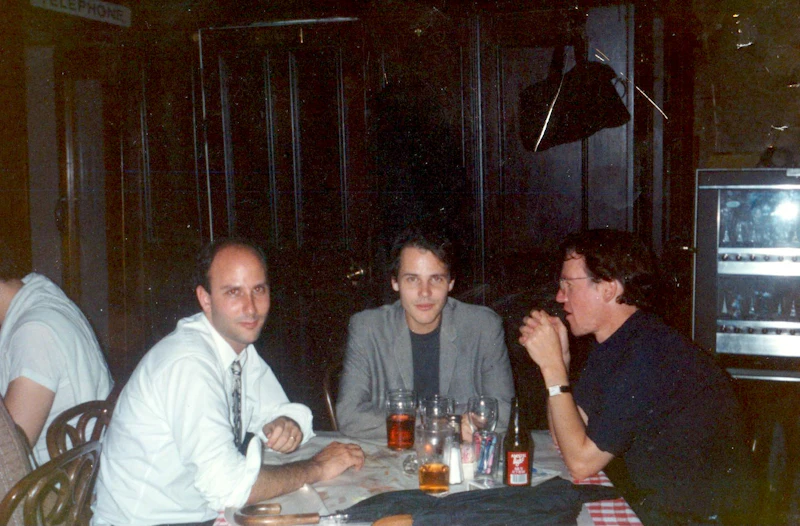
The accompanying photo in Tribeca’s comfy Walker’s on N. Moore St. shows native Baltimoreans Michael Cohen and Michael Gentile, with me on the right. The two Michaels felt exactly the same about D.C. as me, and I don’t think that’s a minority view.
Take a look at the clues to figure out the year: Lindsey Davis’ The Silver Pigs, Ben Elton’s Stark, Hillary Mantel’s Fludd, some assembly-line novel by Joyce Carol Oates, and Pauline Kael’s Hooked are published; Washington, D.C. has no baseball team; Wendy Wasserstein wins the Drama Pulitzer; Robert “Featherbed” Byrd is U.S. Senate Majority Leader; Ron Brown becomes first African-American to chair the Democratic National Committee; Elizabeth Olsen is born and John Cassavetes dies; The Keating Five were named (including St. John McCain, a scandal “memory-holed” by MSM buddies; Mark Davis and Bret Saberhagen win the Cy Young awards; and Chuck Finley was the American League’s May Pitcher of the Month.
—Follow Russ Smith on Twitter: @MUGGER2023