
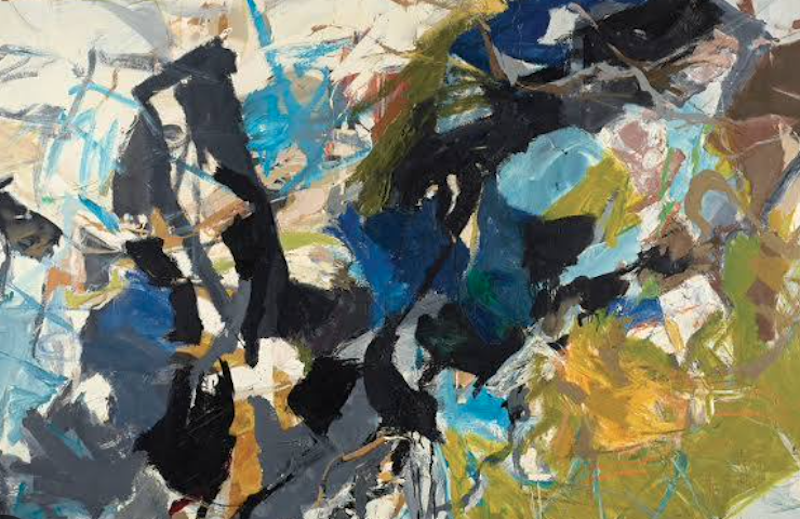
Perle Fine: Because for a thing to be abstract meant to me that you had to feel strongly enough about it to turn your back on realism and do everything necessary in an abstract way to put across a feeling which meant being totally abstract or non-objective.
Peyton Pinkerton: This developed into what I’d describe as a ritualistic songwriting technique.
Fine: It's an awareness of what is happening to, let's say, just a piece of white paper.
Pinkerton: It was the best gift ever.
Fine: Which was really very true.
•••
Pinkerton: After I got out of the hospital I had a remarkably productive period.
Fine: Certainly there is something very exciting about the country.
Pinkerton: At best it’s like trying to catch a trout in the water with your bare hands—you might get a second’s purchase but it will inevitably free itself and swim away, maybe even puncturing your hand with one of its spiny dorsal fins.
Fine: Amorphic shapes, floating in space.
Pinkerton: Over time this changed.
•••
Fine: And he brought me the most horrible picture, surrealist, you know, the world in chaos.
Pinkerton: He channeled this creepy vibe at the bridge of the song and it was just the perfect part for that moment.
Fine: And he was very nervous and excited about it.
Pinkerton: This of course gave us room to play around with his ideas.
Fine: I think they are owned by either Janis or Harry Holtzman. And I can only relate them to a sound in space, a cry, or a chirp or something like that.