
It’s notable that Prime Video scheduled the series finales for two of its most significant adaptations within a week of one another with The Boys and Good Omens. The Boys concluded its five-season run with a controversial finale that confirmed that the show had suffered a decline in quality, while still watchable; comparatively, Good Omens was given such a small marketing push that its release is no more than a contract stipulation. The show’s producers undeniably had their hands tied with an unenviable situation in which there wasn’t a clear solution. The fantasy show had begun as a limited event series adapted from the novel of the same name by Terry Pratchett and Neil Gaiman, but was successful enough to spawn a second season that consisted of new material. The groundwork was laid for what was already planned to be a final installment when allegations about Gaiman’s sexual abuse and trafficking were made.
“Cancel culture” doesn’t come for everyone, as evidenced by the box office success of Michael. However, the evidence was so stacked up against Gaiman that there was a swift dismissal of nearly every project that either he was involved with or was inspired by his work. Netflix prematurely cancelled its adaptation of The Sandman prior to the debut of its second season, and also pulled the plug on its spinoff, Dead Boy Detectives; Disney halted all work on its adaptation of Graveyard Book, and Dark Horse Comics ceased publication of collected issues. Amazon already took the Gaiman-created fantasy series Anansi Boys off of its release calendar, with no indication as to when it would debut. While there’s an outcry against streamers that cancel the release of projects that are or near completion, as was the case with HBO Max’s Batgirl, there’s not likely to be much uproar if Anansi Boys never sees the light of day.
Good Omens was put in a precarious position because production of the third season had gone on for a year before the Gaiman scandal broke, and a complete cancellation in its entirety would likely leave many crew members out of work. An argument could be made that Good Omens wasn’t tainted by Gaiman’s legacy because the novel was also credited to Pratchett, who may have had more to do with its success in the first place. At the same time, Gaiman’s public exit from the series ensured that the third season, in whatever form it took, would be seen as a move away from what the original intentions were. Amazon had the opportunity to choose to rid itself of Gaiman completely or wrap up a popular show so that its fanbase could have something uncorrupted to enjoy. A bold stance wasn’t taken; Good Omens would air its third season, but the intended six episodes were shortened to a single, 90-minute finale. Even for those who could separate the art from the artist, Good Omens ruined its legacy with a denouement that says nothing.
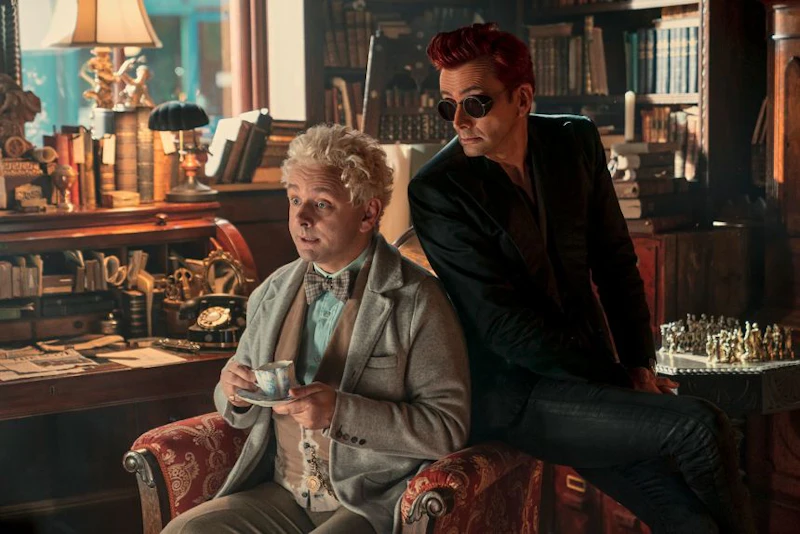
Good Omens is a buddy adventure where Christianity is mythology, and its focus is on the peculiar friendship between the angel Aziraphale (Michael Sheen) and the demon Crowley (David Tennant). It’s a case of “opposites attract” when they become allies to stop the anti-Christ from unleashing hell on Earth, and in the second season the implied queer romance becomes explicit. The third season picked up on a cliffhanger, in which Aziraphale has become an employee of Heaven, which caused Crowley to reject him and bury their relationship. It’s likely that their reacceptance would’ve been given the time and space of two or three episodes in order to culminate, but due to the rushed production, it condensed to the first 15 minutes of a cheaply-made TV movie.
That Sheen and Tennant still managed to give it their all is admirable, given that most of the supporting cast already checked out; Jon Hamm, who had a memorable role in the second season as a hapless version of the angel Gabriel, is absent entirely, presumably because his time was better spent on something people would see. Good Omens (and many adaptations of Gaiman’s work) had always earned some backlash because of its creative revisions to religion, and the third season included potential controversy through the introduction of Jesus (Bilal Hasna), depicted as a confused teenager trapped on Earth. It’s an idea that goes nowhere.
Amazon’s discomfort about giving any limelight to a Gaiman-related project is evident based on the clearly scaled-back production. There’s less extras, simplified set pieces, and even some shaky CGI that stands out, even on the small screen; the show may imply that Heaven is a vast and glorious realm, but viewers only see shots of the same two rooms. Perhaps all the show needed was a wrap-up to bid farewell to its characters, but there’s so little involvement from prior cast members that the finale is a half-hearted backdoor pilot for another show that will never exist.
Good Omens had the opportunity to underline its message of faith in humanity, given that it's out of reluctant admiration that Aziraphale and Crowley choose to fight for mankind. Instead, the garish last 10 minutes of Good Omens is swung in a different direction, in which the implication is that free will is only possible in another universe without the existence of God, Satan, or any supernatural creatures. It has a condescending, infantilized perception of what humanity is capable of that’s contradictory to the show’s thesis. If the goal was for Good Omens to burn any bridges that would even remotely generate praise or success for Gaiman, then the disastrous finale was a success.