
This bears repeating. It’s more than mere chagrin that The Wall Street Journal, once the best newspaper in the United States, forges ahead, quintuple-speed, on that dreary road to cultural (and political) irrelevance, meeting up with other compromised legacy dailies. I suspect that the Journal in less than five years will become completely useless, and I’ll be forced to navigate the frustrating process of canceling my subscription. (More realistically, I won’t renew, and that’ll be another artifact of a relatively long life gone up in smoke. In 1998, I was one of 100 or so guests at the Journal’s indispensable Robert Bartley’s Brooklyn home to watch the midterm elections. That, and conversations with Dorothy Rabinowitz, Paul Gigot and John Fund, among others, is what I’ll remember.)
My particular ire is directed at a November 23rd article that was inexcusably misleading. I’ve no idea who approved the (pointless) double-byline of Laura Cooper and Terrell Wright on this baloney: “Celebrities Are Making Smoking Cigarettes Cool Again: Cigarettes resurface in pop music and movies, raising fears that a yearslong decline in smoking rates could reverse,” but he or she or it ought to be canned. The smell of AI stinks up the perfunctory prose.
The authors of this drivel give several anecdotes of young people who’ve taken up smoking, claiming they’re caught up in the “retro appeal.” Lower in the article is this: “Smoking rates in the U.S. over the past several years have hovered around their lowest levels in eight decades, with 11% of Americans reporting that they smoked a cigarette in the prior week, according to a Gallup report. Younger Americans are even less likely to light up, according to the survey. In recent years an average of 6% of adults under 30 reported recently smoking, versus 35% in surveys from 2001 to 2003.”
Apparently, the smoking celebrities cited—pop stars Addison Rae, Lorde and Sabrina Carpenter, as well as an uptick of onscreen actors smoking—haven’t succeeded in making cigarettes “cool again,” and it’s doubtful that was their intention. Also noted for encouraging the habit is Jared Oviatt, “who runs an Instagram account called @cigfluencers,” who said he began the account “because he and his friends always thought smoking cigarettes was cool.”
This “influencer” says he buys a pack “every few months.” That’s addiction! This WSJ hysteria is, at best, an attempt by the authors to meet a quota; at worst, for reasons unknown, at flirtation with scaremongering. I doubt many people under 30 read The Wall Street Journal, which further confuses me as to why it was printed. Maybe a top editor wanted to do a “scared straight” exercise for his or her curious teenager.
I started smoking (Kools) as a 14-year-old, inevitably because two of my older brothers did. Many decades later, I still do, every day, although on a reduced level from my youth. Perhaps in the late-1960s and early-70s there was a level of “cool” to smoking, but that dissipates quickly. You’re hooked, know the health risks and are now regarded as social pariahs, which is easy to ignore. I don’t give a shit when a sexagenarian fat lady gives me the stink eye after exiting a movie theater, or adds the self-affirming, “You really should quit. Cigarettes are bad for your health!” (So are double helpings of pecan pie, toots.) Soothsayers, more commonly known as busybodies.
Once, in 2008, at the first Splice Today offices on Falls Rd. in Baltimore, I was on the front porch, cupping my hands to light a Merit, and a young colleague drove up and said, “Wow, that’s like a book cover, wearing shades and getting that smoke lit. Cool!” I waved a hand in recognition, and didn’t feel at all “cool,” but it did make me think of the cover of Dylan Thomas’ Quite Early One Morning, a New Directions title that I read in one sitting as an 11th-grader.
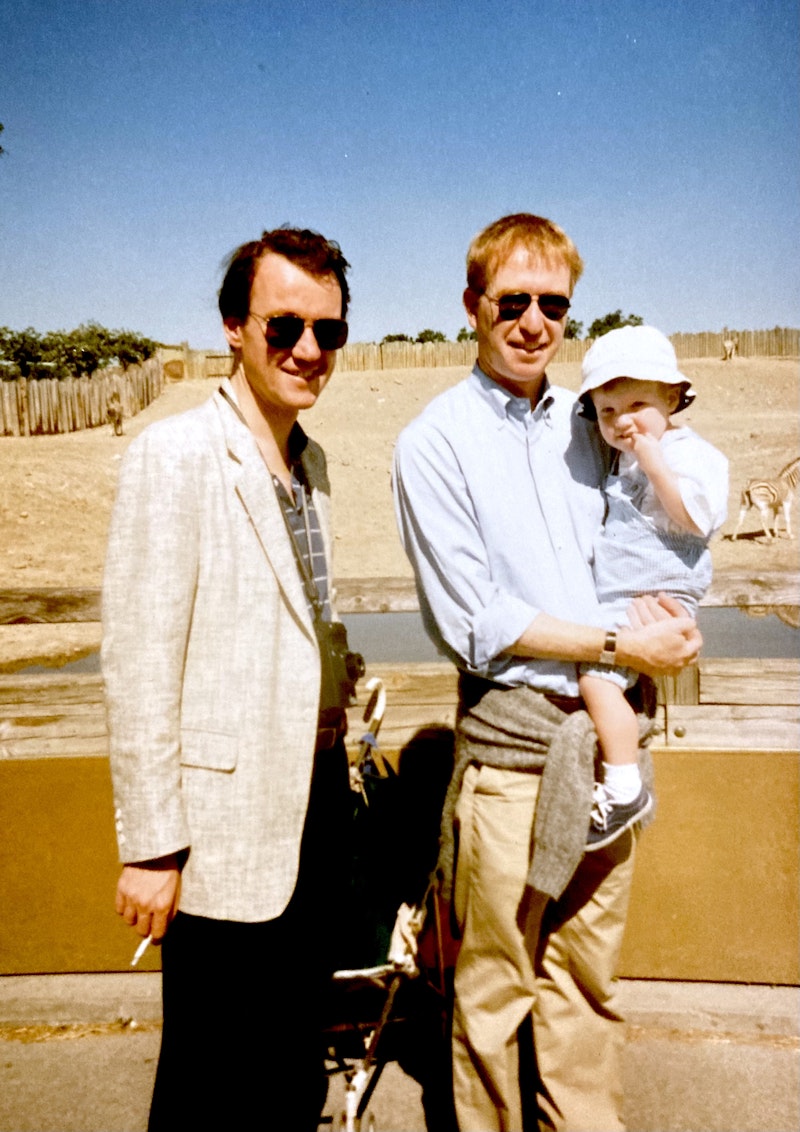
The picture above—me with cig, my brother Gary and his infant son Quinn—is at a location I can’t remember. Thought it was Southampton, but my son Booker swears he sees some zebras. Beats me. Gary, now 75, quit smoking in his early-40s, using The Patch. I tried that, and the poisonous nicotine gum, but it didn’t take. I don’t think smoking is “cool”—although I still like flicking a butt into the street on a walk—but rationalize there are worse health risks, like booze, drugs (legal and illegal) and obesity.
Take a look at the clues to figure out the year: Tom Shales, Thomas Friedman and Dave Barry win journalism Pulitzer Prizes (all three part of The Club); Nick Mullen is born and Divine dies; the Deftones and the Smashing Pumpkins are formed; the Drifters are tapped for the Rock and Roll Hall of Fame; Nick Lowe’s Pinker and Prouder Than Previous is released; the Birmingham Six lose an appeal on their convictions; Albert Dock is reopened in Liverpool; Matthew Sadler, 14, becomes the UK’s youngest international chess master; David Lodge’s Nice Work and Roald Dahl’s Matilda are published; Jesse Plemons is born and Hal Ashby dies; Nicholas Brady sworn in as Treasury Secretary; “The Endangered Earth” is Time’s Man of the Year; and Mats Wilander wins the U.S. Open.
—Follow Russ Smith on Twitter: @MUGGER2023