
Not sure why, but I was semi-convinced that the death rattle for The Washington Post, rumored for more than a week, was a decoy on the part of that daily’s management. Send out dire memos, watch employees (present and former), other Beltway journalists and people who got “Democracy Dies In Darkness” t-shirts out of the closet, and a modified “re-structuring” wouldn’t seem so bad. I was as wrong as the morons who shamelessly shilled for sure winner Kamala Harris in 2024 (including Post reporters, but not the editorial page, which didn’t issue, to the irrational consternation of many), but won’t think about it too much.
The Post, even when Public Enemy #4 Jeff Bezos bought the flagging company in 2013 for the John’s Bargain Store price of $250 million, at a time he wanted to curry favor with the Obama administration, hiring lobbyists to push his far more important businesses (as in profitable), and bask in the adulation, was already history, consigned to the nostalgia bin. There was no more real competition between the Post and New York Times (which brilliantly constructed an impenetrable wall of digital lucre, with its puzzles, recipes, videos and effective “events,”) and the Bezos purchase was bound to end in sniffles and self-aggrandizing thumping.
Because media layoffs—300 at the Post—are more important to the media than 16,000 jobs lost at Amazon and other tech giants, it required three Times reporters to write a short story about the downsizing. Benjamin Mullin, Katie Robertson and Eric Wemple wrote, with ostensibly straight faces: “The cuts are a sign that Jeff Bezos, who became one of the world’s richest people by selling things on the internet, has not yet figured out how to build and maintain a profitable publication on the internet.” Left unsaid was that Bezos owns the newspaper and can do what he wants; also, he likely staved off the Post’s elimination by 10 or so years, with paychecks to those now demonizing him clearing the bank during that time.
I have a digital subscription to the Post—but not print—mostly to very occasionally read the warped op-ed columnists. It’s striking how much angst has been expended in the past week over the gutting of the Post’s sports department, described by old-timers as a “gateway” to the rest of the paper: sports, comics and then a foray into the news. Do these people believe it’s still 1982 when big daily newspapers posted double-digit profit margins, spent a lot of money on staff, and, along with the Times, gave the morning talk shows pegs for their “news of the day” stories before this or that celebrity sauntered on stage?
Last July I wrote a story here about the death of sportswriting that was wistful in tone, but realistic: for example, when I want results and re-caps of MLB games during the season, I click on ESPN, which at least for now provides the box scores and maybe some scant commentary. That’s the nuts and bolts, and though it’d be swell to still have the Post’s Thomas Boswell to read, that era’s over.
It wasn’t always so, as journalists, almost all over the age of 60, sanctimoniously held forth last week at a virtual wake disguised as protest. I remember back in the 1970s having a debate with my Johns Hopkins classmate and then City Paper colleague Eric Garland about which Sunday paper was better. I went with The Post, Eric successfully batted that down by choosing the Times. We had beefs with both dailies, but read them every day, and not just for baseball agate, “Doonesbury” and (usually lousy) pop music reviews.
I didn’t have much money at the time, but newspapers were ridiculously cheap, considering the amount of material to read, and started each day with a “bulldog” copy of The Baltimore Sun that I bought at midnight at the all-day newsstand at Greenmount Ave. and 32nd St. Then the Post, New York Post, Times, Baltimore’s News-American, and maybe the Philadelphia Inquirer. Eric and I often wrote about media for City Paper, so that was a requirement, but mostly it was just part of our routine.
In the summer of 1972, I’d drive less than a mile to pick up the Post and Times, and followed the first Watergate stories of Woodward and Bernstein. I was 17, politically naïve—until the Thomas Eagleton fiasco I though George McGovern had a real chance of defeating the hated Nixon; maybe I was egged on by the stories by Hunter S. Thompson and Timothy Crouse in the golden-age Rolling Stone—and up for anything outrageous.
My multi-newspaper/magazine habit continued until about 2004, when it was obvious the internet had destroyed all media as we knew it. I still don’t like that outcome, but in contrast to journalists of my age, won’t pretend that the Post’s sports section/book review/international reporting mattered anymore.
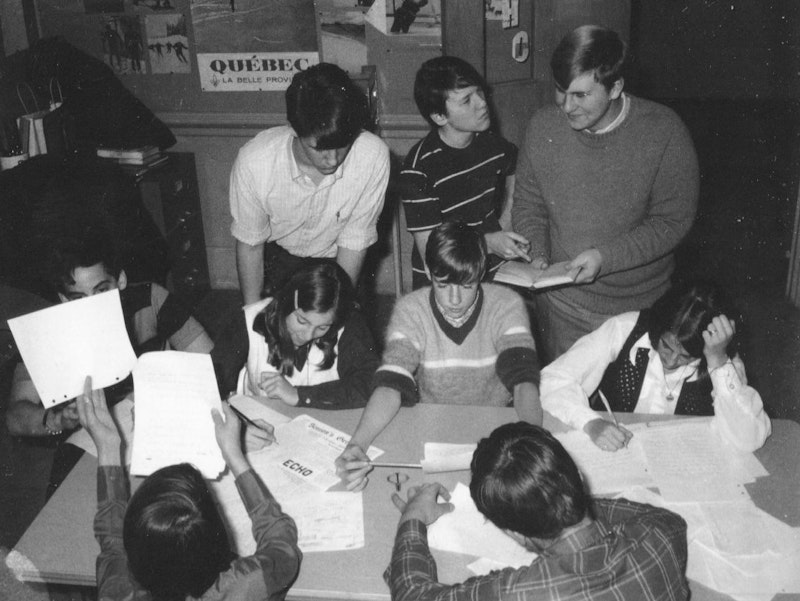
The photo above was taken at Simpson Junior High School’s layout room for the monthly Echo newspaper. Of the nine people pictured (I’m top row, center), only two entered the profession as adults.
Take a look at the clues to figure out the year: Bernice Rubens wins the Booker Prize; Jean Stafford takes the Fiction Pulitzer; Dave Eggers is born and John Dos Passos dies; Alvin Toffler’s Future Shock, Germaine Greer’s The Female Eunuch, Roald Dahl’s Fantastic Mr. Fox, and Jimmy Breslin’s The Gang That Couldn’t Shoot Straight are published; The New York Times raised its single issue newsstand copy to 15 cents; The Public Health Cigarette Smoking Act was passed in the U.S.; John Schlesinger wins Best Director Oscar; The Odd Couple premieres on ABC; Jimmy Carter is elected as Georgia governor and “Doonesbury” debuts in two dozen U.S. newspapers.
—Follow Russ Smith on Twitter: @MUGGER2023