
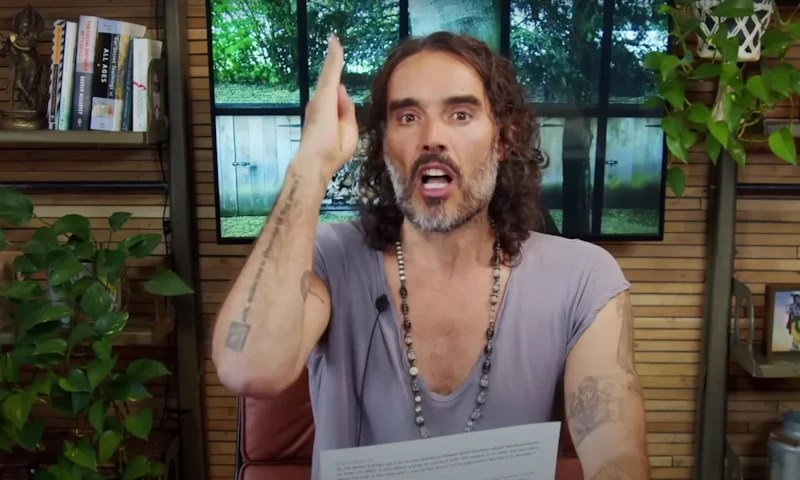
From the man who once diagnosed capitalism as a disease and monogamy as a "severe state," hawked vegan smoothies, transcendental meditation, and a revolution that mostly involved him talking—comes the most sincere, deeply felt, absolutely-not-career-related spiritual awakening of our time.
Russell Brand, no more a Christian than Richard Dawkins is a deacon, recently found God. Right as he prepares to face three counts of rape, three of sexual assault, and one of indecent assault at Southwark Crown Court, where his trial is now set to begin in October. Six women, allegations spanning 1999 to 2009. He denies all of it.
The Brit, who was baptized in the Thames by Bear Grylls, is now flogging How to Become a Christian in Seven Days, the debut title from Tucker Carlson's new publishing imprint. The asterisk on the cover concedes it "may take 50 years of sin and serious f*ck ups to get started," which is the closest thing to candor in the entire enterprise.
And why stop at God? He's running for Mayor of London in 2028, possibly—by his own cheerful admission—from a prison cell.
In the UK and Ireland, where people have lived with him for 30 years, Russell Brand is loathed. Those on the other side of the Atlantic remember the Sachsgate voicemails—the night in October 2008 when Brand and his close friend, Jonathan Ross, on a pre-recorded BBC Radio 2 show, repeatedly phoned the home of Andrew Sachs, the elderly actor beloved by half the country as Manuel from Fawlty Towers, and left a series of messages on his answering machine boasting, in escalating detail, about Brand having slept with his granddaughter Georgina Baillie. He f*cked your granddaughter, Ross bellowed down the line, while Brand giggled. The men responsible were 33 and 48. They thought it was hilarious. They aired it. Eighteen thousand complaints followed, the highest in BBC history at the time, a national scandal that took down the controller of Radio 2, ended Brand's BBC career, suspended Ross for three months, prompted fifteen MPs to file a Commons motion, and ought, by any reasonable accounting, to have ended the rest of it. It didn’t.
They remember the BBC resignation that followed, performed with the same theatrical self-pity he now applies to Christ—the long, mournful, oddly grandiose statement, as if he were Solzhenitsyn expelled from the Writers' Union rather than a man who’d bullied a pensioner on the radio for a laugh. They remember the announcement that he wouldn't be voting because democracy was beneath him, then the announcement a fortnight later that everyone should vote Labour, then the announcement of something else entirely—each delivered with the same breathless certainty as the last, each met with the same dwindling patience. They remember the book about change that proposed nothing, the YouTube channel about awakening that awakened no one, the documentary tour of the financial crisis in which he interviewed bewildered economists and asked them, essentially, but what if love. They remember the awful standup. They remember the hair. They remember everything.
The American right doesn’t remember. America is, and has always been, a duty-free shop for British personalities who either couldn't make it at home, or did make it, briefly, and then found they could no longer. James Corden, a man Britain greeted with relief as he boarded the plane, became late-night royalty doing karaoke in a car. John Oliver, a perfectly serviceable Daily Show correspondent, was elevated by HBO to America's Designated Explainer of Things, the public-radio voice of liberal certainty. Piers Morgan, fired from the Mirror over faked photographs, fired from CNN, keeps failing upward. Even Sharon Osbourne managed it.
The accent does most of the work. Americans hear an Estuary vowel and assume Oxbridge; hear a posh accent and assume genius; hear Brand's particular music-hall cadence and assume, apparently, prophet. The American right in particular has built itself a bottomless trough for prodigal sinners. The more lurid the past, the more dramatic the redemption, the better. Speak solemnly about sinning, clutch a Bible on camera, and weep once at the right moment. That's all that's required. And Brand knows this. He’s a wickedly clever operator, possibly sociopathic, a man who reads rooms the way card sharks read tables. And he understood, somewhere between the Sunday Times investigation and the Bear Grylls baptism, that there was no future for him in London, but there was an enormous, well-funded, theologically illiterate audience in America waiting to receive him as a sort of repentant rake turned preacher. So he packed his accent, vocabulary, his selectively retrieved trauma, and he went.
The conversion isn’t a conversion but a costume change between acts, performed by a man who has correctly identified that there exists, somewhere between Nashville and Mar-a-Lago, a vast paying audience that will never have heard of Andrew Sachs, will never read a British court transcript, and will buy the book.