
The chin and the jawline have always done double duty. Biologically, they’re just bone and muscle. Culturally, they’re shorthand for something bigger: resolve, authority and composure under pressure. We live in an age of algorithms and polling averages, but the old visual codes still carry weight. When people picture a leader, they imagine a face that could look Vladimir Putin straight in the eye and say, ‘I’ve seen colder stares in a DMV.
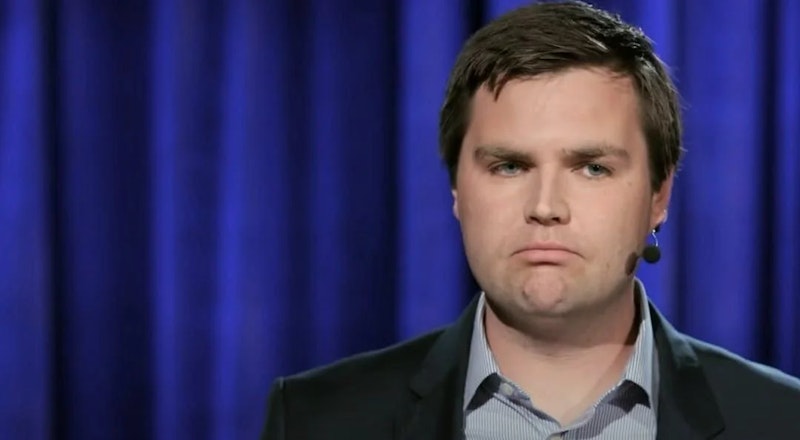
That’s why the recent chatter around JD Vance and his future in Republican politics has taken on such a curious physical edge. With talk that he could succeed Trump, online factions have begun auditing his face. Nick Fuentes and his digital foot soldiers mock his jelly-donut profile as if it were a legislative flaw. This is about optics. They want a figure who looks like command, not one who looks like compromise.
This isn’t new. History’s full of leaders whose jaws became part of their authority. Lincoln’s chin wasn’t handsome, but it was unforgettable, a jutting signature beneath a face made for greatness. De Gaulle’s long, blade-like profile seemed engineered for monuments and murals. The pattern stretches beyond the Atlantic world. Napoleon’s compact face carried an air of authority. Atatürk’s rigid jaw helped sell the image of a man remaking a nation by force of will.
Across cultures, the message is the same. A strong jawline doesn’t make a strong ruler, but it makes the story easier to tell. It turns the face into a promise. The chin becomes a kind of oath: I will not fold. I will not fail. I will not be moved.
Donald Trump breaks the pattern. He has no granite mandible, no sculpted edge of command. His face is all surface and motion, a rolling democracy of jowls and chins with no permanent borders. Where others leaned on anatomy, he leaned on ad-libs. For more than a decade, Trump’s hogged the spotlight through a full-frontal monologue, politics as stand-up soliloquy. His authority never came from looking immovable, though devoted followers do their best to cast him as a Chuck Norris–style strongman capable of bench-pressing the national debt. The President is the exception that proves the rule. He succeeded not because he looked like command, but because he never stopped acting like it. His face didn’t project dominance, but his behavior did.
What matters isn’t that strong jaws make strong leaders. What matters is that people believe they do. Politics has always traded in faces as much as in facts. The jawline becomes a proxy for competence, the chin a cue for confidence. Voters may insist they care about policy, but the first judgment is often silent and instantaneous. Does this person look as though they belong at the head of a table?
In that sense, Vance faces an obstacle. His problem isn’t a shortage of ideas or ambition. It’s that his appearance doesn’t fit the cartoon of command that populist factions want to sell. For a movement that worships alpha-male aesthetics, his rounded features read as a red flag.
If Vance had the raw magnetism of Trump circa 2015, he might get away with it. Trump could look like a traffic cone and still sound like victory. Vance can’t. He’s articulate, controlled, and careful—qualities that win debates but not cults. He speaks well, but doesn’t electrify. His delivery doesn’t intoxicate.
Contrast that with Gavin Newsom, floated as a likely opponent in 2028. His face is angular, his posture upright. He looks like a governor in the way movie governors do. His jawline does half his messaging before he opens his mouth. Granted, much of what comes out of that mouth is drivel, but that’s precisely the point of a handsome face. It sells order long before it sells ideas. The image sticks.
This is where the chin and the jawline become inseparable from leadership in the public imagination. They anchor the face and frame the voice. They give speeches a scaffold. When a man steps to a podium with a strong lower face, his words seem to arrive already armored. When the face is softer, the same words can sound tentative, even when they aren’t.
Democracies like to think they choose leaders by reason. In practice, they also choose them by silhouette. The chin and jawline have become a visual grammar of command. We may resist that reflex, but it still shapes our choices.