
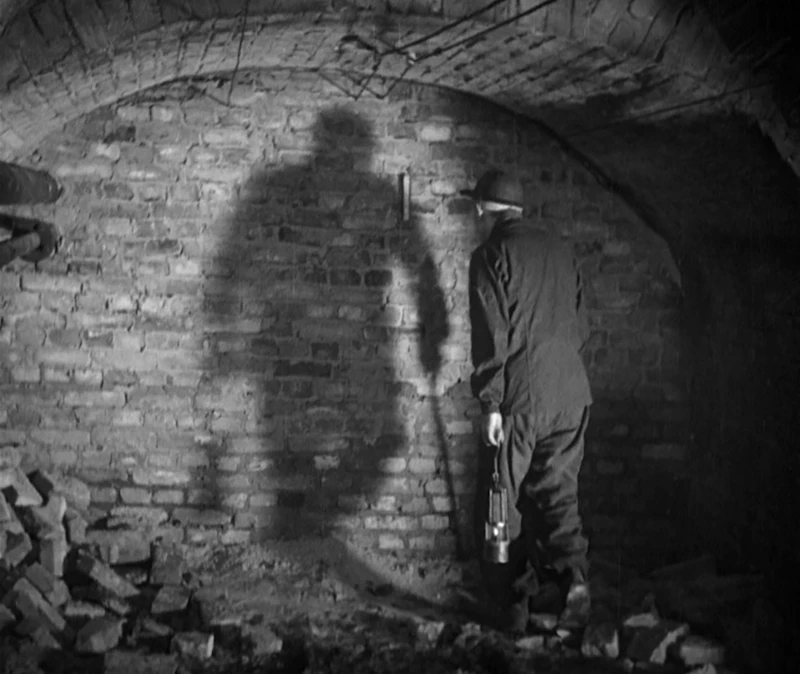
It’d be easy to use historic hindsight to see G.W. Pabst’s 1931 film Kameradschaft as an eerie ode of what was to come, but the writing was already on the wall when the film came out. Siegfried Kracauer notes in From Caligari to Hitler that Pabst’s work of cross-cultural solidarity failed to find an audience in Germany—at the time, in the midst of the collapse of the Weimar Republic and rise of Nazism—which discouraged Pabst and may have contributed to his decline from one of the preeminent pioneers of the form to a rather staid melodramatist. What’s interesting about Kameradschaft is that its internationalist humanism is a product of the time Pabst was peeking as a filmmaker, yet he was of a strain that was rapidly being snuffed out in Germany.
Kameradschaft (German for “Comradeship”) is inspired by the 1906 Courrières mine disaster, when Westphalian rescue teams came to the aid of their French counterparts. This radical act doesn’t preclude the war that will ravage both sides of the border less than a decade later, with all the camaraderie torn apart by artillery fire and machine guns. Pabst updates the story to take place after the Great War, with borders laid out in Versailles holding one nationality of men back from saving the others. Nevertheless, when they learn of the miners stuck on the other end—the men who are just like themselves despite the circumstance of where they were born—they organize a rescue attempt from the bottom-up, with their trucks smashing past border guards and workers tunneling past underground fences. When the Germans meet the French rescue team, Pabst pushes in, lingering on a close-up of the former foes’ hands linked together.
Still, the specter of the war haunts the caverns. When a delirious French miner gazes upon a German gas mask, the sounds of gunfire ring in his ear; he’s back above ground, under the smoke and hail of grenades, wrestling for his life in a trench against a German. The German he has by the throat this time, as Pabst brings up out of the Frenchman’s shell-shocked psychosis, is trying to save his life. In the struggle, the German knocks out the French miner. The German tries to drag the Frenchman’s near lifeless body, but bumps a mine cart and is pulled into the depths only to become another accidental victim of this pointless disaster. Regardless, some men are rescued who might’ve otherwise died at the hands of a neglectful coal mining company, all due to workers willing to sacrifice themselves for other workers.
The triumph of solidarity isn’t where Pabst ends Kameradschaft, instead choosing to focus on the rebuilding of iron bars dividing France and Germany deep in the mine, supervised on either side by military officials. It’d be wrong to say that this final division in some way “predicts” the Second World War, just as it’s incorrect (yet often parroted) that Kracauer argues that The Cabinet of Dr. Caligari “predicted” the rise of Hitler. Kracauer’s argument with Caligari is a psychoanalytic one, digging up the subconscious of Germany. Meanwhile, Kameradschaft reveals a truth already known at the time. The eeriness of looking at the film in hindsight isn’t necessarily because Kameradschaft is well-placed to predict the unnecessary catastrophe of WWII, but because the unnecessary catastrophe of WWI had already happened after Courrières. In updating the context, Pabst writes a thesis about the real event: the people will always try to persist, while their leaders will do everything in their power to try and stop them.