
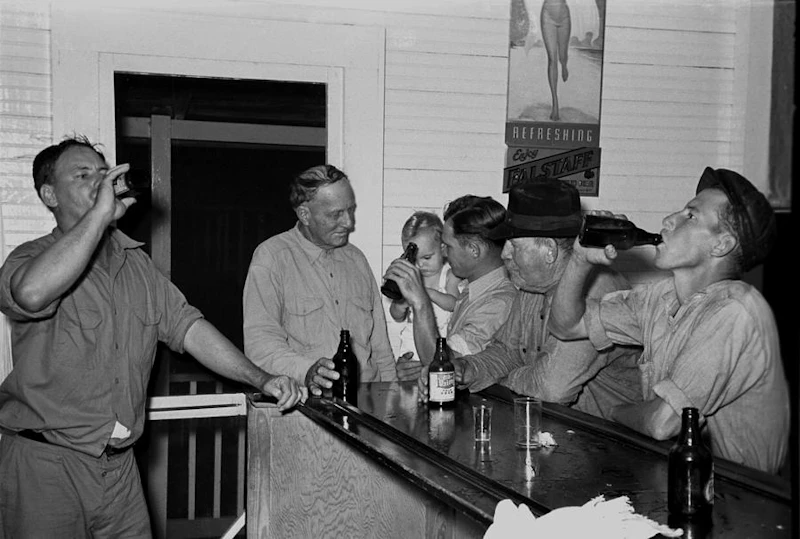
Alcohol’s slipping out of style. Wineries are downsizing or closing. Beer consumption’s declined for years. Young people, who don't go to bars like they used to, are driving the drop-off. More and more of them are saying that they rarely or never drink.
I can barely go a week without hearing which comic has recently quit drinking. Bill Burr and Theo Von. Even Joe Rogan, despite his well-documented history of promoting alcohol, both through personal enjoyment (even on his podcast) and commercial partnerships. Rogan integrated booze into his public “man's man” image for years, and now he's telling us it's not good for us in any amount—that it's “poisoning” our bodies?
It feels like a betrayal. I get it if someone's an alcoholic like Brad Pitt, but I've given up reading about the various reasons so many non-alcoholic celebs are quitting the sauce—to feel “lighter,” sleep better, etc.—because I don't need the guilt trip. Cracking a beer at the end of a work day is a pleasure I’m not interested in sacrificing for some REMs. None of life’s pleasures come without a cost. I haven't drunk to the hangover level in many years, so I'm not jumping on this bandwagon.
What would really disturb me, however, would be a major boozer like Sean Penn, who says he's a heavy drinker but not an alcoholic, announcing he'd quit drinking in order to feel better. Last year, when podcaster Louis Theroux asked him if he ever thought about curtailing his intake, the actor told him he “loved” drinking, adding, “I don't even try to quit anymore.” The actor noted that while he wouldn't recommend his lifestyle to others, he finds a "great comfort" in evenings spent drinking and letting his mind drift, explaining that his alcohol consumption is tied to personal enjoyment and social rituals rather than a "fatal compulsion.”
I got a chuckle when the buttoned-down Theroux, son of prolific author Paul Theroux, earnestly asked Penn if he drank “even on weeknights.” As if Penn, who’s hoisted his share of pre-noon rocks glasses, makes such a distinction when he mixes his standard beverage—vodka tonic.
History has shown that drinking has many benefits. But few today want to address the plusses of alcohol. The scolds are waiting in the wings for any rogue daring to advocate for the joys of hooch. Our national health guru, RFK “Roadkill” Jr., is telling us to drink less, so we're expected to listen to the former heroin addict who used to snort coke off of toilet seats. And who wants the fanatic moms of MADD (Mothers Against Drunk Driving), stoked with their moral fervor and neo-prohibitionist agenda, coming at them? These moms have claws.
Charles Bukowski never gave a hoot about blowback from the temperance police. The novelist and poet, a self-professed “drunkard,” believed that drinking was a “secondary way of life” that allowed drinkers to return to real life in the morning. He viewed booze as a tool for enduring an otherwise “horrifying” existence and an escape from the “standardism of everyday life.” Many use marijuana in that way, but the author hated that drug, claiming it didn't give people the emotional release that alcohol does, and that it makes its users dull and uncreative.
Pot smokers might quibble with that contention, and not everyone feels life’s so unbearable that they need a substance to numb them. But alcohol has been a critical tool for human progress over the centuries. Hunter gatherers used to get their alcohol from rotting fruit and wild grains. There's archeological evidence indicating they eventually turned to agriculture in order to produce beer, which was nutritious, safe to drink, and essential for social and ritual gatherings. The “beer before bread” theory, popular in archaeological and anthropological circles, posits that the thirst for intoxicants, rather than hunger, brought people together in large numbers to create agricultural societies.
Sometimes, hallucinogenic herbs were mixed with the beer. The desire for intoxication that Bukowski tapped into, despite its health and social costs, is a deep-seated urge. In ancient times, alcohol’s ability to alter moods and provide euphoria made it a central element worldwide in cultural and religious ceremonies, and community bonding.
The ancient Greeks consumed wine as a daily staple, viewing it as a civilized, divine gift from Dionysus. Wine was essential to social, religious, and intellectual life—in particular, symposiums, which began by offering a small amount of spilled wine in honor of Dionysus. The Greeks wanted a social lubricant/intellectual stimulant rather than an intoxicant, thus they watered down their wine.
Edward Slingerland’s 2021 book, Drunk: How We Sipped, Danced, and Stumbled Our Way to Civilization, makes the case that if a cultural engineering team were tasked with designing a substance aimed at maximizing individual creativity and group cooperation, “they would come up with something very much like alcohol.” Joe Rogan didn't touch on it when he got preachy about not drinking even a drop. The truth is that the podcast host used to feel “rough” the next morning because he’d overindulged the night before. A shit-faced, disruptive Rogan has made an ass out of himself several times in the past on the Kill Tony comedy podcast.
A disturbing aspect of the downward trend in drinking driven by young people is that it’s, to a significant extent, a byproduct of them not socializing much. Phones have taken the place of the bar, and what a surprise—they’re also having less sex! The youth is more anxious and depressed than ever, yet the public health messaging, which now treats alcohol like nicotine, is scaring them into doing their socializing on social media.
The ancient Greek comic poet Eubulus had sensible views on alcohol, suggesting in his play Dionysius that wise men stop at three “bowls” of drink, which he associated with health, pleasure, and sleep. The fourth bowl invites arrogance and violence, and the bad behavior accelerates all the way to the tenth bowl, which brings on madness. This philosophy is far superior in logical construct and more beneficial to society than the dichotomous thinking that denies the gray areas of drinking.
