
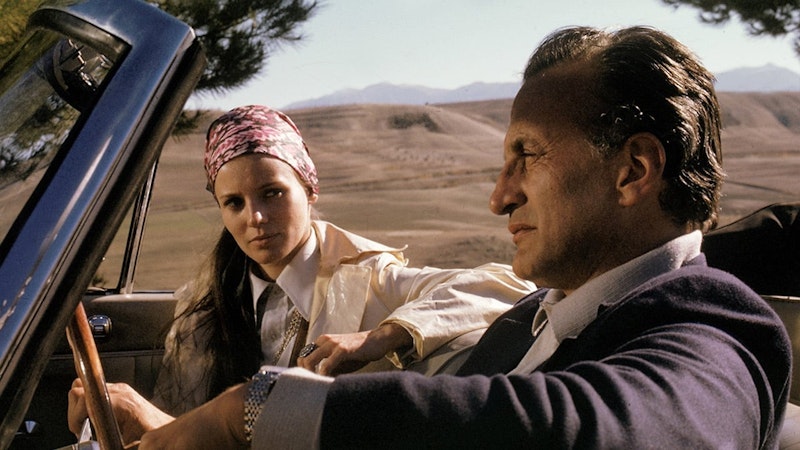
The Last Run has about as generic a premise as a 1970s action-thriller can get: an old getaway driver is brought out of retirement to do one last job. The film, starring George C. Scott and co-starring a BMW 503, is also like any good 70s action-thriller in its nihilistic approach to human relations, where meaning isn’t inherent, whether the characters know it or not—the ones who believe are foolish and the ones who don’t can trick them. The film follows Harry Garmes (Scott) as he’s pulled out of an almost 10-year self-imposed getaway driving retirement and exile to the Portuguese coast. The transport job is way over his head, but he won’t look back now after he’s become attached to the passenger and his girlfriend. Harry knows that once he’s moving, he’s not going to stop.
The 503 is fixed up with a supercharger, a blunt instrument in the motor world. Compared to how a turbocharger spools itself up with the exhaust gas from the engine to force more air into the gas mixture and create more power in its combustion, a supercharger hooks right up to the engine’s crankshaft—this means no lag in power, but also a lot less overall efficiency. As turbos have become quicker to fire up, more reliable, and overall faster, there’s not much competition in the racing scene. But it wasn’t that long ago that they were unwieldy instruments—think about how much lag they had in the Group B cars of the 1980s, where the driver would whip it out of a corner and then the car would suddenly become more squirrely on the straights once the turbo kicked in. Rally cars don’t move like that anymore, they’re much more stable, practically looking like they’re on rails.
Harry’s no rally driver, but he whips his 503 around the narrow two-lanes of the Iberian coast with fury. In the opening scene, after a title sequence where Harry works on the aging BMW, he takes it for a test run, carrying as much speed into the cliff face corners as his backend steps out a little and then a lot as his tires move around the tight turns on a mountainous coastline. Harry aims for a wide line through the apexes before his car goes from understeer-y to oversteer-y, and suddenly every turn starts to feel like a ready-made suicide towards the sea. It’s a professional drive, but slippery, losing grip both literally and figuratively.
Everything about the 503, from its increasing outdatedness to the aftermarket supercharger he installed (it’s no bullshit on the way to get where it's going), are reflections of Harry’s character. Filmmakers often stress out over the gun that someone should carry, but don’t pay enough attention to the car driven beyond some basic aesthetic principles or social signals, and that’s due to the films unlikely to portray the cars as they’re supposed to move. I like this comment from a user on The Last Run’s Internet Movie Car Database page:
- Watch this movie ("The Last Run"). You'll see what I mean. They actually drive this 503 like it should be driven. The movie "The Chase" is pathetic in comparison. These are genuine scenes with this 503—you can hear the real sounds of the car, being driven very hard.
Part of the reason this attention to detail isn’t often given with cars is simply that what I’m talking about are strictly enthusiast concerns: most audience members are unlikely to know as much about a 503, let alone how it should be driven. Moreover, a car can be a blunt instrument, but never hits you as directly as a gun—firearms make easier shorthands to express character because of the immediacy of their size, shape, and rate of first as well the production consideration of it being a lot cheaper to play with a bunch of prop guns than it is an automobile made to look at speed. Think of how many people are still blown away by cars driving at half speed in John Frankenheimer’s Grand Prix.
The beauty of The Last Run, and Fleischer’s direction, is that he imbues this meaning within the film regardless whether it’ll be picked up by everyone or not. It might not do much on the surface at all times, and it’s a texture of realism that many may not catch, but it adds to that ineffable quality that the film holds which makes it stand above so many of its contemporaries. Vanishing Point might give ample time to its car, and The Getaway the emotionality of a doomed chase, but The Last Run synthesizes an undercurrent which will become front and center in 1970s cinema, one where meaning is self-constructed in a post-existentialist, nihilistic world.