Where has Jim Jarmusch been and what has he been up to? Like everyone else, looking for money and a suitable environment. His last film, the DOA zombie comedy The Dead Don’t Die, bombed without a trace in June 2019, and since then he struggled and ultimately gave up on finding financing for his future work in the United States. In 2023, he said, “The film industry is kind of gone… It sucks. It’s gotten worse. The kind of split-rights deals—an equal 50-50 shared profits, after costs, with financiers—that I used to be able to do with my films… if you even suggested that now, you would be laughed out of the fucking building.” Jarmusch is in rarefied air among filmmakers, the master of his domain: he owns the negative to every single one of his films and has for the entirety of his career.
Quentin Tarantino and Christopher Nolan may have their own dreamboat deals, but they haven’t spent their entire careers controlling every aspect of their work. “I’m a control freak in that I have to do it my own way… I have to choose all my own collaborators. I have to have final cut. I have to produce it through my own company. And as for the people financing the films, I allow them to give me notes on a rough cut but I always, contractually, have absolutely no obligation to use them.” He finally found some new partners a few years ago, a familiar name for aging European auteurs: Saint Laurent’s Anthony Vaccarello.
Father Mother Brother Sister, Jarmusch’s first post-pandemic work, premiered at the Venice Film Festival last year after it was rejected by Cannes. It ended up winning the Golden Lion. “Now I kind of never want to go to Cannes. After I gave my little speech up there, that I kind of improvised, someone in the back of the auditorium says, ‘Jim, you know we love you!’ And everybody applauded, right? They were giving me real, sincere love. It wasn’t 2,000 French hairdressers from L’Oréal in Cannes, you know what I mean? It was real. And that was really moving. I never felt that before.”
After its Venice premiere last August, Jordan Ruimy called it Jarmusch’s “most experimental film,” which is nuts: The Limits of Control? Only Lovers Left Alive? Ghost Dog: Way of the Samurai? And it’s not as if those movies are in line with Bruce Conners or Kenneth Anger. Father Mother Sister Brother is a reiteration of familiar Jarmusch tropes: episodic structure, distant families, and a couple of twentysomething stand-ins for the director whose gray hair no longer looks unusual. At 73, Jarmusch might have two or three films left at the rate he’s going, maybe fewer. Thank God for European subsidies: after being turned down by Cannes, Jarmusch spent May 2025 writing a new script, a French road movie. Look forward to lots of shockingly bad green screen during every scene that takes place in a car. Hey, his buddy Spike Lee did it in Highest 2 Lowest, I guess Jarmusch thinks he’s safe. NO! Just have them pull over to the side of the road or a gas station or something. Haven’t you seen that Twilight Zone episode with Gig Young?
Jarmusch has said many times that he’s “a proud dilettante,” and this early-2020 interview where he reads a list of “influences” shows that nicely: William Blake, Greta Thunberg, Sam Fuller, Lucretius, Abbas Kiarostami, Missy Elliot, Hildegard von Bingen, Joyce Carol Oates, Joan of Arc, Gustav Mahler, Pythagoras, James Brown, Maya Deren, Billy Eilish, and Jean-Luc Godard (this list has been edited for brevity—watch the man read the whole list for yourself). His films have catalogued a certain kind of New York hipster taste as it moved from No Wave through the New Wave Nineties through the widespread fascination/fetishization of hip-hop and other previously marginalized people and places. Broken Flowers, a masterpiece, stands apart from all of Jarmusch’s other films for its vulnerability and emotional depth and sophistication; unconcerned with cool, the atmosphere he can’t help but create is actually used to elaborate rather than as an end in itself. So many Jarmusch films amount to people standing in rooms, not talking but tense, unresolved. There’s always language barriers, but in Broken Flowers he explores—presumably—his own anxiety and sadness over not having children; in his words, “yearning for something that you're missing and not necessarily being able to define what it is.” If you’ve seen the movie, it’s pretty obvious. Jarmusch and his longtime partner Sara Driver have no known children.
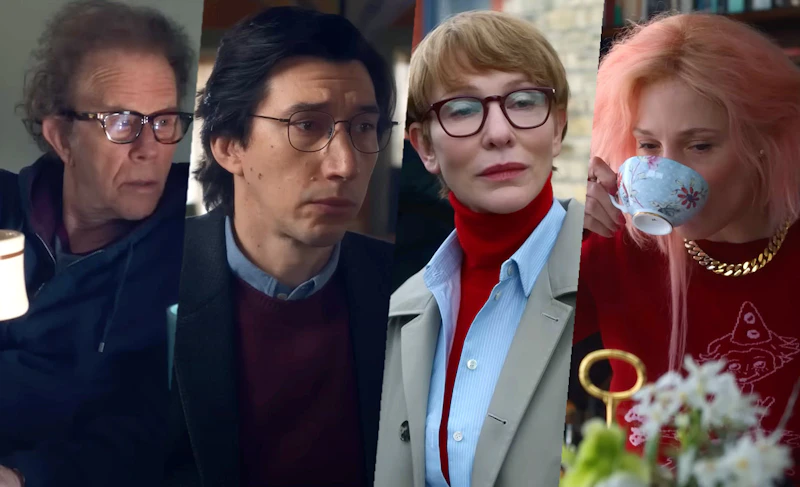
Father Mother Sister Brother is at least set in the present, our present—no vampires or zombies are involved. The first segment features Adam Driver and Mayim Bialik as Tom Waits’ semi-estranged kids. They have an awkward talk over water at Waits’ lake house, and after the perfunctory exchange of dried goods and cash at first refused and then quickly pocketed, the adult children leave and Waits cleans up, not a hoarder but a man about town with a hot date in 20 minutes. This should’ve been the whole movie, or at least some kind of recurring bit; there’s no direct connection between the people in Father Mother Sister Brother, just a couple of motifs like fake Rolexes and the English expression “Bob’s your uncle” (Driver and Bialik are mystified when Waits says this, but hasn’t everyone heard “Bob’s your uncle”?)
Charlotte Rampling is the mother of the second segment, preparing to host her “annual” tea time with grown daughters Vicky Krieps, the lesbian rebel, and Cate Blanchett, the studious and mousey one. Their dinner is suitably awkward, and it ends quickly, and we’re once again transported to the next story through a series of colorful out of focus lights. Indya Moore and Luka Sabbat are twins visiting their peripatetic parents’ Parisian apartment after a mysterious plane crash. This is the segment that should’ve been cut or radically reconsidered, because as it is, it’s merely yet another example of Jarmusch desperately trying to stay cool, whatever that means. His references are a decade out of date anyway: they microdose psilocybin, call their dead mother “problematic,” stress over how “fragile” the world is.
And that’s about it. Why is Jarmusch so hesitant to really face his fixation on strained family relationships and the absence of family relationships? He comes so close in that first segment—Tom Waits, who’s usually annoying beyond belief, is charming for a change—and keeps teasing with the second, only to bounce with the twins and include yet more poorly-photographed car scenes. We get it, you’re in Europe. I’m glad Jarmusch has found a new artistic home, and I hope that French road movie comes out soon, because maybe he’ll finally be able to talk about himself once he can do it in a foreign language.
—Follow Nicky Otis Smith on Twitter: @NARCFILM