
When I was a kid, like most of my friends, I loved summer. No school, too young for a job save mowing lawns, mornings starting with re-runs of sitcoms (My Little Margie, Father Knows Best, Dennis the Menace, The Bob Cummings Show and so on), playing softball, exploring the woods behind the 14-house development we lived in, and swinging from vine to vine, sneaking a cigarette or two at the construction site nearby and having wicked water pistol—or machine gun—fights. The unrelenting heat (usually two out of three months) sucked, as did the mosquitoes at night. Towards the end of August, I got a little restless and tentatively looked forward to another year of elementary or junior high school. That lasted about a week.
As I got older, the heat was still a drawback; none of my apartments (or tiny dorm room freshman year of college) had air-conditioning, and movie theaters and the Wall Whitman mall were temporary respites. But that changed, and I remember exactly when: it was in July in 1985 and Baltimore featured the annual Artscape festival (when it was still non-commercial) and as my late friend Joe Potts and I walked up and down Mt. Royal Ave., drinking beer, the sweat splattered our bodies. When I returned to my apartment on nearby E. Biddle St., turned on The Smiths’ Meat Is Murder, I made a vow to forevermore ignore the heat and embrace it. Never looked back, and that’s why summer remains my favorite part of the year: ideally it’s 90 degrees with 100 percent humidity. Maybe that’s an oddball stance, but my oddball meter busted a long time ago.
Last week I read a surprisingly pleasant essay in The Atlantic—rare as finding a crunchy Granny Smith apple in July—by Elizabeth Bruenig, who details the reasons why she initially loves summer, but has had her fill shortly after the Independence Day holiday. There’s also the mandatory climate change statistics, including the deaths and heat waves in Europe and that weird smoke from Canada, which she says resulted in “forcing all activities indoors.” What a sissy. During that week or so, when the sky was a brown-acid kind of color, with a faint smell, I kept to my normal schedule.
A 35-year-old parent of two active daughters, Bruenig writes: “Summer always overstays its welcome by about a month. After the Fourth of July, which has its charms, nothing but a stretch of relentless heat lies ahead, reaching toward Labor Day, and I begin to yearn for fall. By mid-August, grocery stores are stocking their shelves with autumnal goods… As I stroll through the aisles, I gaze wistfully at candy corn while the frosty supermarket air cools the sweat I worked up walking to the store beneath the blazing sun.” (Bruenig and her husband Matt—a far-left “progressive” pest—were raised in Texas, so you’d think “the blazing sun” wouldn’t rattle her.)
That’s dramatic, but I’d guess most who forsake the insane political commentary The Atlantic runs, and read this essay, will nod like yo-yo’s in agreement. I’ve never “gazed wistfully at candy corn” or packs of 96 mini-Milky Way bars; in fact, the stocking of Halloween goods, school supplies and even Christmas ornaments washes over me, just like the now-locked up rows of deodorant, shaving cream, or Tide detergent.
I found just one paragraph really maddening, when Bruenig recounts activities with her kids. “My two daughters are golden-skinned, with sun-bleached braids; their fine, downy body hair catches the light, lending them an ethereal glow. They look like young gods in the summertime of their lives.” Jesus Christ, why not send the “young gods” to a modeling agency and get it over with! (I was surprised she described the gals as “gods,” rather than “goddesses,” surely an Atlantic infraction that wasn’t caught by a copy editor.) But, in fairness, this Bruenig essay is (aside from the rote climate change apocalyptic baloney) devoid of any overt political commentary, a relief since she’s a “progressive” who’s worked at The New Republic, Washington Post, New York Times and now The Atlantic.
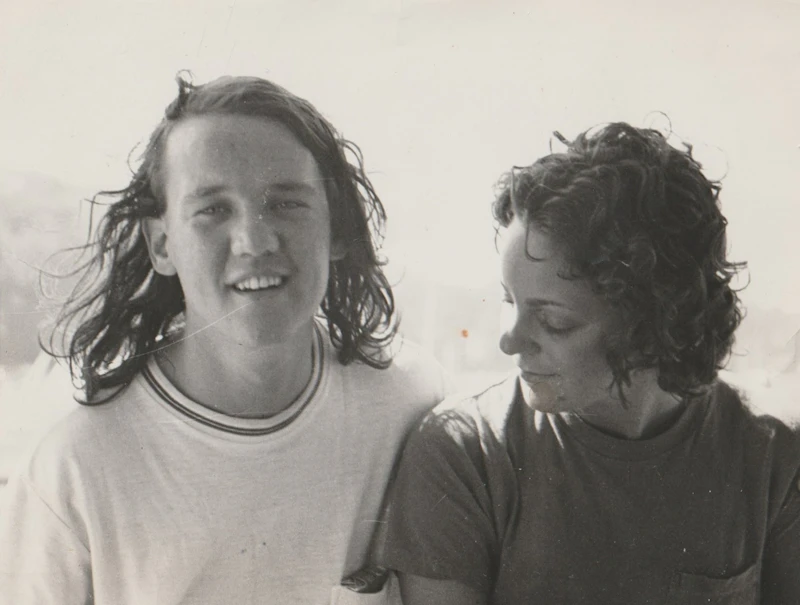
The picture above is of my longtime friend Elena Seibert and me, one summer afternoon on a small boat in Huntington Harbor. After carousing far too recklessly the night before—about 15 of us went skinny-dipping at midnight in a swimming pool (the owners were on vacation) while drinking from jugs of very cheap red wine—I’d fallen asleep on the boat for an hour and awoke with a killer sunburn. A 15-minute swim was about as restorative as possible, and after a Burger King “dinner,” my friends and I were ready to go another round.
Take a look at the clues to figure out the year: Jacques Chirac becomes France’s Prime Minister; Charles de Gaulle Airport opens in Paris; Eddy Merckx wins the Tour de France; AP’s Slava Veder wins the Photography Pulitzer Prize; Daylight Saving Time begins four months early in the U.S.; Happy Days debuts on ABC; Mia Farrow is on the first cover of People; the Boston Celtics win the NBA Championship; Leonardo DiCaprio is born and Jack Benny dies; The Los Angeles Dodgers have best record in MLB at 102-60; Mike Hargrove is the American League’s Rookie of the Year; and Studs Terkel’s Working is published.
—Follow Russ Smith on Twitter: @MUGGER2023