
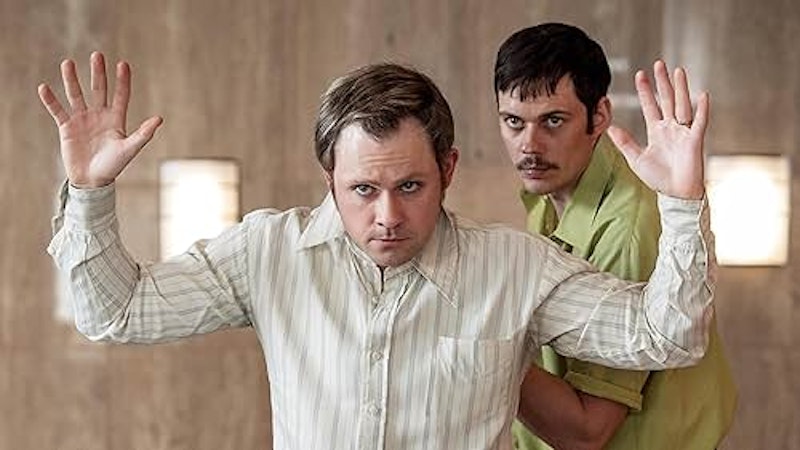
Gus Van Sant’s Dead Man’s Wire ends with Gil Scott-Heron’s “The Revolution Will Not Be Televised” playing over credits and news footage of the 1977 Indianapolis Tony Kiritsis kidnapping. It’s a stylish, ambivalently ironic commentary on America’s obsession with anti-establishmentarian violent spectacle as a substitute for actual change—an obsession which Van Sant is maybe critiquing and maybe just reproducing.
Tony (Bill Skarsgård) was an Indianapolis businessman who fell behind on mortgage payments for a property he hoped to fill with commercial developments. Kiritsis was convinced that his mortgage broker, M.L. Hall (Al Pacino) had deliberately driven away potential tenants so Kiritsis would be forced to sell them back the property at a loss.
As revenge, Tony went to the offices of Meridian Mortgage planning to kidnap M.L.—but when M.L. wasn’t there, he settled on seizing his son Richard (Dacre Montgomery). He strapped a wire connected to a shotgun around Richard’s neck; if Tony was killed, the shotgun would fire, killing Richard too. Then Tony holed up with Richard in his own apartment for days, demanding an apology from M.L. and $5 million in restitution.
Van Sant’s direction, in the true crime tradition, is gritty, matter-of-fact, and largely refuses to take sides—you never learn whether or not Meridian really did cheat Tony or not. The movie gives you reports of truth, delivered by local up-and-coming reporter Linda Page (Myha’la) and local radio DJ Fred Heckman (Colman Domingo.)
Tony’s obsessed with the latter, and the cops try to keep him calm in part by urging Fred to broadcast interviews with the kidnapper—interviews in which the DJ’s smooth tones are interspersed with Tony spewing populist bile and then apologizing for his language. His pseudo-revolutionary jittery rants, in which he portrays himself as an everyman ground down by bankers, enthrall many listeners—and it’s easy to see why. Skarsgård captures Tony’s instability, sincerity, and oddly inappropriate gallantry; he seems genuinely concerned about Richard’s family even as he threatens his life. Tony never doubts that the cops are honest when they offer him immunity. He’s a man of his word, in a weird way, and he can’t believe that others aren’t, even though he’s kidnapped a man who he believes defrauded him.
Part of Tony’s gullibility is linked to his faith in the image; if people make a promise in front of a camera, he figures, they have to keep it. Public image is public truth is public validation. That’s nonsense, but Tony isn’t the only one who finds it convincing. M.L. is so concerned with public opinion that he won’t issue an apology or admit fault, even with a gun to his son’s head.
Tony loathes M.L., and Pacino as M.L. oozes self-satisfied contempt when he addresses Tony. But the two share a fetish for control. M.L. berates waitstaff for failing to memorize his weekly lunch schedule; Tony’s dead man’s wire, and the explosives rigged in his apartment, are the work of a man whose revenge is served with elaborate planning. For each, their own self-image as successful men is dependent on making others do their bidding. To be a man, for both, is to force others to see them as they want to be seen.
The film doesn’t validate either of these assholes. But it does imitate them, to some degree. Tony doesn’t just stage a kidnapping; he stages the media event of a kidnapping. In that he’s not unlike Van Sant, who’s remaking the film that Tony made, down to some of the shots, as the footage over the credits indicates. Tony sees himself, the film suggests, as a movie star like John Wayne, turning film into reality—and then Van Sant comes along and turns reality back into the film we’re watching.
The allure of that film is linked to the ingenious mechanics of violence, the righteous thrill of revenge, the anti-establishment frisson of fighting the man. Like the ghoulish TV executive watching Tony’s press conference and salivating over the possibility of an on-air execution, we’re there to see banker blood on the walls.
And like that ghoulish exec, Van Sant’s aware that the banker blood on the walls can itself be taken to the bank. The film’s populist cynicism and its anti-populist cynicism are in perfect balance. And if that seems like a cop out—I think Van Sant would be the first to tell you that the revolution will not be filmed.