

8th Ave. extends north from Hudson St. at Abingdon Square to Central Park (where it becomes Central Park West, and north of 110th St., Frederick Douglass Blvd.). It has an odd little stretch between the square and 14th St. in which it cuts across the street grid, creating interesting plazas and building angles.
I’m not sure when 8th Ave. was extended south of Greenwich Ave. to Hudson St. at Bethune, but it shows up like that on maps as far back as the 1840s. The south end of 8th Ave. is punctuated by Abingdon Square, which is named for the Earl of Abingdon, the son-in- law of Sir Peter Warren, a Royal Navy officer who owned much of the territory in the Village before the Revolutionary War, including the triangle of property now occupied by the square. The square’s statue, dedicated in 1921 for its centennial, was sculpted by Philip Martiny. A former major east-west road in lower Manhattan, predating the grid, was called Abingdon Rd.
The statue depicts a World War I “doughboy,” as do many WWI memorial statues around town, and was a gift from the Jefferson Democratic Club. Martiny sculpted a second memorial nearby at 9th Ave. and W. 28th St. that used the same model.
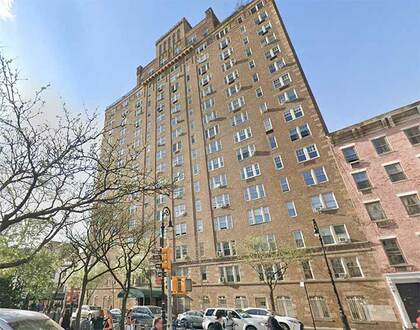
The magnificent Tuscan-styled #299 W. 12th St. faces the park, with a fine southern view. It was developed by developed by brothers Leo S. and Alexander Bing, designed by Emery Roth and completed in 1931. The Bing bothers founded their development company in 1906, building properties with spacious apartments around town. The Bings also developed the equally voluminous #320 W. 12th, on the catercorner.
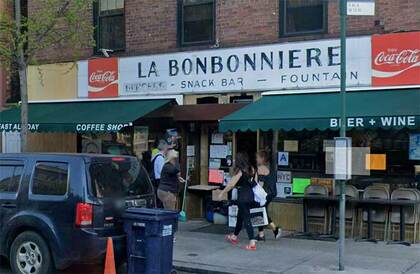
8th Ave. and W. 12th meet at an angle. which makes for a sharp triangle building at the NE corner. There’s a magazine store on the corner, and a couple of doors north on 8th Ave., a restaurant with a French name (meaning “candy dish”) serving burgers. I like the mid-1970s Coke Adds Life! signs. If it was Kinky Friedman’s kind of place, it’s mine as well. The white band on red Coca-Cola signage, known as the “dynamic ribbon,” was created by designers Lippincott & Margulies in 1969 as a graphic reminder of Coke’s iconic green curved bottles. The red square also has a name, the “Arden Square.” The history of various Coca-Cola logos over the years is related on its website.
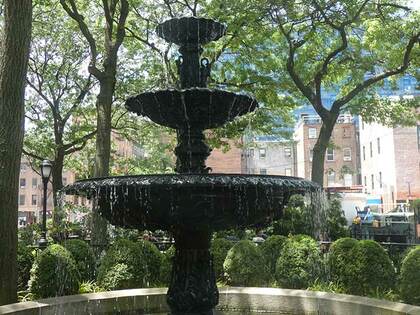
Located on the triangle between 8th and Greenwich Aves. and Horatio St., Jackson Square has officially been a public park since 1872, though it appears as a “square” on maps prior to that. It’s widely thought that the square is named for its most obvious honoree, President Andrew Jackson ( 1767-1845) since “Old Hickory” had been a hero in Tammany Hall circles. However, Mozart Hall, a faction that had split off from Tammany, met in a building called Jackson Hall at #2 Horatio across the street from the park. Mozart Hall founder Fernando Wood was elected mayor of NYC in 1859 after winning from Tammany in 1854. The large iron fountain was added as part of renovations that took place in 1990.
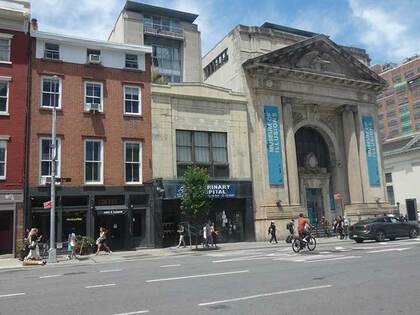
Two grand old bank buildings face off across 14th St., which is now closed to most auto traffic, excepting buses and truck deliveries. What was originally the New York County National Bank (ghost letters can still be seen on the pediment) was built in 1907 from designs by architects DeLemos and Cordes with Rudolph Daus. (DeLemos and Cordes also designed other monumental buildings such as the Siegel Cooper Dry Goods Store on 6th Ave. and W. 18th and Macy’s in Herald Square.) After a stint as Manufacturers Trust—later Manufacturers Hanover Bank —the building became a theater and is now the Museum of Illusions.
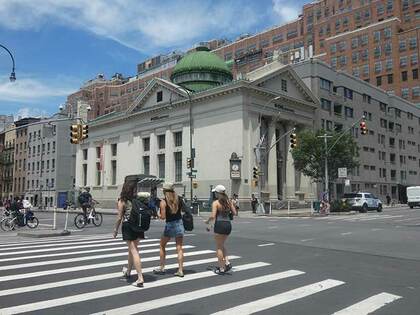
This copper domed, Corinthian-columned building on the NW corner of 8th Ave. and West 14th St. is the former New York Bank For Savings, constructed in 1897 by architect Robert Henderson Robertson. It passed through incarnations as Goldome Bank, Central Carpet, Balducci’s, and now the fanciest CVS drugstore in NYC. The Classic Revival bank resembles its contemporary, the Bowery Savings Bank in Chinatown. The former bank was restored in the 1980s by Robert Scarano Jr. Note the white marble exterior and the stained glass windows surrounding the dome. The copper clock features renderings of bees and beehives, a traditional symbol of thrift.
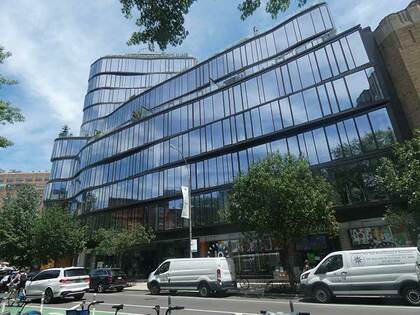
I disliked the glassy, undulating One Jackson Square at 8th and Greenwich Aves. when it arrived in 2009-2010 because it hides a very large ancient painted ad for the long-gone Wellner Motors, but I’ve had a grudging appreciation lately; it’s more imaginative than what I’ve seen in new buildings since.
Kevin Walsh is the webmaster of the award-winning website Forgotten NY, and the author of the books Forgotten New York (HarperCollins, 2006) and also, with the Greater Astoria Historical Society, Forgotten Queens (Arcadia, 2013)