

Jamaica Hills is one of the smallest neighborhoods I’ve profiled for Forgotten New York. It spans a few square miles between Grand Central Parkway on the north, Hillside Ave. on the south, Parsons Blvd. on the west, and Homelawn St. on the east. It sits atop the terminal moraine that stretches across Brooklyn and Queens, a group of steep hills that mark the southern advance of glaciers that retreated during the last Ice Age. The hills were fortuitous for rich property owners, who built multitudes of expansive mansions in the region in the late-1800s and early-1900s. When the Long Island Rail Road built a massive interchange nearby in Jamaica proper in 1913, Jamaica Hills, just to its north, became more populated and first, frame houses and then, multi-family apartment buildings sprung up amid the hills.
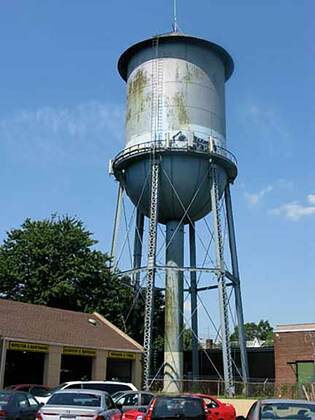
The neighborhood formerly featured at least two of these huge water tanks. This one made an imposing sight from 84th Ave. and 164th St., and there was a second one on Austin St. near Kew Gardens Rd. They were remnants of the last private water company in NYC—the Jamaica Water Company, who supplied well water to the Jamaica/Jamaica Estates area up until 1996. The water was pretty horrid, and almost everyone was glad to finally receive NYC water. Most of the pumping stations are still around and maintained. It’s probably a good “forgotten” subject in itself. One of the interesting “problems” from the shutdown—the water table in that part of Queens has risen five to 10 feet and places that were always dry (because pumping had been going on for 100 years) are now wet, and you get flooded basements.
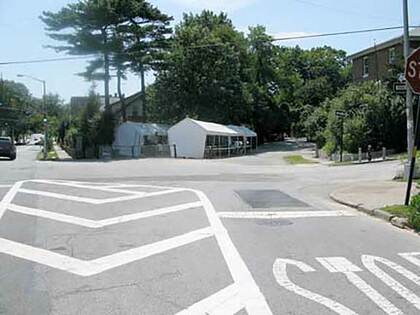
Traveling south on 164th, there’s a bit of road that slants off to the southwest and comes to a dead end. This is called Glenn Ave. on some maps, but it’s really a remnant of the New York and Queens County Railway—a trolley line that connected College Point, Flushing, Pomonok, Jamaica Hills, and Jamaica.
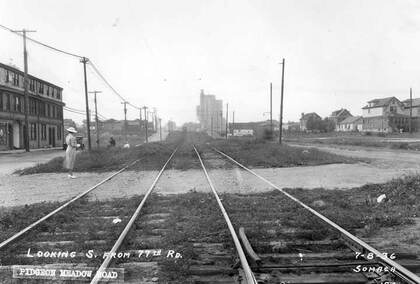
The line ran in a right of way on a relative straight line south from Flushing Cemetery, turning southwest here, and then south again on a right of way adjacent to Parsons Blvd., east on 90th Ave. and then south on 160th. When 164th St. was built in the early-20th century it assumed a route adjacent to the trolley line and then absorbed it, becoming a wide four-lane traffic route. This view shows the streetcar line on 164th St. and 77th Rd. in 1936; it’d close the following year.
Part of the trolley route traversed what would eventually be called Normal Rd., which runs between 162nd St. and Parsons Blvd. and 86th Ave.. The reason behind this name isn’t immediately apparent, at least in Queens, but I remembered Normal, a mid-sized town in central Illinois, and researched that name. In the 1860s it adopted the name from Illinois State Normal University; in turn, normal schools are teacher training schools and are so-called for teaching standards, or norms.
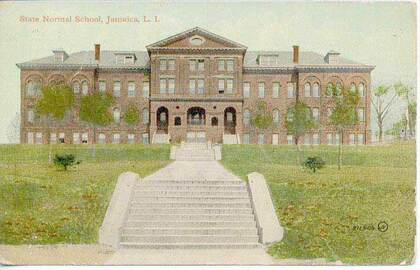
PS 86 and Hillcrest High School was built on a parcel at the corner of Highland Ave. and Parsons Blvd. which used to be the site of the State Normal School which was razed in the late-1960s I believe, to build the two current school buildings.
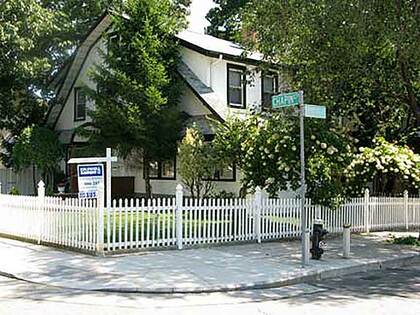
I’m somewhat more baffled by the presence of two streets in Jamaica Hills, Chapin Ct. and Chapin Parkway. The parkway runs in an “S” shape from 164th St. east, south and east again to Captain Tilly Park and Jamaica High School (see below) where it becomes Gothic Dr.; the court, seen here, runs between the parkway and 165th St., where there are a pair of representative frame houses, one on sale, picket fence and all. The Chapin streets were named some decades before the rise of the late folk rocker/activist, Harry Chapin, in the 1970s, though the streets always bring him to mind.
Chapin’s a prominent family both in Brown University and southeastern New England history. I’d believe that both of those streets reference Alfred Chapin, former mayor of Brooklyn, U.S. Representative, and NY State Railroad Commissioner. The New York Times made him out to be a political star in 1892, naming him a long-term prospect for the presidency in 1892. He was viewed both as a proponent of schools and transportation at the time, and thus a road named after him would make sense.
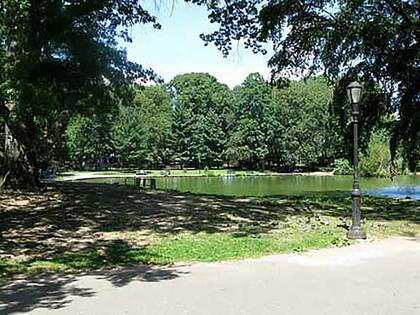
Finding Captain Tilly Park and Goose Pond, roughly between 85th and Hillside Aves. east of 165th St., was a pleasant surprise for me when I moved to Flushing in 1993 and started cycling around the borough—I was unaware a large, pleasant park like this was here. It’s also sort of out of the way—I traveled down twisting Chapin Parkway, and there it was, just past the second bend in the road.
The park was built on land owned by the Highland Park Society (the park’s southern boundary is Highland Ave.), who sold it to NYC in 1908 for the price of $1, with a stipulation that it remain a public park. Until 1995, Goose Pond was fed by underground springs, but since a park renovation in 1998 it’s been kept clean by a filtration system.
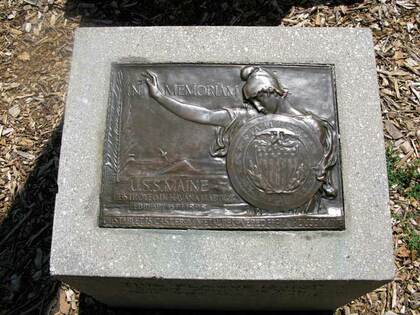
There’s a Spanish-American War monument in Captain Tilly Park—a war that’s underrepresented in NYC statuary. The park’s honoree, Captain George H. Tilly, was killed in action (as part of the Army Signal Corps) in the Philippines on May 22, 1899. On the island of Panay to repair a damaged telegraph cable, he ignored warnings to go mufti, and he and his group were fired upon; all but Tilly from among his group made it back to their boat safely.
The Tilly family once owned the land where this park sits. After the Highland Park Society sold it to the city, it was called Highland Park, then Upland Park; it was named for Tilly in 1935. The stele honoring Spanish-American War veterans, with this bronze remembering the Maine, was placed in the park in 1941.
Dear Old Jamaica High
by Harwood Hoadley
There is a certain High School out in old Jamaica Town
Of all the schools we’ve ever known she most deserves renown
Her boys are strong and manly and her girls are beyond compare
And Royal Red and Loyal Blue are the colors that they wear
In gym, on track, on diamond her honor we maintain
In oratory and debate for her fresh laurels gain
Her fame’s upheld by song and play, for loyal each and all
We rally to defend her name and gather at her call
Then cheer for old Jamaica High, the school without a peer
We’ll cherish long the memory of the days we’re spending here
Prosperity be always hers, courageous purpose high
And loyal love attend her and fame that shall not die
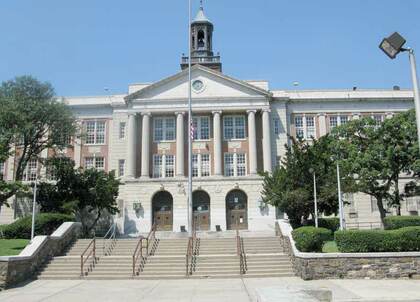
—from “The Beaver Book,” a fascinating history of Jamaica High School from 1892-1927. The book takes its name from the now-filled-in Beaver Pond, just south of downtown Jamaica: the school mascot is a beaver. The school, on Gothic Dr. east of Tilly Park, has a rich history, but declining admissions forced its closure in 2014. It now operates as the Jamaica Educational Campus, housing multiple smaller public high schools. Ground was broken for imposing Jamaica High School (Gothic Dr. and 168th St.) on March 25, 1925; it was completed in 1927 (it resembles Fort Hamilton High in Bay Ridge and Franklin K. Lane in Cypress Hills, with all three hailing from the same decade).
Prominent Jamaica High graduates include filmmakers Josef von Sternberg and Francis Ford Coppola, science writer Stephen Jay Gould, humorist Art Buchwald, Brooklyn Dodgers owner and mover Walter O’Malley, and John Mitchell, the Watergate-era U.S. Attorney General.
—Kevin Walsh is the webmaster of the award-winning website Forgotten NY, and the author of the books Forgotten New York (HarperCollins, 2006) and also, with the Greater Astoria Historical Society, Forgotten Queens (Arcadia, 2013)