
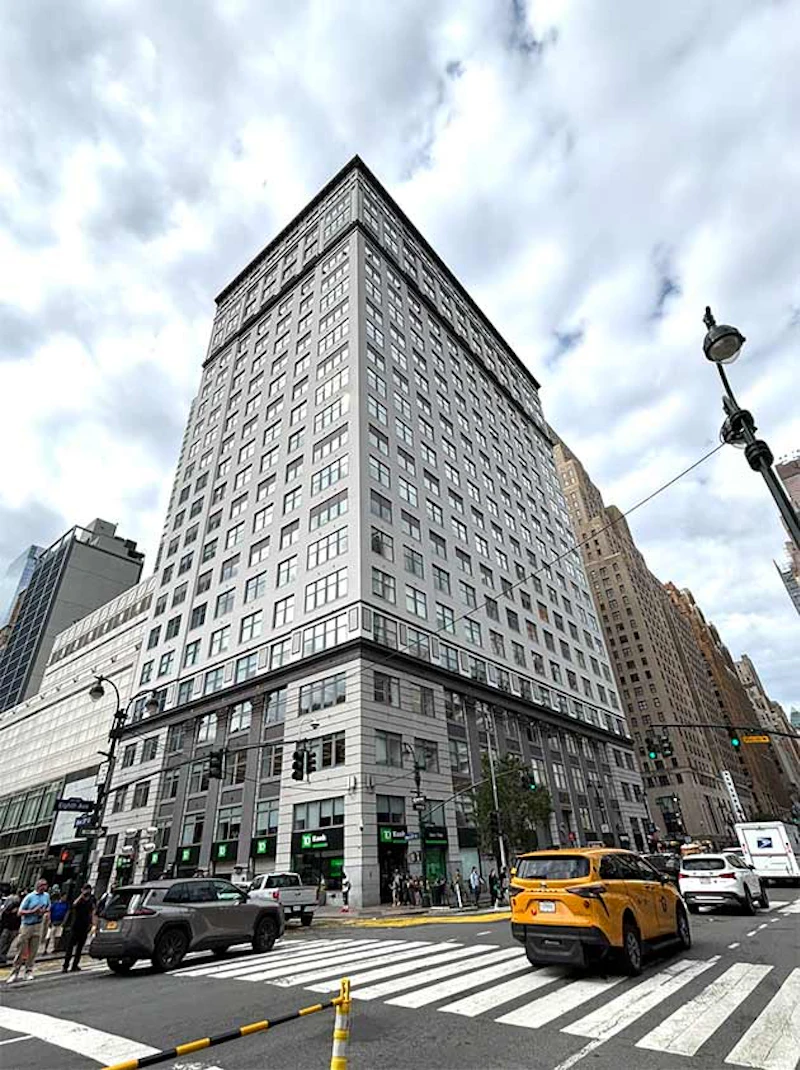
Though the columnated James A. Farley Post Office, now hosting the Daniel P. Moynihan commuter train hub, is by far the most photogenic building at 8th Ave. and W. 33rd St., today I’ll be referencing #461 8th Ave. across 33rd St., which has since been dubbed #5 Penn Plaza (Penn Plaza consists of several buildings in the Penn Station area numbered #1 to #11, though they are scattered around in no particular order). I’ve visited this area with regularity for over 30 years but have never considered it of particular note until recently.
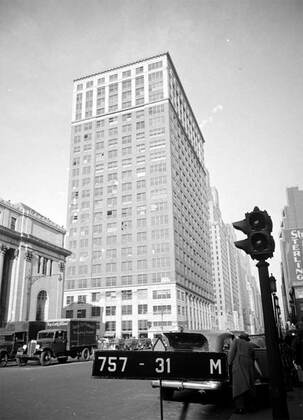
The 24-story all-steel tower was constructed in 1916 and you can see it in this Municipal Archives tax photo from 1940. Its original name was the Printing Crafts Building. According to New York Times articles from 1916, it was the largest structure in the country dedicated to printing and publishing, with 600,000 square feet of floor space. What an atmosphere must’ve been in there, with multiple printing presses clickety-clacking away. The second to 11th floors were devoted to printing, binding, lithographing, electrotype, engraving, and ink and paper distributors. The 12th floor and above housed offices, salesrooms and stockrooms of publishers, advertising agencies and graphic arts dealers. Since I’ve been in the print business in a variety of roles since 1981, had I been around in this era, I might’ve found employment in the Printing Crafts Building.
Among the printers and tenants, the Times article notes Trichromatic Engraving, Field and Stream, Boulevard Publishing, lord and Nagle, New York Master Printers Association, Printers League of New York, Graphic Arts Association, New York Monotype, Edward B. Sott and many more. Most of these, save Field & Stream, have been lost to bankruptcy or merger.
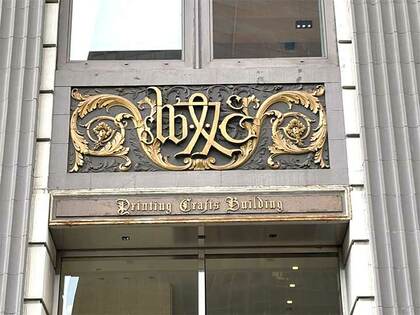
I’ve said I didn’t give this building much notice. Back in 2000, I was interviewed by the late Bill Bell and had my photo taken by award-winning photographer Susan Watts for a Daily News piece in an Irish-themed restaurant on the ground floor, Tir Na Nog, which has since moved to West 31stStreet. Then and till just this week, I didn’t notice the finely wrought metal cartouches above the first-floor windows, separated by Corinthian pilasters (columns attached to the building). This one spells out “Printing Crafts Building” in blackletter, and above it a digraph (2 interlocking letters). In this case, the letters are W and C, as this was the printer’s mark for Willliam Caxton, a 15th-century Briton who introduced the printing press to England in 1476. He was also a master translator: for example, he published the first English-language edition of “Aesop’s Fables.”
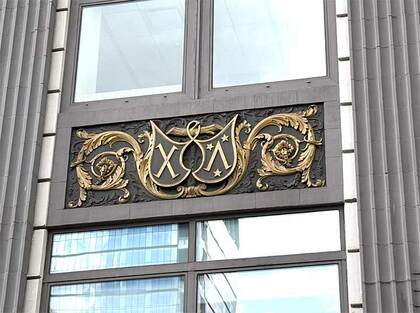
Apparently perplexing is this cartouche that seems to show a letter X and upside-down V, the mark of German printers Johann Fust and Peter Schöffer, successors to Johann Gutenberg and publishers of the Mainz Bible in 1462. Unfortunately, my research hasn’t turned up what the characters signify.
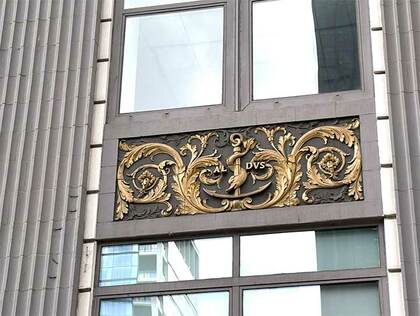
Italian pressman Aldus Manutius (1449-1515) established one of Italy’s finest printing presses in Venice in 1493. It’s thought he invented the slanted style we call italic type. His printers’ mark was a dolphin surrounding an anchor. The design stands for the classical phrase festina lente, which means "make haste slowly"; the dolphin shows speed, while the anchor shows steady weight and safety.
Aldus is the name of a former software company that made, you may recall, an early giant in the desktop printing biz, Aldus Pagemaker. It was purchased by Adobe, which updated it through 2001; Adobe has succeeded it with the more complex InDesign.
Aldus St. in Longwood, Bronx runs through the former estate of Colonel Robert Hoe, inventor of the rotary press. When the city developed the area and streets were cut through, three were named Hoe Ave. (which is still there), Guttenberg St. (now E. 165th), and Aldus St. The dolphin and anchor symbol can be seen in other former printing buildings such as #20 Vesey St. downtown and the Underhill Building, #438-448 W. 37th St. in Hell’s Kitchen.
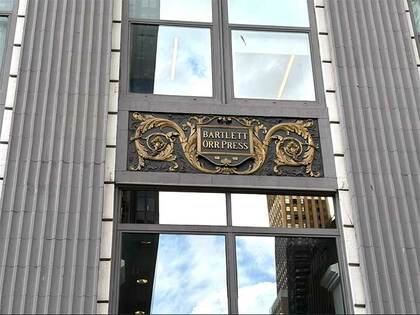
The Bartlett-Orr Press is the only print firm referenced on the cartouches. According to ancient advertising expert Walter Grutchfield, the company had already signed a lease when the Printing Crafts Building was completed in 1916. The press was founded by Edward Everett Bartlett and Louis Herbert Orr in 1888 on Rose St. near the Brooklyn Bridge, at the time a printing district, and moved to W. 25th St. in 1908. Bartlett was an illustrator, wood engraver, type designer and author of the book Typographic Treasures of Europe. Orr was an expert wood engraver and president of the Springfield (Massachusetts) Printing and Binding Company. The Bartlett-Orr Press remained in business in the Printing Crafts Building until 1932.
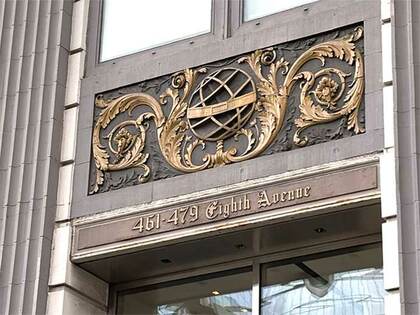
This belted globe seems to signify the building handled worldwide business. Possibly, another printer’s mark.
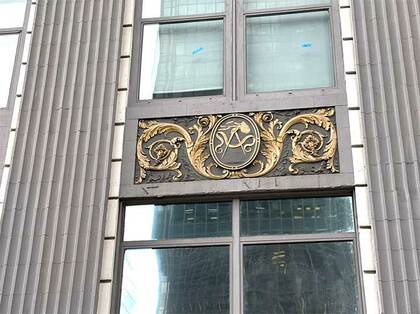
This busy cartouche depicts a hand coming out of a cloud, holding a compass. A ribbon is imprinted with the Latin phrase “labore et constantia” or “work and perseverance.” It’s a printer’s mark, for 16th-century French printer Christoffel Plantijn (Christopher Plantin). A compass has a moving leg and a fixed leg: moving for the labor, fixed for the constancy. His publishing house, Plantin Press, made Antwerp, Belgium the leader in the European printing industry at the time. His most important work is considered to be the Biblia Regia (King's Bible). The popular serifed text font, Plantin, bears his name. If you remember the old Village Voice, in the 1970s and 80s its headers were in Plantin Condensed Bold.
You never know what history you’ll find by looking up from your phone.
—Kevin Walsh is the webmaster of the award-winning website Forgotten NY, and the author of the books Forgotten New York (HarperCollins, 2006) and also, with the Greater Astoria Historical Society, Forgotten Queens (Arcadia, 2013).
