

I lit off down Court St,, a walk I’ve done for Forgotten NY and long before that. Court St. runs from Brooklyn Heights southwest to Red Hook, and I frequented that area most days between late-1975 and early-1981, when I went to school and worked there. First long-term employment, first real girlfriend, struggling through college. I never used the degree I obtained but took the basics from working on the college newspaper… the picas, points and type sizes and fonts… and worked for much of the next 45 years in type as a proofreader, compositor, copy editor and writer. I learned the basics of writing from the newspaper but when I consult the few issues I’ve saved, it’s embarrassing. Perhaps I’ve reached a level of aptitude I was comfortable with (both Harper Collins and Arcadia Publishing agreed, since they published me in 2006 and 2013).
I’d never noticed there was a Korean War Veterans memorial at Cadman Plaza West (formerly Fulton Street) all the time I was around the area between 1975 and 1981. That’s because this particular memorial was installed in 1992. Korean War memorials in NYC are sparse; there’s a substantial one in Kissena Park, but it’s deep in the park, far from the nearest street, Rose Ave.. In Staten Island, Richmond Parkway, which started out as local-access Drumgoole Blvd. and connects Richmond Ave. with the Outerbridge Crossing, was renamed Korean War Veterans Parkway.
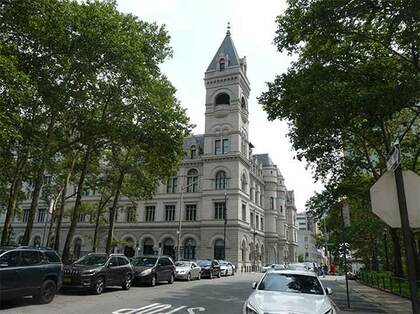
One of the most monumental buildings in Brooklyn, the Romanesque US Post Office, Johnson St. between Cadman Plaza East (Washington St.) and Adams was built in stages from 1885 to 1933, with Mifflin Bell the architect. I recall my old man visiting this post office on numerous occasions when I was a kid. He shipped and received reel-to-reel tape recordings and was a member of a club called Tapeworms International. He had “tape pals” as far away as Cape Town, South Africa. I remember him using a scale to determine how much postage he had to use.
Brooklyn moved its main postal facility way out east to near the undefended Brooklyn-Queens border several decades ago, but this building is still busy. I wonder if a different fate awaits it, like the James Farley Building’s transformation into the Moynihan Train Hall.
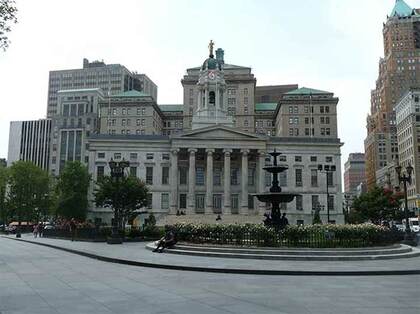
Brooklyn’s City Hall was originally built in 1848 in the Greek Revival style in Tuckahoe marble, designed by architects Gamaliel King and Calvin Pollard. In 1898 it was “demoted” to Borough Hall as the county of Kings was absorbed into Greater New York. That same year it received its present cupola and gilded statue of Justice; the originals were destroyed in an 1895 fire. There was a push to demolish the structure in the 1930s; some critics felt its design wasn’t sufficiently attractive. The Depression and war ended whatever plans there were for a new Boro Hall, and in 1966 the building received designation by NYC Landmarks. The sign from the opening credits of Welcome Back, Kotter that read “Welcome to Brooklyn, 4th largest city in America, Hon. Sebastian Leone Borough President” (1976) currently hangs in the lobby of Borough Hall. And, a tile representation of Boro Hall can be found on the walls of the #2/3 IRT platform underground.
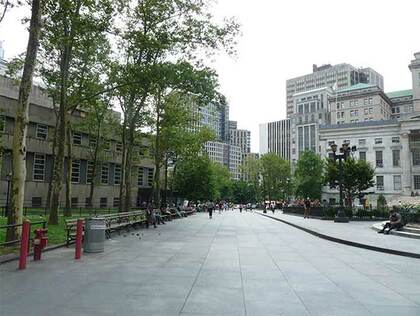
This path, adjacent to Boro Hall, is a remnant of Fulton St., which is a very old road going back to the early-1700s as the British forged what they called “King’s Highway” that reached from what was the Fulton Ferry landing south along what is now Old Fulton St., Cadman Plaza West, Fulton St., Flatbush Ave., and the modern Kings Highway all the way to Midwood in the heart of Brooklyn. When Cadman Plaza was built in the early-1950s, this section of Fulton St. was closed to traffic and turned into a pedestrian path. Creating Cadman Plaza meant the closing of several streets and razing nearly a hundred buildings. In addition, the Fulton St. El also ran along this section of the street until it was eliminated west of Rockaway Ave. in 1942. Other sections were later torn down; only the part that runs along Liberty Ave. in Ozone Park remains today.
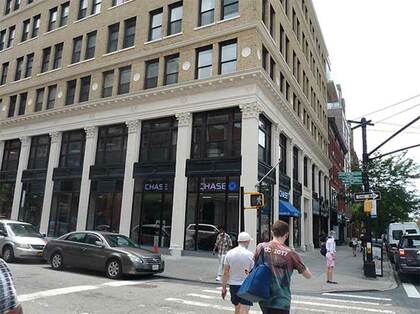
My first paying job in the mid-1970s was in this building at the SE corner of Court and Schermerhorn: I was hired by my friend Anthony Casale, recently deceased, to sweep up and develop photos in the darkroom of a passport photo studio he co-owned on the ground floor. It’s said you should never work for your friends and our friendship was bruised during the summer of 1978. However, it recovered and I knew him a long time.
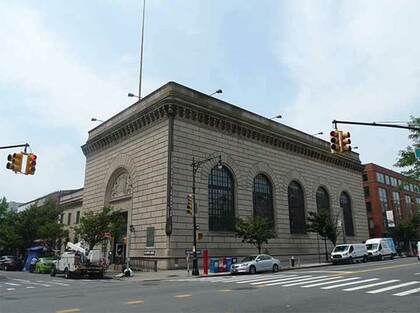
South Brooklyn Savings Institution, 130 Court, NW corner of Atlantic Ave. Trader Joe’s moved in in early-2009. John de Cesare’s equestrian relief of George Washington marks the spot in Cobble Hill where General Washington observed some of the Battle of Brooklyn in what’s now Prospect Park in August 1776. The hill, high in the colonial era, was gradually leveled over the ensuing decades. “South Brooklyn” was once the generic term for the neighborhoods of Cobble Hill, Carroll Gardens, and Red Hook since they were located directly south of downtown Brooklyn.
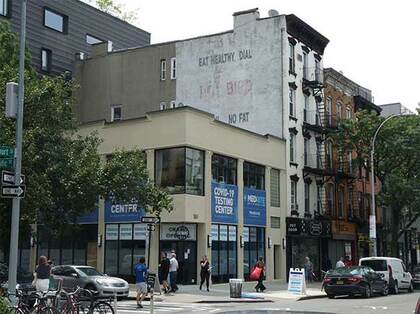
Hot Bird, cold world. The last remaining Hot Bird sign is fading. In the 1970s there were a string of barbecue chicken joints advertised by these wall paintings. One was here on Court St. at Pacific and another on Vanderbilt Ave.; the sign there prompted the opening of a bar by the same name that closed in 2018 and demolished for a skyscraper soon after.
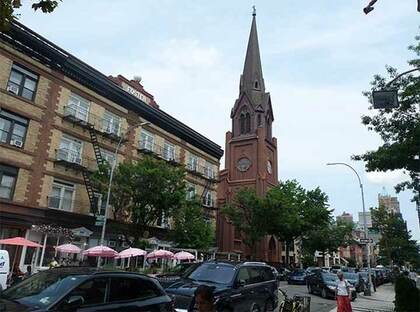
St. Paul’s Church, Court and Congress Str. Rather, St. Peter’s. More properly, St. Paul’s, St. Peter’s, Our Lady of Pilar Church. An old church built in 1838 by Gamaliel King on land formerly owned by a furrier, Irish immigrant Cornelius Heeney, who served as a guardian to a boy named John McCluskey, who later became the USA’s first Cardinal. While Heeney donated some of his property to this church, he also donated some of Manhattan Island holdings so that St. Patrick’s Cathedral in Midtown could be built, and also pews and gallery fittings to St. Peter’s on Barclay St. in lower Manhattan. Heeney had a hand in some of NYC’s oldest extant Roman Catholic buildings. Heeney’s interred in the churchyard here.
—Kevin Walsh is the webmaster of the award-winning website Forgotten NY, and the author of the books Forgotten New York (HarperCollins, 2006) and also, with the Greater Astoria Historical Society, Forgotten Queens (Arcadia, 2013).