

I took the A train uptown to the 145th St. station and milled about the upper Manhattan neighborhoods of Hamilton and Washington Heights. The Bailey Mansion, St. Nicholas Pl. and W. 150th St., was built for James Anthony Bailey, one of the circus impresarios of Ringling Brothers and Barnum and Bailey Circus, and completed in 1888, a peak year for American architecture, by architect Samuel Burrage Reed.
After enlisting in the army at 16 and fighting for the northern side during the Civil War in Sherman’s company, Detroit-born James McGinniss reinvented himself as a circus showman and operator, changing his name to the more aristocratic-sounding “James Anthony Bailey.” By 1881, even though his circuses were successful, he recognized Phineas T. Barnum as the undefeatable master of the genre and joined forces with him, acquiring Jumbo the Elephant from the London Zoo for $10,000.
Bailey was an avid sportsman and horseman, and the choice of this location for his mansion was influenced by the nearby Kingsbridge Rd., now known as Broadway and St. Nicholas Ave. in different stretches, and the Harlem River Driveway, both of which were famed as venues for taking teams of horses and carts out for weekend outings. In 1886, when work on the house began, the general area was wide open and the hill on which the house was built commanded a view of the Hudson River.
Architect Samuel B. Reed brought in J. B. Tiffany and Company to do the mansion’s ornamentation and appointments. Joseph Burr Tiffany was a cousin of stained-glass king Louis Comfort Tiffany and founded his own company in 1884 as a “Specialist in Constructive and Decorative Fine Art.”

Beauty and the beast? Early-20th century meets early-21st century on St. Nicholas Pl. and W. 155th, where the new modular, square-windowed, boxy Sugar Hill Development, 13-story affordable-housing complex designed by British architect David Adjaye, was competed in 2014. The complex also contains a preschool accommodating 100 children along with a children’s art museum.
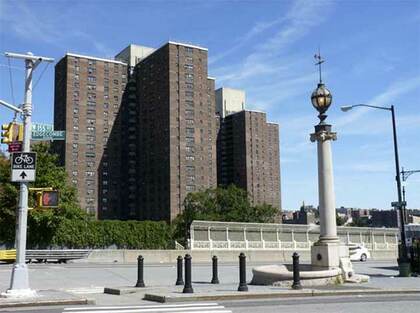
The Sugar Hill Development wasn’t the first boxy housing complex in the neighborhood. The Polo Grounds Houses, constructed where the longtime home of the New York Giants and (briefly) New York Mets had played since the early-20th century. The complex, opened in 1968, features a plaque where home plate had been and stars like Mel Ott, Willie Mays, Bobby Thomson and Marvelous Marv Throneberry had taken turns at bat.
As for that object in the foreground, it’s fascinating—a combination horse trough and lamppost. The unusual Hooper Fountain at Maher Circle, W. 155th and Edgecombe Ave. and St. Nicholas Pl. was a gift from civil engineer/newspaperman/entrepreneur John Hooper. In his will, made public upon his death in 1889, he appropriated funds for the construction of two public fountains that had to include horse troughs as well as drinking fountains. Both fountains were built in 1894: the one here, designed by George Martin Huss at Maher Circle and another, in Brooklyn at Flatbush and 6th Aves. in Park Slope that disappeared long ago. The design features a trough topped by an Ionic column with a human-scale drinking fountain appended, while the column’s topped by a spherical lantern topped by a weathervane.
After motorized traffic began to overtake equine in the early-1920s the trough became an anachronism and there were efforts made to remove it to a bridle path. But here it remained, decade after decade with no upkeep and gradually deteriorating. Vandals finished it off in 1981. However, it was renovated and restored to its old spot in the mid-1990s.
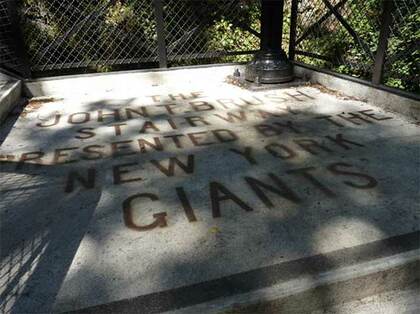
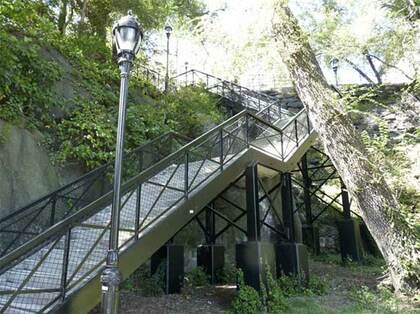
The old, previously rusted and dangerous John T. Brush staircase, named for former NY Giants owner, has been revived. The restoration took almost two years and was completed in 2013, 50 years after the last baseball game was played at the Polo Grounds. Funds were provided by the NFL New York Giants and New York Jets as well as MLB’s New York Mets, Yankees and San Francisco Giants, all of which had played at the Polo Grounds during its history.
John Tomlinson Brush was born in Clintonville, New York in 1845. After founding a clothing company in Indianapolis in 1875 he became involved in local baseball teams to promote the city and business. He later owned Indianapolis’ short-lived entry in the National League in the 1880s, and later acquired the Cincinnati Reds in 1895. After selling the Reds in 1902, he bought the New York Giants the same year. When the Giants won the National League pennant in 1904, he agreed with manager John McGraw that the Giants shouldn’t play the “junior circuit” American League champion Boston Pilgrims (later, the Red Sox) because of an ongoing disagreement with AL president Ban Johnson. The World Series would be played every year thereafter until 1994, when a players’ union strike forced a cancellation. Brush was on his way to California on board a train in 1912 when he suddenly passed away.
The staircase, at Edgecombe Ave. between W. 157th-158th Sts., was commissioned by Brush’s son-in-law Harry Hempstead and was used to provide a means for Polo Grounds fans to climb the steep escarpment known as Coogan’s Bluff to the neighborhood now called Sugar Hill. The staircase remained in place after the Polo Grounds closed.
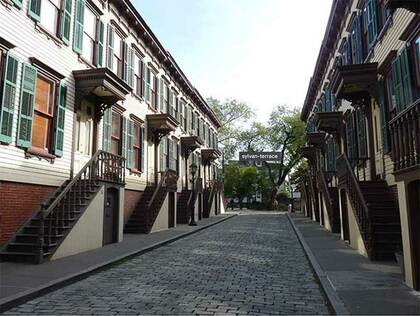
“Sylvan” is an adjective that means “woodsy” or “like a forest” and there are three uptown alleys named “Sylvan”: Sylvan Ct. and Sylvan Pl., which are on E. 121st St. near Marcus Garvey (Mount Morris) Park, and Sylvan Terrace, which dead-ends on Jumel Terrace facing the Morris-Jumel Mansion, with a set of steps leading down to St. Nicholas Ave. This was once the carriageway to the mansion, but since 1882 it’s been home to about 40 nearly identical clapboard wood-frame houses, meticulously maintained by their owners. It was developed by James Ray and built by architect Gilbert Morrison. Earlier critics mistook them for servants’ quarters, but they were originally middle-class residences, and present prices on the terrace are around $2 million.
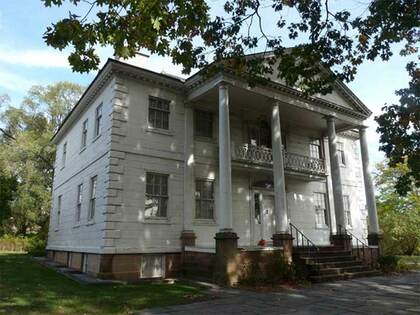
The highlight of Roger Morris Park, between W. 160th-162nd Sts. between Jumel Terrace and Edgecombe Ave., is Manhattan’s oldest remaining residential building. The Morris-Jumel Mansion was built around 1760 by a British colonel, Roger Morris, who was married to Mary Philipse: some say Mary had previously turned down a proposal from George Washington. Morris’ estate, Mount Morris, covered a vast amount of Harlem acreage, some of which would become Mount Morris Park, now Marcus Garvey Park. During the war, Morris, a loyalist, was forced to vacate the mansion and return to England; it then became a headquarters for Washington in the autumn of 1776. While President in 1790, Washington had a formal dinner in the mansion with John Adams, John Quincy Adams, Thomas Jefferson and Alexander Hamilton.
After several owners, the mansion was purchased in 1810 by a wealthy French emigrant, Stephen Jumel, and his wife Eliza. They redecorated the house in the French Empire style it retains today and imported furniture; a bed purportedly owned by Napoleon can be found in the Mansion.
After Jumel’s death in 1832, Eliza married former Vice-President Aaron Burr, who’s remembered today for killing Alexander Hamilton in a duel in 1804. Their marriage was stormy and brief, and after their divorce in 1834, Eliza occupied the Mansion until her death in 1865 (she is entombed in nearby Uptown Trinity Cemetery). Some say her spirit is in the house. I don’t believe in the supernatural and if there are “spirits” they can be explained in a scientific way we haven’t yet discovered.
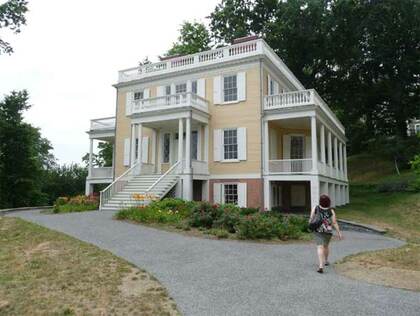
Alexander Hamilton built his home in 1802 in what is today’s Hamilton Heights that he called the Grange in honor of his family’s ancestral house in Scotland. The word grange has its roots in the medieval Latin word for grain, granica, and has been brought through French and then English in its present form. Originally it meant granary and then widened its meaning to barn and even further, to farm. The National Grange of the Order of Patrons of Husbandry, founded in 1867, is America’s largest agricultural advocacy organization.
Hamilton was born in Charlestown, Nevis in the Caribbean and arrived in New York at about age 18 to attend King’s College, now Columbia University, after clerking at several firms and attending the school that later became Princeton University. He was quickly swept up by the fervor for independence that was gathering steam in the colonies, and served with distinction in the revolutionary army, eventually becoming George Washington’s chief of staff. He’d go on to co-write the Federalist Papers that promoted the ratification of the US Constitution, and then became the USA’s first Secretary of the Treasury; he founded the Bank of New York, the nation’s first national mint, and in a foray into publishing, the New-York Evening Post. Hamilton never lost his attachment to New York City and in 1802 built the first house he had ever owned in upper Manhattan, in what was then completely rural land, on a hilly 32-acre plot on what would become W. 143rd St. west of Convent Ave.
In 1889 Hamilton Grange, an early example in 1802 of what became known as the Federalist style, was acquired by St. Lukes’ Episcopal Church and moved from its original hilltop location 250 feet away to Convent Ave. just north of the church. Three of its four sides had porches that were removed during the relocation, and the Grange was hemmed in a tight fit between the church and an apartment building. Despite becoming part of the National Parks system, and its employment by St. Luke’s as a chapel, it gradually fell into genteel shabbiness.
That changed beginning in June 2008 when National Parks moved the Grange to its third location, an empty part of the northern end of St. Nicholas Park across from Hamilton Terrace. Parks then spent $14.5 million to rehabilitate the building, adding porches that had been stripped away during the first move. The Grange reopened to the public in 2011.
—Kevin Walsh is the webmaster of the award-winning website Forgotten NY, and the author of the books Forgotten New York (HarperCollins, 2006) and also, with the Greater Astoria Historical Society, Forgotten Queens (Arcadia, 2013).