

I recently attended the Halloween Harvest Festival with my associated organization, Greater Astoria Historical Society in Socrates Park, a wonderfully “organic” green space on the waterfront at Vernon Blvd.’s northern end, which features an ever-changing display of artworks by local Astorians and others.
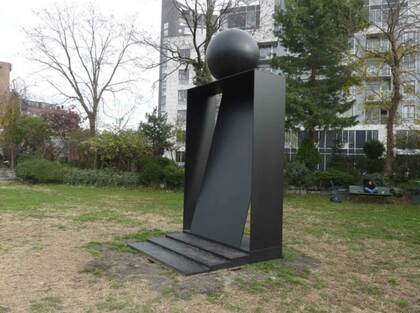
Named in tribute to its proximity to Greek-flavored Astoria, this waterside area along Vernon Blvd. between Main Ave. and Broadway was a dumpsite until it was “rescued” in 1986 by a coalition of artists/activists headed by Mark di Suvero. The Socrates Sculpture Park now works as an outdoor workshop for aspiring artists and a waterside park. A recent visit revealed works by sculptors Paul Ramirez Jonas, Sandy Williams IV, Xaviera Simmons and Jeffrey Gibson.
Where the park sits now was once above a creek running between the Queens Plaza area and emptying into Hallett’s Cove. A grist mill—the first one was built in 1679—once stood in the Socrates Park area and in 1957 workers discovered two millstones and Spanish pieces of eight dating to 1797. Unlike the two millstones belonging to the Paynter farm which are displayed at Queens Plaza, the whereabouts of the two millstones found here are unknown.
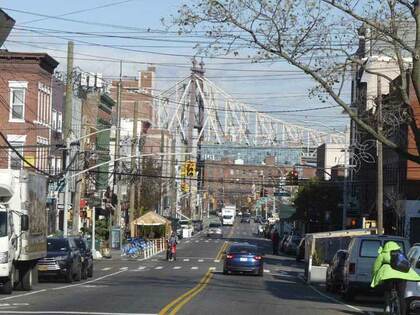
In this view north from Vernon Blvd. and 48th Ave., the Queensboro Bridge (which has wound up with three names: Queensboro, 59th Street and Ed Koch Bridge) spans over the road. Over a century after its opening, the name of this bridge is disputed. Officially the Queensboro, designed by Gustav Lindenthal and Henry Hornbostel, it opened to traffic in October 1909. Since March 2011, the bridge has been officially known as the “Ed Koch Queensboro Bridge,” gaining the name before the three-term mayor’s death in February 2013. The bridge was renovated in stages from 1987-2012. I’ve rarely been on the bridge—the only occasions I can recall are on a bicycle, during the 5-Boro Bike Tours I participated in, from 1984-1987, 1990, and 1999.
The third name is “59th Street Bridge,” as made plain by Simon & Garfunkel’s “59th Street Bridge Song.” What I don’t know is: how the name of the bridge breaks down between Manhattanites and “Queensicans.” My thinking is, Manhattan people call it the “59th Street Bridge” and Queens people call it the Queensboro, but maybe I’m wrong.
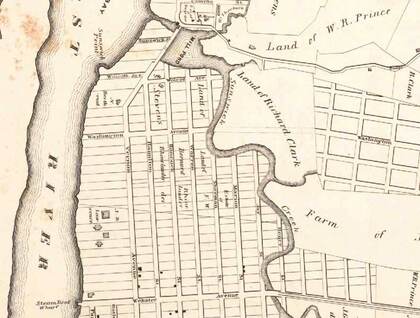
Who was Vernon? Ebenezer Stevens, born on August 11, 1751 in Roxbury, Massachusetts, died on September 2, 1823, in Rockaway, New York and is buried in Astoria. He was a lieutenant colonel in the Continental Army during the American Revolution, a major general in the New York state militia in the War of 1812, and a New York City merchant.
His training as an officer in the artillery gave him an opportunity to be at more pivotal points of the Revolution than anyone, excepting perhaps only George Washington. His distinguished record included Bunker Hill, the British surrender at Saratoga, and war’s end at the Siege of Yorktown. He served with distinction under Nathanael Greene, Marquis de Lafayette, and George Washington.
It was after fleeing from the Boston Tea Party that he found shelter with his friends, Samuel and William Vernon, merchant bankers of Newport, Rhode Island, and leaders in the resistance to the taxation policy of Britain. He never forgot their kindness. At war’s end Stevens moved to Astoria, purchasing much of the Hallett Farm they lost as a penalty for supporting the British. He was one of the first to see the Treaty of Paris as it was delivered to New York, then the seat of government, by neighbor John Delafield.
The first decades of the 19th century was a time of rapid growth where farmland transformed into blocks and lots and meandering country lanes into turnpikes directly linking communities. In the budding neighborhood of Ravenswood, the location of Stevens’ farm, he plotted streets named for Revolutionary leaders: Warren, Hancock, Hamilton, Washington, Marion, Jay… and as a tribute towards his friends at the beginning of his career, Vernon.
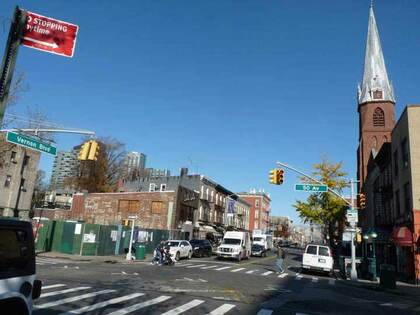
Here we see Vernon Blvd. looking north at 50th Ave. in Hunters Point, Queens toward the steeple of St. Mary’s Church. St. Mary’s, at Vernon and 49th Ave., was built in 1887 and designed by church architect Patrick Keely. St. Mary’s, with its distinctive clock steeple, was the tallest structure in Hunters Point for over a century until the Queens West development of the 1990s set off the current spate of glass-clad residential skyscrapers in the blocks to its west. The church is built from brick and brownstone in a simple Gothic design, featuring multiple pointed arches across the façade on Vernon Blvd., and a tall steeple that rises several stories. Clad in gray slate, the steeple houses clocks on each side, and marks the skyline as it rises over the boulevard.
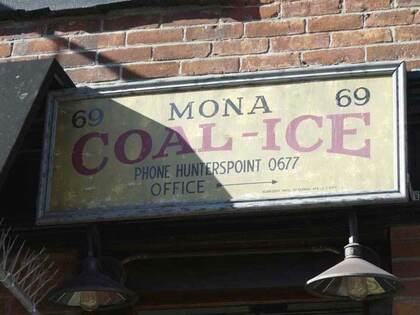
I was tipped about this ancient sign at 49-10 Vernon Blvd. in the recent book by Bill Helmreich, The Queens Nobody Knows (Helmreich, who I met on a Forgotten NY tour I was leading in Fordham in 2018, passed away in 2020.) The family of Italian immigrant Antonio Mora marks the spot at #69 Vernon Ave., now 49-10 Vernon Blvd., where Mora maintained his coal and ice business after immigrating from Italy in 1897.
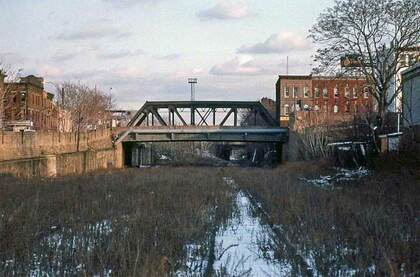
Until the 1990s, Vernon Blvd. was bridged over a LIRR railroad cut leading to what is now Gantry State Park on this truss bridge. The bridge was demolished and the west end of the cut was filled in, becoming a park and athletic field.
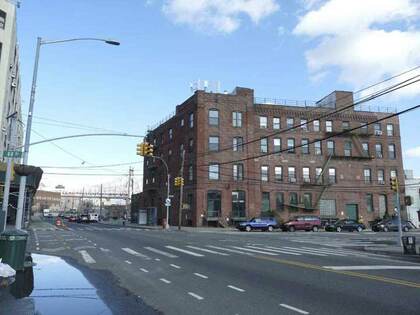
The Talking Heads are perhaps more associated with the Rhode Island School of Design in Providence, where the band originated, or Manhattan, where they made their name in the club scene of CBGB and the Mudd Club. However, they’re associated with southwest Long Island City as well. The band practiced in this industrial loft building until 1979 at 9-01 44th Dr, at Vernon Boulevard, and bassist Tina Weymouth and drummer Chris Frantz lived in the building in 1976-1977.
This crossroads was slated to be the site of a large Amazon office complex before pressure from local politicians forced a change of plans.
North of 44th Dr., Vernon Blvd.’s aspect changes considerably from residential/retail to industrial; any residential buildings along the road are in housing projects from here north through the neighborhood of Ravenswood.
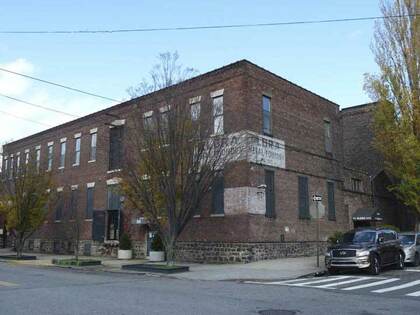
At 43rd Ave, and Vernon Blvd. is an ivy-covered brick building home, on the 43rd Ave. end to DuVal Enterprises, which develops the interior spaces of this former metal foundry for magazine and video shoots. It’s divided into three separate areas: The Foundry, The Terrace and The Loft.
The Foundry is a 19th-century building where originally fine varnishes were manufactured (by Emil Calman and Co.) before it housed the Albra Metal Foundry. Their logo is still visible on the corner of the building at 9th St. and 43rd Ave. (hidden by foliage during the summer). It’s hard to make out because of the ivy, but the name “Emil Calman & Co.” can still be seen on the Vernon Blvd. entranceway.
By the 1970s The Foundry was essentially an abandoned space, housing defunct vehicles and a mountain of debris. In 1980 the Du Val family purchased the property. The family restored and renovated the space to reflect its original industrial character, and began using it as an event space in 2001. It’s the only foundry in the area still standing today.
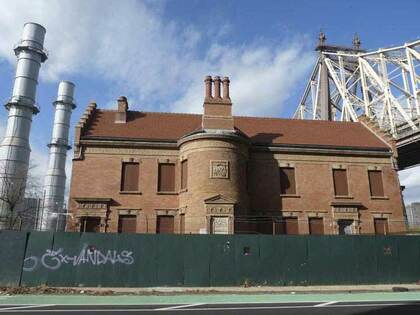
The New York Architectural Terra Cotta Works was established in 1886 by James Taylor, who was fresh off successes in the Boston firms Lewis and Wood and the Boston Terra Cotta Company. The New York works would go on to produce terra cotta for Carnegie Hall and the Ansonia Hotel. While Taylor died in 1898, his NYC terra cotta works thrived until 1928. Its small office/showroom building, built in 1892, still stands at 42-10 Vernon Blvd. The little brick building has been landmarked, and recently the exterior was rehabilitated by Citigroup, revealing even more incredible detailing, but any future uses for the building are undetermined.
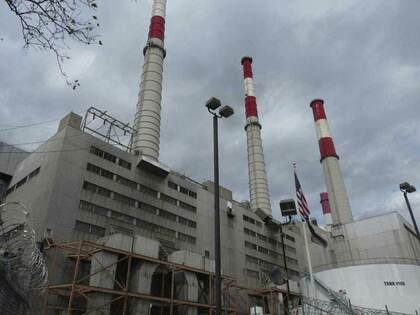
“Big Allis,” officially known as the Ravenswood Generating Station, at Vernon Blvd. and 36th Ave., provides 21 percent of the electricity consumed by New York City. It was constructed by the Allis-Chalmers Corporation; when it opened in 1965, it was the world’s first million-kilowatt power plant. It’s been owned by several: Con Edison, then Keyspan, National Grid, and TransCanada since 2008. Its red and white smokestacks can be seen for miles in Queens and Manhattan. The plant sits on the former location of the 1744 Blackwell Mansion; the northwest Queens colonial-era family also originally owned what we now call Roosevelt Island.
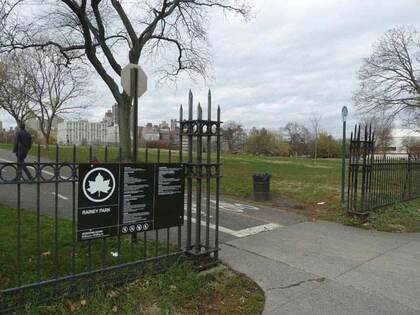
This expansive riverside park between Vernon Blvd., the East River, 33rd Rd. and 34th Ave. is named for a local resident who worked tirelessly for the construction of the Queensboro Bridge.
According to NYC Parks, “Dr. Thomas Rainey had been one of the earliest and staunchest supporters of the project, and the burden of organizing and refinancing the company fell on him, first as treasurer in 1874, then as president in 1877. Dr. Rainey lobbied around the country to get financial backing and a bridge franchise. However, the War Department, concerned that a bridge could interfere with the defense of New York and access to the Brooklyn Navy Yard, withheld approval. Most interest in the region was for another bridge between Brooklyn and Manhattan. The sparse population in Queens at the time raised further concerns of need and profitability, and the project had once again lost steam by 1892.”
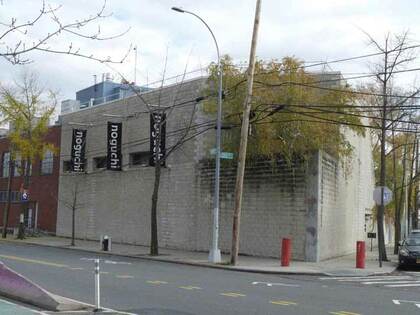
At Vernon and 33rd Rd. you’ll find a museum dedicated to Japanese-American expressionist sculptor Isamu Noguchi (1904-1988). Though born in Los Angeles, Noguchi spent most of his childhood in Japan before attending Columbia University to study sculpture. Among his more notable works are the bridge in the Peace Park in Hiroshima, sunken gardens for the Beinecke Library at Yale University at New Haven and Chase Manhattan Bank in Manhattan, the Billy Rose Sculpture Garden in Jerusalem, and Moerenuma Park in Sapporo, Japan. Noguchi also designed stage sets and furniture pieces.
250 of Noguchi’s works are on permanent display here, including stone, bronze and wood sculpture, “Akari” paper and bamboo light sculptures, his sets produced for choreographers Martha Graham and George Balanchine, and an outdoor garden.
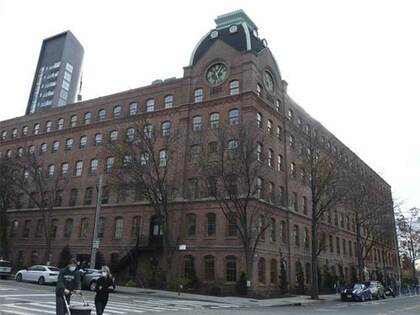
Vernon Blvd.’s most venerable structure may be the former Sohmer Piano factory, 11-31 Vernon at 31st Ave., opposite Socrates Park. I first encountered the building several years ago when it was still occupied by the Adirondack Chair Company (their ad can still be seen on its south side) and spoke with John Pupa, Vice President of Operations for Adirondack. He said that Adirondack no longer heated the building with coal but it still maintained its old Hewes and Phillips coal-burning oven, which he showed me and Greater Astoria Historical Director Bob Singleton, and took coal deliveries. From one of the upstairs rooms, now converted to a condo apartment, we had a good view of the river, Roosevelt Island and its lighthouse.
It’s not the only piano factory converted to luxury in NYC of late—I was surprised to discover that the fortress-like, hulking Steinway factory on Ditmars Blvd. and 45th St. in Astoria became the Pistilli Grand Manor, and the clock-towered Estey Piano building and its distinctive clock tower in the Bronx’ Mott Haven became residential in the early-2000s. Sohmer pianos? They’re now manufactured in Korea.
—Kevin Walsh is the webmaster of the award-winning website Forgotten NY, and the author of the books Forgotten New York (HarperCollins, 2006) and also, with the Greater Astoria Historical Society, Forgotten Queens (Arcadia, 2013)