

Seen here on a Forgotten New York tour I conducted in 2018, The Tompkins Square Temperance Monument on the Ave. A side of the park, erected in 1891, was a gift from a San Francisco dentist and temperance activist, Henry Cogswell (1820-1900). His successful practice, and fortunate real estate investments, allowed him to retire at 36, having amassed a fortune of $2 million. In the late-19th and early-20th Centuries, temperance movements in which people gave up drinking were prevalent (enough so that the US Congress adopted Prohibition from 1919 to 1932, and Russia, Iceland, Norway, Hungary and Finland adopted similar laws in the same time period). Cogswell became a philanthropist with his chief interest prohibiting liquor consumption, and so sponsored this monument and fountain. The goddess on the top is the little-known Hebe (pronounced ay-bay) the gods’ cupbearer on Mount Olympus, and one of Heracles (or Hercules’) many “conquests.” The statue was originally forged by Jordan Mott Works, the iron works that gave Mott Haven, Bronx, its name; this is a bronze replica installed in a 1992 renovation.
In 2003 I was making my way down Pennsylvania Ave. in Washington, DC one morning when I spotted a monument at its intersection with 7th St. and Indiana Ave., within sight of the White House, that resembled the Tompkins Square monument.
There is a good reason for that: Cogswell is responsible for this one, too: “Cogswell’s most lasting legacy was the 50 monuments he sponsored nationwide between 1878 and the 1890s. Most were versions of the temperance fountain. Several of the fountains, such as those in Washington, D. C., Boston Common, and in Tompkins Square Park, were covered by a stone canopy or baldachin supported by four Doric columns. As can be seen here, the four stone entablatures were emblazoned with the words Faith, Hope, Charity, and Temperance.” [NYC Parks]
There are subtle differences; the Washington monument has a stork on top, replacing Hebe, and the pedestal is occupied by a big fish; it’s empty in Tompkins Square Park. Other Cogswell temperance fountains in Buffalo, Rochester, San Francisco, and Pawtucket, RI have been torn down.
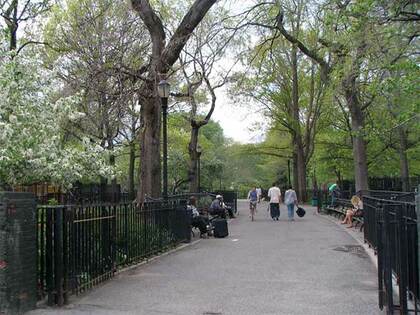
Like many other NYC public squares, Tompkins Square Park was originally used as a place where military commanders could review troops marching in formation, in this case the 7th Regiment, and you need a wide, flat space for that. Between 1836 and 1850 what had been a swampy and unstable area was gradually graded and landscaped, with some sycamore trees planted (most were chopped down when the Regiment arrived in the 1860s but some, on the outer edge of the park, survive). The park didn’t become a public area until 1878; like many other NYC locales and streets, it was named for NYS Governor, then Vice President Daniel D. Tompkins, who was from what is now Scarsdale in Westchester County, though he later settled in Staten Island and found the town of Tompkinsville; he’s buried in St. Mark’s churchyard, a couple of blocks away.
Some public monuments and sculptures followed the opening, including the Slocum Memorial, Temperance Fountain, Congressman S.S. Cox Memorial (see links).
In the 1950s and 1960s there was a gradual deterioration in NYC’s public spaces, as funds dried up and there was a general attitude on the part of elected officials for deferred maintenance. Everything came to a head in the summer of 1988, when the Koch Administration decided to forcibly oust the drug dealers and homeless that had largely “occupied” the park, and a riot ensued (see Luc [now Lucy] Sante’s account). The necessity of the force used by the NYPD is debated to this day, but the cleanup was the first shot in the battle between the longtime residents of the East Village and gentrifiers, who’ve gained the upper hand since the Tompkins Square Riots.
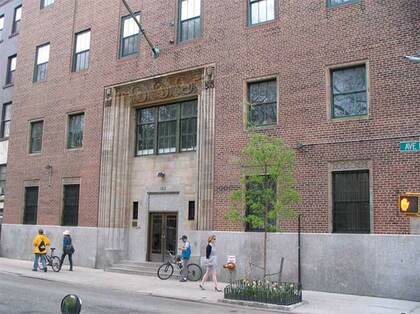
In 1988, the Christodora House on Ave. B and E. 9th was the focal point for what longtime East Village residents saw as a battle between the status quo with affordable rents and a future of the rich moving in and pushing them out, as it was one of the first buildings in the area to be redeveloped as a condominium. It was built in 1928 as a settlement house and used by community groups until that time, providing food, shelter, medical treatment and education to nearly 5000 locals every week. It had a third-floor concert space where George Gershwin gave one of his first public recitals.
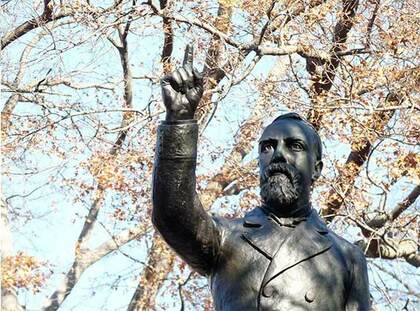
Louise Lawson’s sculpture of Ohio Congressman Samuel Sullivan Cox has stood at Tompkins Square’s southwest corner at Ave. A and E. 7th St. since 1924, after its initial placement at the triangle formed by Lafayette St., 4th Ave., and Astor Pl. in 1881. S.S. Cox (1824-1889) was a Democratic Party member of the House of Representatives from Ohio from 1857-1865, and from New York from 1869-1889, when he retired. He championed the Life Saving Service, which patrolled the coast looking for shipwreck survivors; the Service became part of the US Coast Guard in 1915.
He’s remembered with a statue, placed while he was still in Congress, for his involvement with the US Post Office. He introduced legislation that assured paid benefits, two weeks’ vacation, and a 40-hour work week—progressive in that era—for postal workers. Letter carriers from 188 cities inscribed on the monument raised $10,000 for its creation.
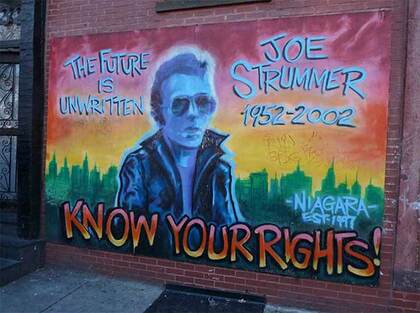
Cox’s statue stands across the street from a likeness of a man from a completely different place and time. John Mellor, known professionally as Joe Strummer (1952-2002), was the founder of “The Only Band That Matters,” the Clash. Of British parentage, he was born in Ankara, Turkey, as his father Ronald served in the British foreign service.
The Clash was of the most overtly political and exciting bands of the late-1970s and early-80s, with their music taking on Nazism, racism, unemployment, and police brutality. They achieved success in the US with the double LP London Calling and singles such as “Train in Vain” and “Rock the Casbah,” but their chief legacy was as a killer live act—they played the old, non-air-conditioned Bonds clothing store in Times Square for 17 straight days in June 1981, one of which I attended. After the Clash’s breakup, Strummer did solo work and also played with the Pogues and the Mescaleros. He died of heart failure at age 50.
The artwork here at Ave. A and E. 7th St. was originally painted outside the Niagara, a bar Strummer frequented, in 2003, several months after his death, by graffiti artists Dr. Revolt and Zephyr. When the wall was in danger of collapse and had to be replaced in 2013, the artists were called back in to create a new mural. The artists continue to renew the memorial every so often.
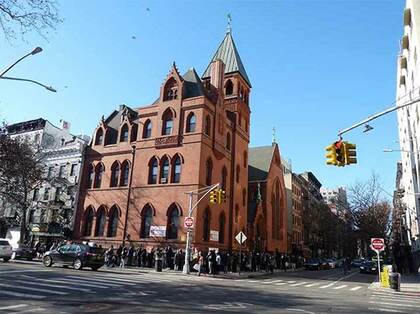
When the Saint Nicholas Carpatho Russian Orthodox Greek Catholic Church, Ave. A and E. 10th was constructed in 1883 the Gothic Revival building was a chapel for nearby St. Mark’s Church at 2nd Ave. and E. 10th, but it was purchased by Eastern Orthodox faithful in 1925. The architect was James Renwick Jr., a pre-eminent ecclesiastical architect best known for St. Patrick’s Cathedral on 5th Ave.
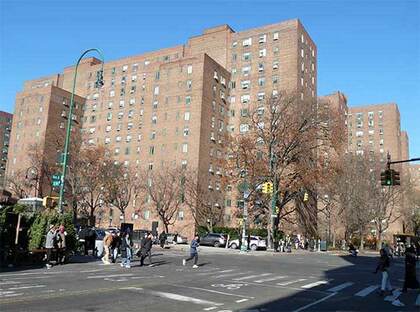
Stuyvesant Town sits on an almost-square defined by E. 14th and E. 20th St., 1st Ave. and Ave. C, with 89 buildings containing 8757 apartments. By car it’s accessed by a series of ovals located on its four border streets, and pedestrians can easily access its four “quadrants” via the center oval. A second residential complex, Peter Cooper Village, sits north of E. 20th St.
I have a personal connection to Stuyvesant Town—my father worked here as a custodian for 30 years, between 1958 and 1988; he retired when he turned 70. This was an era in which unionized jobs with ample benefits were more attainable than now. He’d work the usual Monday through Friday, but occasionally he’d work the weekend and take Wednesday and Thursday off, on which days he would see me off to school. It was a long way with two trains from Bay Ridge to Stuyvesant Town, so he’d leave the house at around seven a.m., before I got up, usually arriving home around seven p.m. During snowstorms he’d need to go in at off-hours to shovel snow.
What’s surprising is that I never visited Stuy-Town when he was working there. The old man never helped put me on the famed list of people waiting for apartments to open up, but as he’d probably say now if he was still around, “You didn’t ask me!” My whole trajectory would’ve changed, as I’ve occupied Brooklyn and Queens for over 67 years now.
—Kevin Walsh is the webmaster of the award-winning website Forgotten NY, and the author of the books Forgotten New York (HarperCollins, 2006) and also, with the Greater Astoria Historical Society, Forgotten Queens (Arcadia, 2013)