
A significant indicator of how contemporary prestige television has changed was this year’s Emmy Awards, in which The Pitt won Best Drama Series. Despite facing more expensive, buzzier competitors that were packed with A-list talent, The Pitt was hailed as a breakthrough because it was a return to a more traditional form of “real television,” in which seasons last 18 episodes and new seasons could be expected on a yearly basis. That it was a more grounded, less melodramatic version of a “medical drama” was a bonus, as interest in the pressures put upon the healthcare industry have spiked in the aftermath of Covid. As with most aspects of American television culture, it was a response to something that British TV did first.
House of Cards was inspired by a BBC series, Succession’s Jesse Armstrong got his start on BBC Four’s The Thick Of It, and most Netflix miniseries have adopted a formula already been prevalent on British airwaves. This Is Going To Hurt, an excellent medical drama starring Ben Whishaw, isn’t necessarily an influence on The Pitt; the former’s a tight seven episodes centered on a single protagonist, and the latter is an ensemble show set to run for many more years.
This Is Going To Hurt was created and written by Adam Kay, a former doctor in an obstetrics and gynecology ward in a National Health Service hospital, who cast Whishaw as a lightly-fictionalized version of himself. Set in 2006, the series is centered around Kay’s years as the senior practitioner on a highly-frequented wing, even though he’s just under 30. Kay has worked without proper resources, and must contend with his supervisor Nigel Lockhart’s (Alex Jennings) attempts to stage public relations activities to gain additional funding. Most frustrating to Kay is the weight of responsibilities he’s faced to be a whip-smart problem solver with leadership skills and impenetrable bedside manner. Although Kay’s ability to discern a diagnosis is borderline genius, his bouts of rage have made him unpopular among the nurses and junior doctors. Most critically, Kay has found it nearly impossible to connect with patients who reject the fundamentals of science.
Although prestige television has had many anti-heroes, Kay’s a compelling protagonist because he’s been unjustly framed as one. Despite the blunt, insensitive comments he’s made, Kay’s placed in the position as the perpetual scapegoat; patients unhappy with their services are unlikely to condemn their nurses, but they rarely look to the higher-ranked decision makers in the hospital to file their complaints. Kay’s forced to give patients the answers they don’t want to hear, and must offer the “tough love” to his underlings that can feel particularly ungrateful.
In order to ensure that Kay’s demeanor isn’t limited to his aggressive outgoing persona, This Is Going To Hurt has a clever device in which Whishaw is allowed to break the fourth wall and explain his personal frustrations to the audience. This is a compelling way to get into the specifics of sensitive situations that would be incomprehensible to someone without a medical degree, but it’s also a reflection of the ways in which Kay has been forced to erase his personality to be the friendly doctor that his patients need the most. The rare instances in which his guise is snapped are indicative of Kay’s personal ethics; when dealing with a racist, pregnant patient, Kay’s decision to use a Black nurse amidst the birthing process is his professional act of rebellion.
Unlike The Pitt, which was told in a “real-time” format similar to 24, This Is Going To Hurt is set over the course of many years. There isn’t time to learn the names, backgrounds, and family details of all the other staffers in the OBGYN ward because it has such a high turnover rate, and Kay has enough experience to know that making strong interpersonal relationships is pointless. A majority of Kay’s lines are spoken direct-to-camera, and it's suggested these internal monologues to a non-existent bystander are a byproduct of his own loneliness.
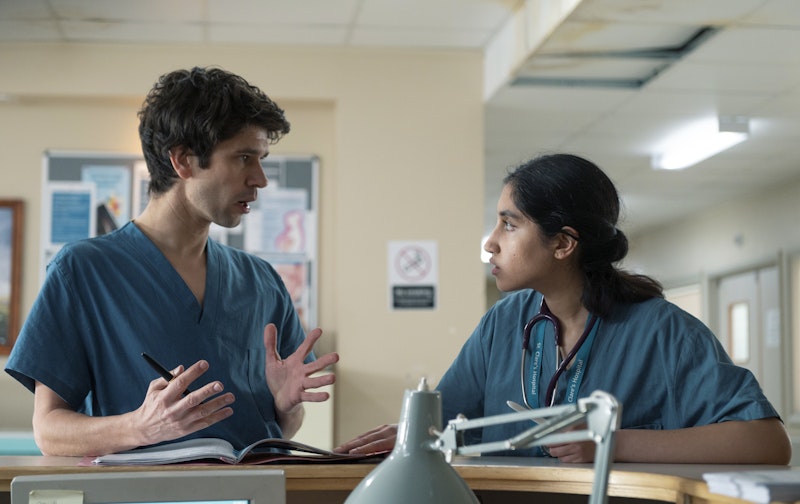
Although the aftermath of Covid helped raise awareness about the mental health crisis among medical professionals, This Is Going To Hurt has made it clear this wasn’t a recent occurrence. Even if Kay has made it a priority to be as impenetrable as possible while on the hospital floor, many of his underlings face the same pressure to retain complete professionalism, despite being in frequently upsetting situations. This Is Going To Hurt is a showcase for Whishaw, but his co-star Ambika Mod is particularly memorable in the role of Shruti Acharya, a troubled student doctor who’s faced pressure from familial expectations. What’s heartbreaking is that the dynamic between Kay and Shruti is strongest when she’s struggling and meek because he’s forced to intervene; since Kay doesn’t feel the need to “check in” on Shruti once she’s become a consummate professional, he’s blind to the reality that she’s experienced depression and anxiety.
This Is Going To Hurt is such an immersive experience that its rare instances of conventionality don’t feel dishonest; although Kay’s struggles to deal with his homophobic mother (Harriet Walter in an appropriately slimy performance) could’ve felt melodramatic, they’re used to emphasize how fractured his life is within and outside of the hospital. This Is Going To Hurt has a message, and its one made clear by a stellar monologue given by Whishaw in the final episode about why the rising suicide rates of doctors should be “a national fucking headline every time it happens and instead it's just brushed under the carpet.” This blatant cry-for-help could’ve felt like a tacked-on piece of activism in a lesser show, but in This Is Going To Hurt, it's an honest admission by a well-developed character.