
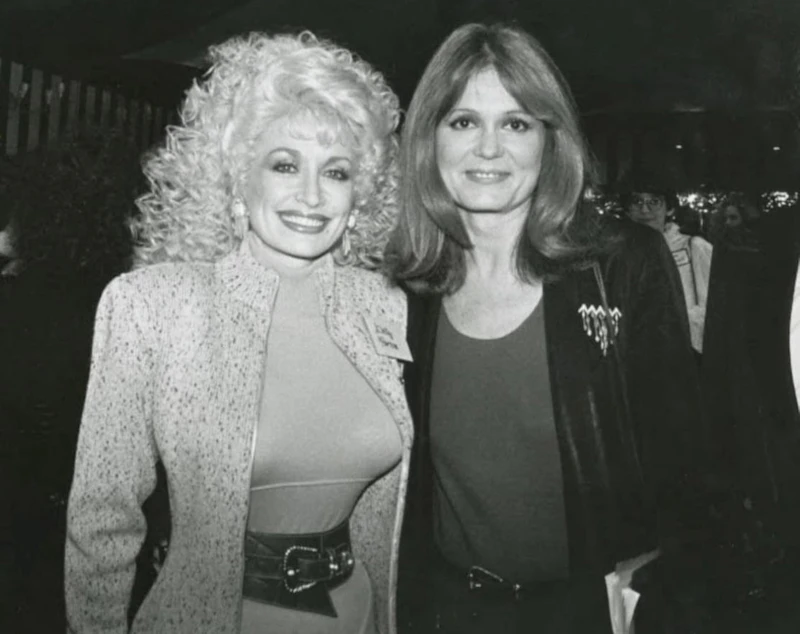
Two women died within days of each other recently who couldn’t appear more different on the surface: Gloria Steinem, 92, in her trademark aviator glasses, and Dolly Parton, 80, in her trademark everything. Though I’ve always admired the style and influence of Dolly Parton, I’m not a country music fan. Steinem, on the other hand, helped make me who I am.
When I was 12, a revered queer family member gave me a subscription to Ms. magazine. This same person played “Friend of the Devil” for me on guitar as a kid, causing me to believe, when I eventually heard the Grateful Dead version on the radio, that those bastards had stolen the song.
Steinem co-founded the magazine in 1971, creating something revolutionary: a national publication where women could write seriously about their lives, politics, work, bodies and rights without those subjects relegated to the ladies’ pages. Steinem was a journalist before she became the face of a movement; perhaps that was part of her particular magic for me. Words can be activism. Journalism can change something.
“If feminism means anything, it means taking responsibility for ourselves: our own lives and actions. It is not ‘women as victims, but women refusing to be victims,’” Steinem once wrote. “Women may be the one group that grows more radical with age.”
That subscription to Ms. led, indirectly or otherwise, to at least three things. I became a journalist. I have never checked any title on a form other than “Ms.” because Mrs. McCarthy remains my mother-in-law. And when I got married in the Catholic Church, I informed the priest that I’d neither promise to “obey” my husband nor have my father walk me down the aisle and hand me to another man, as though possession of Mary were being transferred between departments. Getting the pinnacle of patriarchy Catholic Church to bend in 1991 wasn’t exactly low-impact Jazzercise, but I did it.
Which makes it particularly horrifying to watch the current “tradwife” trend: submission and romanticized female dependency, sometimes accompanied by outright hostility toward feminism, a concept that’s become dangerously too far in the rear-view mirror for young women online.
Meanwhile, the constitutional protection for abortion that existed for nearly half a century is gone. Women including Josseli Barnica have died after delays in miscarriage care in states with abortion restrictions; experts reviewing Barnica’s case called her death preventable as miscarriages unfortunately fall under the medical class with abortion and women simply trying to bear children are dying because women’s reproductive rights are controlled by Christian nationalist values.
“It’s obviously ridiculous to say somebody is ‘pro-abortion.’ Nobody wakes up in the morning and says, ‘I think I’ll have an abortion. It’s a pleasurable experience.’” said Steinem. “The question is not pro-abortion or anti-abortion, the question is who makes the decision: a woman and her physician, or the government.”
Steinem lived long enough to see women lose rights. I wish she’d lived long enough to see them come back.
And then there’s Dolly. In Ms. in 1987, Gloria Steinem wrote: “If feminism means finding our unique power and helping other women do the same, Dolly Parton certainly has done both.”
Parton spent 60 years married to Carl Dean, a man so determined to avoid celebrity that most people couldn’t pick him out of a lineup. Their arrangement fascinated me. Dolly once described it this way: “We don’t get in each other’s stuff.” She also coyly told Vogue about rumors concerning her relationships: “I’ve been accused of a lot of relationships that I’ve never had. Of course, I have not been accused of some I have had.” And his own quote: “I would think less of any man that didn’t fall in love with her.”
For decades there were also rumors about Dolly and her lifelong best friend Judy Ogle. Dolly always denied that theirs was a sexual relationship, and why wouldn’t anyone take her at her word; she was always supportive of the gay community when asked repeatedly about the rumors. That strikes me as its own kind of feminism.
Dolly built an empire, made her own money, maintained a marriage on terms that apparently suited the two people living in it, supported LGBTQ people despite criticism from parts of her conservative Southern audience, and never seemed interested in fitting herself inside anybody else’s definition of what a woman was supposed to be. Collectively we really should refer to her style of “mind your damn business, I do what I want” as Dollyamory.
Gloria Steinem taught me that women should have the freedom to define their own lives. Dolly Parton went ahead and lived that way. One gave me Ms. The other gave the world rhinestones, 9 to 5 and a husband who apparently understood that loving an extraordinary woman didn’t require putting a fence around her. I’m grateful for both.