
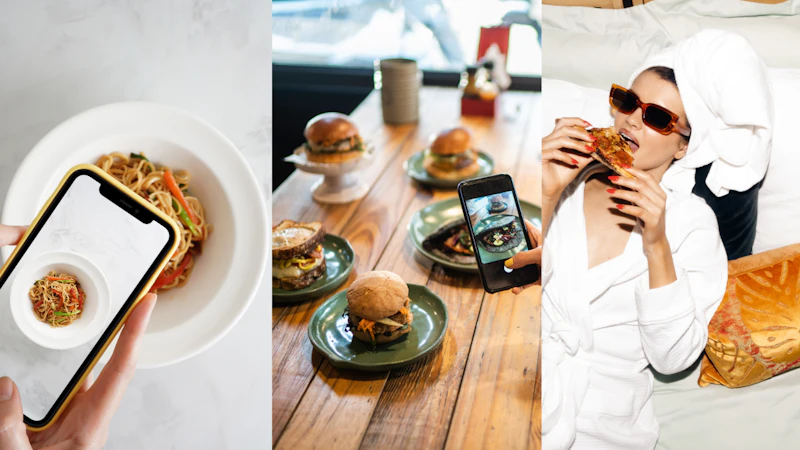
For the past decade, it's become hard to avoid “influencers” who dine at restaurants to post photos and comments on social media. They're seeking clout, and clout is what they're getting. When that happens to those who have no tangible talent beyond knowledge of how to manipulate an algorithm, a sense of entitlement develops. With enough followers, an influencer can demand free food for their services. While that's not exactly extortion, it's far from kosher. Running a restaurant is already a risky, difficult business, and now their owners must learn a new survival skill—how to deal with these opportunistic, self-involved interlopers.
Influencers, even those without big follower counts, now have the ultimate power in their industry—the ability to shut down a restaurant. Last year, a San Francisco Bay area-based influencer, Karla Marcotte (@itskarlabb on TikTok) posted an emotional video describing a failed collaboration with Kis Cafe, a new wine bar located in San Francisco’s Hayes Valley. Marcotte claimed that while she was getting ready to film a promo video for the place, after longtime San Francisco restaurateur and Kis Cafe co-owner Luke Sung found out she had only 15,000 followers, he told her that wasn't enough to justify the effort of his participation while implying her audience couldn’t afford his prices. Sung paid for his attitude. Marcotte walked out and recorded a five-minute video that earned 21 million views, sparking enough “review bombing”—one-star reviews—to close the place down.
Meanwhile, Marcotte’s follower count has now rocketed to over 500,000, which had nothing to do with her minimal talent at evaluating restaurants. By the same token, Sung’s disaster had nothing to do with his talent at preparing food. He came up in a restaurant world in which success was shaped by traditional critics, word of mouth, and industry insiders. His experience hadn't taught him that any negative influencer post can go viral, and when that happens the defense doesn't get to present its case. Internet “justice” is swift and without a conscience.
The power of influencers has grown to the point where they've usurped much of the clout established restaurant critics once had as arbiters of where to dine. Surveys indicate that 40 percent of respondents choose a new restaurant based on an influencer's review. While this new, decentralized model has had a positive, democratizing influence on the business of evaluating restaurants that's been especially helpful to smaller, lesser-known establishments, its downsides overshadow the plusses.
Top restaurant critics typically have formal culinary training or extensive industry experience, while influencers’ personality-driven succeed by creating engaging, relatable videos. Reviewers intentionally work anonymously to avoid special treatment, while influencers will ask a restaurant owner or chef who isn't playing ball with them, “Do you know who I am?” To these privileged hotshots, restaurants are merely staging grounds for “content creation.” They often think nothing of interrupting the operation of a business with their photo setups or lingering too long at a table after ordering only a few appetizers.
Influencers frequently accept free meals, and often demand them. The difference is that reviewers are bound by standards, while influencers operate unchecked, which invites unprofessional behavior. Not all of them behave badly, but there's enough clout-chasers now to push the industry in the wrong direction.
When the success or failure of a restaurant depends on its food looking good on Instagram, the palate takes a backseat to the eye. “We eat first with our eyes" is a well-known phrase referring to the power of visual stimuli to change the perception of flavor in the brain. In one study, a salad arranged to look like a Wassily Kandinsky painting was rated as significantly tastier and more complex than the exact same salad with a more mundane presentation.
Chefs are under pressure to develop dishes designed for social media platforms not equipped to reward them for preparing food that tastes great. Some restaurants, hooked on this new paradigm, hire food stylists who use non-edible materials in their photos. When restaurants surrender to such dishonesty, they're chasing trends rather than that long-standing cornerstone of success: consistent quality. Dining becomes more of an event to be filmed and shared with the masses rather than a meal to be enjoyed with a few friends. It's a way of saying, “Look at me,” or even worse—”Don't you wish you were me right now, living this posh lifestyle?”
Prior to the banking crisis of 2008, large financial institutions took excessive risks to chase higher profits, knowing that the government would bail them out because they were “too big to fail.” The banks were involved in what economists call “moral hazard”—a situation in which people behave differently because they know they won't bear the full consequences of their actions. Similarly, influencers taking free food (including tip) and even charging restaurants for a positive review are creating their own moral hazard. If a New York Times restaurant critic were able to behave like this, they'd have to answer to the boss when the inevitable chatter surfaced. Not so for the influencer, who faces a much more diffuse feedback loop with no boss to answer to.
Compare the careers of former New York Times restaurant critic Pete Wells and Karla Marcotte. Wells briefly worked in public relations at The New Yorker, which gave him early exposure to how high-end journalism operates, including editorial standards. Wells went on to become a columnist and editor at Food & Wine, where he established himself as a serious food writer. He became the dining editor at The New York Times in 2006, and was named NYT restaurant critic in 2012.
Marcotte has no known experience in the restaurant industry prior to her “breakthrough” moment. There’s no evidence she's worked in any capacity in a restaurant. Her power’s a fluke.
Whereas Wells learned editorial standards, Marcotte thought it was appropriate to publicly air her dispute with a respected chef/owner instead of dealing with it privately, knowing Luke Sung wouldn't get a chance to tell his side of the story. Sung has said that the viral backlash devastated his family and livelihood, tanking his career and forcing him to step back from another restaurant he was involved in due to incoming hate. His daughter and son were also devastated by all the hate comments they received.
All Luke Sung did was question whether Marcotte had the qualifications for their planned collaboration. There's no evidence he berated her personally or was dishonest.
The industry has lost a talented chef while “gaining” a “major player” with almost nothing to offer besides a sob story.