
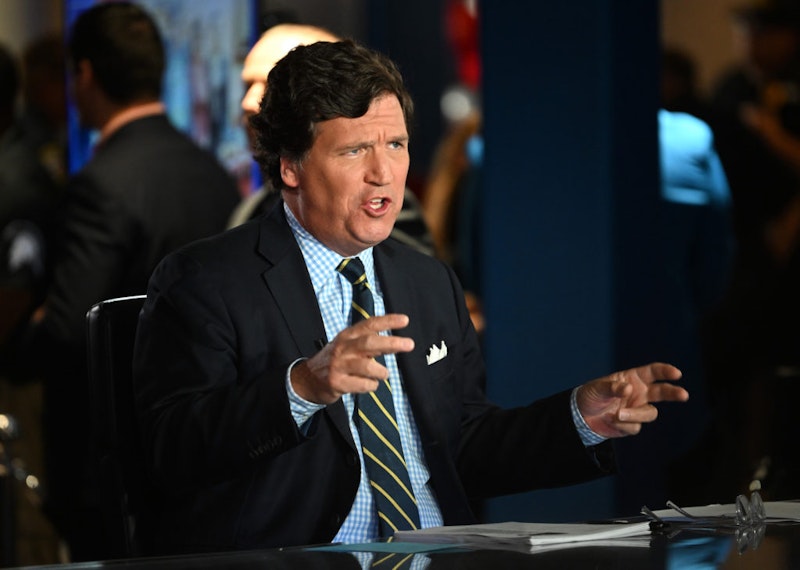
During a recent interview with the human Cracker Barrel that’s Mike Huckabee, Tucker Carlson stated that America has become, in many ways, a third-world country. It's easy to dismiss, until you realize that the professional provocateur is right.
Start with the basics. Clean water was once so foundational to American identity that the country practically exported the concept. Then came Flint, Michigan—where children drank lead for years while officials shuffled paperwork. Flint wasn't fixed; it was forgotten. There are now an array of Flints, quietly poisoning their zip codes while Washington optimizes the tax code for people who’ll never drink tap water.
The roads. God, the roads. The American Society of Civil Engineers grades US infrastructure a C-minus—and that's the charitable assessment. Potholes swallow sedans in Chicago. Bridges hum ominously in ways bridges shouldn't hum. The country that built the interstate highway system now can't maintain it. Meanwhile, a high-speed rail journey from Los Angeles to San Francisco remains a fantasy—the kind of fantasy that's been funded, debated, litigated, and re-funded for 30 years without a single train departing.
Then there's healthcare, that American theatrical production where the audience pays for their own seats, gets sent to the wrong theater, and receives a bill six months later for the parking. The US spends more per capita on healthcare than any developed nation. In return, it gets lower life expectancy than Slovenia, a country most Americans confuse with Slovakia.
Wealth inequality now mirrors the kind of statistics usually accompanied by a World Bank disclaimer. The top one percent holds more wealth than the entire middle class combined. American billionaires added trillions to their fortunes during a pandemic that killed over a million Americans. That particular coincidence passed without consequence.
Political institutions, once the country's proudest export, have become a cautionary tale with a flag. Congress moves with the urgency of a sleepy magistrate in a forgotten province. Gerrymandering has made elections, in many districts, ceremonial. Money flows so freely through politics that lobbying is essentially just legislating with better catering.
And things are, structurally, getting worse. The political system rewards paralysis. The media ecosystem rewards outrage over accuracy. The education system—starved in poor districts, bloated in wealthy ones—produces two entirely different countries within the same borders. Neither country particularly understands the other, which suits everyone in power just fine.
What makes this distinctly American is the insistence that none of it’s happening. Third-world countries, the thinking goes, are elsewhere—somewhere dusty and distant, with roaming militias and without indoor plumbing.
Carlson's observation wasn't original or especially brave. Foreign correspondents have filed variations of this story for a decade. What's remarkable is that it still surprises anyone—that the gap between national mythology and material reality has to be spoken aloud, rather than simply observed by anyone buying insulin, driving over a bridge, or waiting 18 months for a passport.