
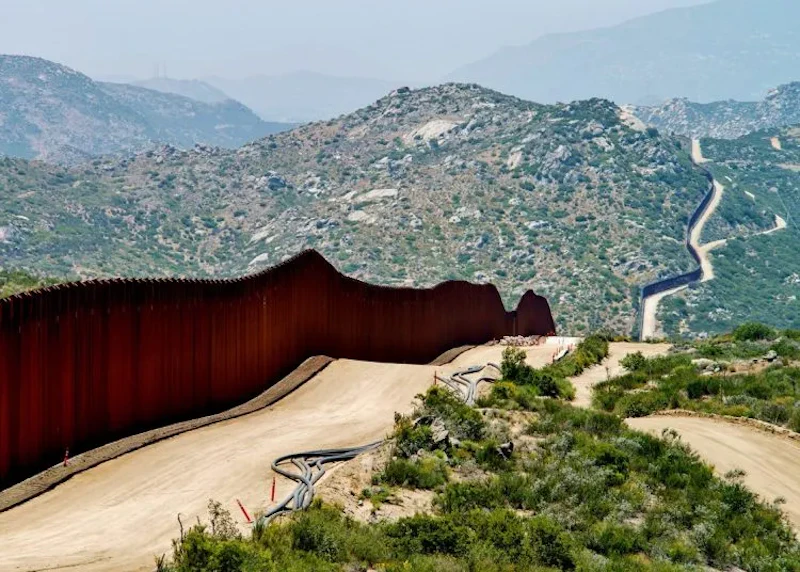
There's a utopian vision shared by a sizable number of people in Western nations (i.e. the nations that the people of the world want to emigrate to) that involves opening up the borders and letting everyone in—like a free concert in Central Park.
An episode of the Philosophy Bites podcast I listened to dealt with the question of whether or not nations have the right to keep people out. Sarah Fine, a professor of political philosophy at Kings College London, explained why they don't have that right in the moral sense; they do obviously have the legal right to choose who crosses their borders.
Fine came out of the gate limping. When the podcast host expressed skepticism about his guest’s opinion, Fine brought up the hypothetical of a country not allowing the spouse of a citizen to enter, suggesting that this scenario might make him feel differently about the issue. That was disingenuous, as she knows that opponents of open borders (the majority view in the U.S.) aren’t fixated on denying entry to spouses, unless they happen to be, for example, known terrorists or convicted pedophiles.
The professor said that the usual defense of the right to exclude is, “The state is the kind of entity that needs the right to exclude because it's essential to the functions of the state.” Countering, Fine cited the fact that some states once claimed to have rights that’ve since been discredited, such as the right to control exit from the state and the right to control the movement of individuals within the state. She asked, “Why should we think that the right to exclude is one of those rights that states are able to still claim with impunity.”
The host didn’t push back on her faulty logic, but just because two types of laws regarding restriction of movement within a state are no longer considered acceptable doesn’t mean the third one, which deals with individuals outside the state, is bad, outdated or immoral. It's a false equivalency when applied to those outside of a nation. If a state blocks a citizen from leaving, they’re trapping that person in a sort of prison. But if the state blocks someone from entering, that person is simply left where they are. If they want to leave, there are other options.
If a man were to prevent the members of his household from leaving the house, that would be both immoral and illegal, but if he restricts those who enter his home, he'd be considered sane. Now if he were to deny a lost child’s request to come inside on a sub-zero evening, that would be a different moral issue, but Sarah Fine isn't advocating merely on behalf of asylum seekers whose lives are in danger. She's speaking for every living person in the world who might want to emigrate to another country.
Fine describes states claiming the right to exclude as a “sleight of hand,” and disputes the notion that it's impossible to have a nation without border control. She goes on to state that EU nations don't have the right to exclude citizens of other EU states, but that doesn't mean they've stopped becoming states. Once again, her logic is flawed in that the EU is essentially a super-state, with its own borders, courts, currency parliament and immigration policy. Under this rubric, EU member states can’t restrict the entry of the citizens of other member states because they’re not outsiders, just like Texas can't restrict the entry of Californians.
Next, the host disputes the idea that, in a democracy, people have the right to choose who to exclude from their nation. At this point, Fine’s argument goes from fuzzy to off the rails. She posits that the government doesn't have the moral right to exclude certain internal groups, because all those who are governed have the right to some participation in the governing process. Fair enough, but then Fine makes a giant leap in concluding that since people outside of a nation are “governed” by that nation's restrictive immigration policies, we “might” think of them as governed, which grants them “participatory rights” on decisions that affect them.
Fine’s position is so shaky that she needs to conflate “affected by” with “governed by.” The contention that every nation that maintains a border that keeps some foreigners out “governs” every person on Earth is ludicrous.
The host pushed back on Fine’s verbal trickery, but she told him to imagine that the U.K. had decided to put an extra tax on all French people living within its borders. This, she said, is analogous to what's going on with immigration laws because the state, in both cases, is deciding to direct some of its laws to people who aren’t its citizens. While that’s true, it's not a given to state that because two laws share one trait they must share the same moral outcome. In the above scenario, the U.K. is singling out only its French residents for their immutable characteristics. The morality of such an act is easy to dispute, but excluding non-residents for the benefit of current residents isn't so clear.
Continuing with her ill-conceived argument, Fine said that some defenders of immigration laws draw an analogy with a country club that doesn't allow everyone in. Fine claims it's not an apt analogy because someone can join another club. But she said it's not the same with states because people need to be a member of a state—”life is terrible if you don't have a state.” This would make sense only if people denied entry into one country were thereby rendered stateless, which isn’t the case.
The professor's entire narrative resembles sophistry. It's full of logical flaws, plus it only gives one side of the “moral” coin. Fine focuses on prejudice and malice, but an argument could be made that a nation state has specific moral obligations to its existing members that supersede its obligations to outsiders. Through another lens, open immigration could be viewed as a failure of the state's moral contract in that it would lower wages for the poor, strain local infrastructure, and result in overcrowded schools.
This “moral” right to exclude potential immigrants is a gray area that's open to debate, although it's of little consequence to lawmakers who believe it's their moral imperative to act in accordance with the wishes of the citizens. Those citizens are, in general, not willing to roll the dice and risk potential chaos by endorsing a wide-open immigration policy that academics have deemed as the best “moral” option.
Sweden and Germany decided they had no moral right to exclude immigrants, so in the recent past they embarked on separate open-immigration experiments. The result was strained social infrastructure, a sharp rise in violent crime statistics, and a massive political backlash.
Those idealists pining for open borders should look for a better advocate then Sarah Fine. As a philosopher, she's free to imagine a world without borders, but the migration crises that have buffeted Europe and North America suggest that immigration policy involves tradeoffs more than vague, logic-challenged discussions of morality.