
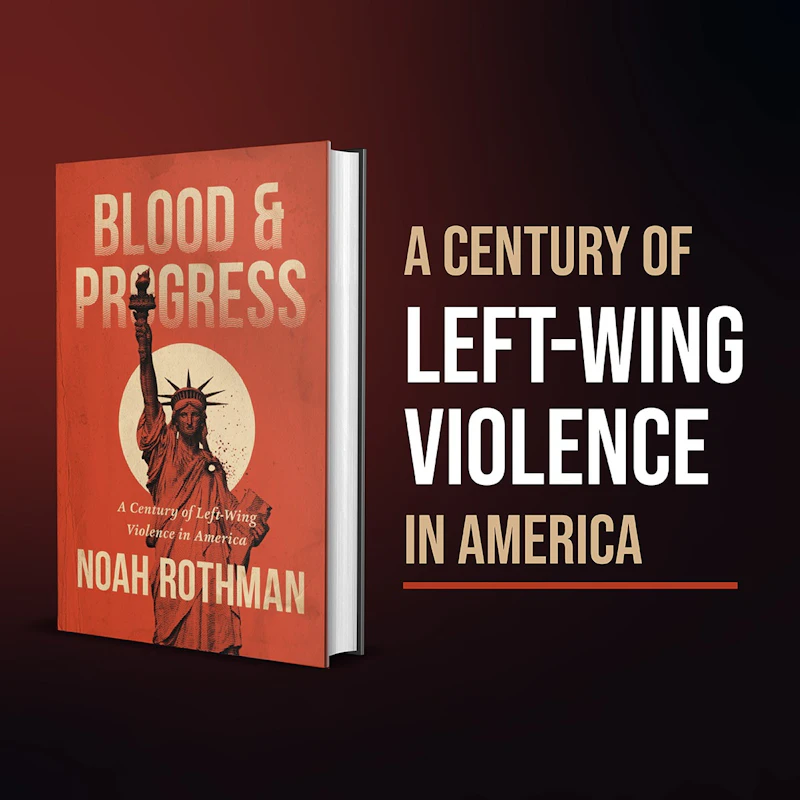
Journalist Noah Rothman has a new book out. Blood and Progress: A Century of Left-Wing Violence in America charts the long and often untold history of the Left’s political violence in America.
The book is especially timely in light of the recent, and third, assassination attempt on President Trump, and the mental derangement of the Democrats.
According to Rothman, “It is necessary to bring a gratuitous amount of evidence to bear in support of the observable fact that the American left—too often, fringe and mainstream alike—either refuse to confront or are disconcertingly comfortable with a certain level of domestic political violence. Indeed, its members will heartily protest the allegation that there is a rising tide of left-wing violence to speak of. They are inclined to ignore it, excuse it, explain it away, or marshal their own evidence in support of their belief that the American right is the font from which all political violence springs.”
Blood and Progress reminds readers that in 1995, community activist Barack Obama launched his first run for the Illinois state Senate at the house of Bill Ayers and his wife, Bernadine Dohrn. In 1970 Ayers and Dohrn were indicted for inciting a riot and conspiracy to bomb government buildings. Dohrn was convicted and Ayers wasn’t. Ayers told The New York Times in 2001, “I don’t regret setting bombs. I feel we didn’t do enough.” Ayers and his fellow terrorists bombed the Pentagon as part of his anti-war activities. As journalist Bernie Quigley once put it, “Maybe we should begin to ask ourselves where we are going in our world today when a right-wing terrorist, resolute in his conviction to the very last, like Ayers, gets a quick and short ride to the death chamber and a shallow and forgotten grave, while bombers from the ’60s get tantalizing offers from Harvard, $100 million grants from Ambassador Walter Annenberg and dinner with [celebrity academic professors].”
I wish that Rothman had spent more time on Obama’s mentor, the card-carrying Communist Frank Marshall Davis—or “Old Frank” as Obama called him. There’s also nothing about Hasan Piker, the left’s new Marxist darling. A mix of Lenin, Paul Bunyan and Torquemada, Piker posed in a recent photograph on a train with a copy of What Is To Be Done? by Lenin. As Sam Tanenhaus notes in his biography of Whittaker Chambers, would-be revolutionaries often tout Lenin’s work while ignoring the violence in those same pages.
Lenin’s The Soviets at Work is a book that, as Tanenhaus notes, “is written in a prose of almost unrelieved brutality, a combination of insults (“Let the poodles of bourgeois society scream and bark”) and threats (“everyone who violates the labor discipline in any enterprise and in any business… should be discovered, tried and punished without mercy”).” Lenin’s analogies “are drawn almost exclusively from the battlefield” and “he is thrilled by the spectacle of violence. His favorite adjective is ‘merciless.’ Nor does Lenin conceal the authoritarian character of the government he is assembling. Democracy in the new world can be achieved, he explains, only ‘by subjecting the will of thousands to the will of one.’”
Piker once declared, “Let the streets soak in the red, capitalist blood!” None of this is new.
In Blood and Progress Rothman explores violence from the anarchists in the early-20th century to the American communists after the Russian Revolution to the anti-war rioters in the 1960s. Then there were the 1999’s Occupy Wall Street and Floyd Corkins, the gay-rights activist, walked into the offices of the Family Research Council in Washington in 2012 and shot a security guard before he was subdued. After that came the Black Lives Matter. Today we have radicals like Piker calling for the blood of “capitalists”—and the attempt on President Trump’s life by leftist Cole Allen.
Rothman highlights how liberal politicians, journalists and civic leaders wave it all away. “I support the message to the establishment,” said Nancy Pelosi, about Occupy Wall Street, the protest that would become violent. “It’s young, it’s spontaneous, and it’s focused. And it’s going to be effective.” Obama also expressed his sympathy and support: “The protesters are giving voice to a more broad-based frustration about how our financial system works,” he said at the time.
When there was an attempted assassination on Supreme Court Justice Brett Kavanaugh in 2022, Michael Schaffer of Politico wrote that the episode was “not especially hair-raising.” Schaffer isn’t exactly one of the 300 Spartans. He once offered this about Brett Kavanaugh and Georgetown Prep during Kavanaugh’s 2018 SCOTUS hearing: “My classmates, from our much less macho school [Georgetown Day], looked at the yearbook pictures of Kavanaugh and his friends and saw people we’d been afraid might beat us up.”
Rothman’s also critical of President Trump, arguing that Trump “spent much of the 2016 primary season giving his followers permission to indulge in their own violent proclivities,” goading his followers to “knock the crap” out of his detractors and saying he would “pay the legal fees” incurred by those who caught an assault charge. “Trump’s recklessness inspired much-deserved hand-wringing and conveniently blinded political observers to regular, kinetic acts of left-wing violence that were happening in response to his rise,” Rothman writes.
Trump can be over-the-top. Yet there’s a difference between Trump’s rhetoric, which is comical and slapstick, with the real-world actions of someone like Bill Ayers, Antifa or the president’s recent would-be assassin.